Showing posts with label 2500. Show all posts

Thursday, December 31, 2020

ARP "From Jimmy With ARP" advertisement, Downbeat Magazine 1974


ARP "From Jimmy With ARP" half-page black and white advertisement from page 41 in the June 20, 1974 issue of Downbeat Magazine.

Well, look at this! I hope you are noticing the trend. As part of trying to get all my 2020 ARP 50th anniversary celebration posts... eeer... posted, I've been uploading quite a few ARP pieces this month, including two of the many ARP advertisements from the time period that used a very similar half page, black and white format. 

And now... I've posted the third. With more to come.

I love that all three of these ads all fit into a theme, but yet they are all very distinguishable from each other. There isn't a stagnant "photo/artwork at top" - "text in the middle" - "Logo in bottom right" format to them. Each of the ads has kept a unique look. As unique as the different artists that are featured in each one. 

One other thing I like about all three ads is they all contain one of those little cookies I went on about in my last Carpenters ad. This earlier ad uses the code "DB-620" (Downbeat June 20), but curiously leaves out the "year", unlike that those other 1975 ads included (DB 1-16-75). Looking at a few of the other earlier ARP ads like the Edgar Winter ARP ads that appeared around six months earlier, they too used the earlier cookie format that didn't include the year. No real other comment to make on that fact - just interesting that they changed the format.

Another little thing that separates this earlier ad from the others is the little picture in the bottom right hand corner of three of ARP's products. This little photo also appears in Edgar Winter's Frankenstein and Freeride ARP ads, but not in Billy Preston's Space Race ARP ad or Stevie Wonder's WonderArp ad (none which I've posted yet). Once I've mapped out the timeline for all these half-pagers, it will be interesting to see when exactly they were added and removed. 

My past experiences of 'Zep run along the same lines of The Who. I didn't really understand or 'get' the synth influences first time around. The one thing I do notice when looking back, is that fans of Townsend were much more accepting of the band's use of synthesizers where Led fans weren't so sure they shared their favourite band's love for them.  Just my observation - your mileage may vary. 

Now, where deeper knowledge of most Zeppelin songs flew over my head (except for the mandatory ever butt-grabbing Stairway to Heaven), there was one song I was always willing to get behind...

Carouselabra. 

For some reason I've always had an affinity for that one. Maybe it was the synths that first got me hooked? Maybe?  It could also have been that some of the dreamier parts reminded me of Alan Parson's stuff.  I dunno. Hard to say. But I can tell you when the topic of Led Zeppelin came up with friends at a party, I would turn the convo towards that song, and trying to convince them to play it on whatever stereo system was handy.

Just for fun, I googled the song to see what others had to say, and this rather interesting post on Cheatsheet.com came up - "What Robert Plant Regretted About Led Zeppelin’s ‘Carouselambra’". It takes a little bit of a deep dive on the lyrics of the song.  

Go Cheatsheet! Go Carouselabra! 

And okay... go Stairway to Heaven!

Friday, December 11, 2020

ARP Literature Order Form, 1975


ARP three-page Literature Order Form from 1975.

I know its Friday afternoon - the time that company's put out news releases they don't want anyone to see and the place that blog posts go to die. Well, tough! There are still a few weeks left in ARP's 50th anniversary and there's stuff to be posted!

To many of you peeps, an order form ain't that glam, but for a collector... dat right dar is pur gold. 

It's a checklist for what is potentially out there... waiting... for me. It's a list of search terms to plug into Google and eBay. 

The thing that is so striking about this lit form are the prices. I get they are 1975 prices, but even for 1975, many of the items are cheap as borscht.

Mmmm... borscht.  Sorry, my blood sugar is getting low. 

I'm guessing those cheap prices are so dealers will buy 'em and pass them on to potential customers. 

Just look at 'em:

2500 manual - $3.60. 

2600 manual - $3.60. 

Odyssey manual - 90 cents! 

ARP Educator's brochure. Wut?!?!? Never come across that before.  12 cents! 

Odyssey cassette course. Never seen that either I don't think. $6.00. 

Now, let's flip to page two - and specifically "Dealer Materials". Boom! Promotion Kit! Musician's Workshop Invitations! Educator's Clinic Invitation! Decals! Tie tacks!  The list goes on and on. 
Let's flip to page three. Arrrrgh! 

Dummy plug? If someone knows what these are, contact me. Wait - never mind. Googled it. 

From an August 2012 post in one of the modular forums... someone going by the name Sempervirant had this to say... 
"A dummy plug is just a plug with no cable attached. I remember seeing one in Automatic Gainsay's videos on YouTube, where he was demonstrating the ARP 2600. Most of the internal connections on the 2600 are normalized (which is why it's considered a semi-modular). If you want to break one of those internal connections, but don't actually want to patch something else in, you just insert a dummy plug to bypass the normalized connection." 
And then, later on in the discussion, Sempervirant was nice enough to find that AG video - thank you very much! Go to 5m:58s to see him use one. Sweet. 


I have an ARP 2600, and many other semi-modulars and never knew dummy plugs existed.  Just goes to show you, we never stop learning. 

Now to find out if those ARP patch cords are branded at all. I gotta know. 

Now. 

Wednesday, December 9, 2020

ARP "The Arp Story" brochure, 1974


ARP "The ARP Story" 8-page colour brochure for the Pro Soloist, Odyssey, 2600 and 2500, including two extra colour inserts for the Axxe and Explorer. 

Okay, it's been a while since I've blogged. But it's ARP's 50th anniversary and I just gotta get a few more ARP posts in over the next week or so. So, if things go as planned, you will be sick of me. But lucky you, I'll be keeping these short. 

We are talking a colour brochure for six of Arp's kick-ass instruments, gorgeously designed and positioned. The instrument shot, those sexy flowing backgrounds, thin, yet chubby font, and those unique little white computer generated swirlies that appear somewhere on each product's page.  And, then to accompany each of those product page (except the 2500) is an accompanying page that includes some info on each instrument along with... yup... my fav...  

DIAGRAMS. 

Diagram. Line drawing. Whatever you want to call 'em. 

I call it... ART. 

Straight up, Boo. (I have no idea what I just said. But the kids will get it, I'm sure). 

Now, you will notice that ARP sacrificed a back page for the 2500 so it could, rightfully, include a little bit about ARP itself.  But even this page is very much art, with its colourful duotone photographs - one that includes, of course,  Alan R. Pearlman, and the other, double f course - Pete Townsend of The Who. More on him and his connection with ARP in a future post, I'm sure

Now, if there is one thing I like in my brochures, its when they talk about other marketing material I just have to get my hands on. And ARP punches me in the face by throwing a few teasers out...
"We offer an exclusive series of instructional programs, playing guide songbooks, and cassette tape packages designed specifically for ARP synthesizers."
Gak! Time to go down another rabbit hole. But first, let me finish...

All put together, the brochure and the extra leaflets, it all becomes one of the most gorgeous retro synth brochures in existence. Not just ARP brochures - of all synth brochures. Sure, there are few others on this level. But this is top five for sure. If not top three. ARP at it's finest. 

There is nothing more I can say that is not already included on those pages. I suggest you give ARP some of your time during their 50th anniversary and read 'em.   :)

Friday, September 4, 2020

ARP 2500 modular "The ARP electronic music synthesizer" brochure and mail-in insert, 1970/71


ARP 2500 "The ARP electronic music synthesizer" 8 page colour brochure and mail-in insert from approximately 1970/71.

Oooooh boy! Here's a doozy. Such a doozy that this post got rather long-winded. My apologies in advance. 

"What? What's so 'doozy' about this?!?!", I hear you say... "I've seen this brochure on tons of sites! BORING!!!!!" 

Well, yes. But no. 

Take a closer look at that front page. That's not ARP's treble clef logo!  And the company name and address is listed as... "Tonus Inc. 45 Kenneth Street, Newton Highlands, Massachusetts. 02162"

TONUS INC. 

Now go take a look at all those other ARP 2500 8-page brochures with a similar front page image. They all have "ARP Instruments, Inc. 320 Needham Street" as the company and street name. 

So, for example, the front page of this September 1972 "The ARP 2500 Electronic Music Synthesizer" brochure on the Internet Archive has the same image, but the title is slightly different, it includes the new more familiar treble clef ARP logo instead of the older Tonus/ARP logo, and it has the later Needham street address at the bottom (see image at right). 

Interestingly, it seems that this same set of September 1972 scans pops up on a few sites, including the ARP 2500 page on soundprograaming.net, but can be traced back to Tim Stinchcombe's awesome set of old synth brochure scans, including this 2500 brochure that was originally scanned by Ben Ward and sent to Tim for posting. Good work!

An even later version of this 2500 brochure dated September 1974 recently went up for auction last August on eBay and some photos can be found on the fabulous MATRIXSYNTH website. Although only six of the eight pages were photographed in the auction, I've managed to find a few differences between the 72 and 74 version. 

For one, in the 1972 brochure, there were five different keyboard models available for the 2500 - 3604, 3001, 3002 3212 and 3222, but in 1974, that list seems to have shrunk down to three models - 2604, 3002 and 3222. And this has lead to some small price differences on four of the six sample systems featured a few pages later. 

Another difference is on the back page where ARP does a little cross advertising of their other synths. In the 1972 brochure, the Odyssey, Pro Soloist, Soloist Mk II and 2600 are featured. But in the 1974 brochure, we see the 2600, Odyssey, Pro Soloist and Explorer. 

But I'm getting off topic... let's get back to *my* brochure.  Not only is the front page different, but so are guts. For example, there is no other instruments being promoted in this earlier brochure. And we definitely don't have as much pricing info scattered throughout. 

All in all, the biggest takeaway from this brochure has gotta be the design. Those lovely colours. That lovely fat font used for much of the titles. And of course those lovely graphics and close-ups of the modules.  I've never taken a closer look at that angel - did you ever notice the different wave forms coming out of the trumpet?!?! GAH!!!

Take my word for it - its worth going down the rabbit hole of the different iterations of this 2500 brochure  - ALL OF THEM!

I gotta say I was pretty proud of myself thinking I had *the earliest* version of this 8-page brochure. So proud I've been strutting down the street like the dude from Saturday Night Fever. But after doing the research, someone out there, of course, happens to have an EVEN EARLIER VERSION!!!!

This earlier version is dated 1969/1970 and I found it as a featured eBay auction from 2017 on MATRIXSYNTH! Unlike my 1970/71 brochure, the front page doesn't include any ARP logo on the front page. Even more cool, is that some of the modules on pages 4 and 5 don't even have photos yet! They are just white spaces with the name of the modules. 


Seriously, just how cool is that. 

And the last page is totally different as well. My version of the brochure has a lot more information about the modules available, and that cool map that we see in future iterations of the brochure as well.

As angry as I am that MAXTRIXSYNTH has outdone me AGAIN *shaking my fists at you!!!!*, I thought I'd return the favour by include two other scans in my post! I haven't seen the mail-in insert that was included in my brochure ANYWHERE else online (although I'm now afraid to look). Either way, its another two pages of cool ARP history. 

Well, that's the end of another blog pos... wait a second!!!

One last point I'd like to make has to do with that map on the back. The one of the left from my brochure (1970ish) has the Kenneth Street location. The one on the right (from the 1972 brochure) is the Needham Street location. 


The new location is literally just down the street - a ten minute walk! And in that 1972 map, they include the location of the "old ARP location" as a reference point. Sweet. 

Maybe more interestingly is looking these locations up on Google Maps. 

The Kenneth Street location looks to be still there, but there's a few differences from the map in the brochure. The house to the Northeast of Tonus Inc. has been replaced by Salon Fabio. And the Power'd Equp building is now the Loyal Companion pet store. But the Liquor store seems to have managed to stand the test of time!


The 1972 Needham Street location is definitely still there. There is even that notch in the south corner that is drawn into the building in the map from the brochure. Looks like its now Inflexxion - a business consulting business, among other things. 


Now, I'm not asking anyone to stalk these location, but the first people to send me a photo of themselves (preferably with an ARP synth) in front of the doors of either location - or inside getting your hair done at Salon Fabio - will get added to the blog post.  :)

This is exactly why I love historical documents such a these. Not just the location info, but having a date on the later document allows me to more accurately estimate print dates of other undated ARP brochures that came after it. 

Okay. I think I'm done now. Phew. 

Monday, September 19, 2011

The ARP Family of Synthesizer Demo Record, 1973


The ARP Family of Synthesizer Demo Record from 1973.

 Ever since I first used my USB record player to record that ARP Proportional Pitch Control sound sheet, I've been recording my old records. And now I've finally gotten around to using it again to record another older ARP demo record.

The first side of the record is all about demo'ing a few different  excerpts of music created by synth owners - with a voice over introducing each piece. The second side includes four discreet songs created with ARP synths. No voice-over here.

The ARP Family of Synthesizers - Side 1 - 1973 by Retro Synth Ads


The ARP Family of Synthesizers - Side 2 - 1973 by Retro Synth Ads
It is that first side of the record that interests me most as a marketing person. Although the music created by ARP synths do the final sell-job, it is the voice-over that steers the listener with that one-sided conversation.

And ARP is in fine form - really pushing their synthesizers in every industry - TV, film, education, on stage, on tour, and in recording studios. And they also give a big nod to all the amateur musicians across the country that were starting to buy synthesizers as prices started to drop (or at least ARP figured they would be).

ARP is also in fine form on the name-dropping. Just a tad over a minute in to side one, the announcer drops Pete Townsend's name. Bam! And the next thing you know, you are listening to a bit of Teenage Wasteland - I bet you can guess which part. :)

But it is about three and a half minutes in that really starts me smiling. ARP makes a good effort to get it's synthesizers in the schools by suggesting that their synthesizers possess "tonal resources beyond that of even a symphony orchestra". Good work.

ARP includes two musical excerpts to promote the use of synths in educational facilities. The first is a short "interesting interpretation" of a romanian folk dance by a student on an ARP Odyssey. Meh. And the second is a very short example of students creating their own compositions "using sounds of their own invention". Starts around the 5:00 minute mark. Not long enough. :D

Side two is made up of four songs by two musicians.

Roger Powell has been creating "retro-future music since 1973". He was the keyboardist for Utopia back in the day. Check out his Web site and MySpace page for his latest work.

I'm not as familiar with Dave Fredricks, and am assuming this is his Web page. Definitely got some chops  :)

My short summary of each song:
  • Song 1: Dave Fredericks doing his thing. Ends strongly.
  • Song 2 (starts at 2:23): Roger Powell piano-like piece. A nice long ending with a few odd things going on.
  • Song 3 (starts at 3:57): Roger Powell is outta control! I kid!  Obviously a lot of effort went into this - just not my thing.
  • Song 4 (starts at 5:27): Great song to end on. Dave Fredricks sounds like a new-wave Lawrence Welk. 
One of my big peeves when documenting ads and promotions is when there is no date printed anywhere - and that includes records. Unfortunately there was no date printed or etched anywhere on this record, so I decided to do a bit of search.

Obviously, one of the first places I looked for clues was in the recording. Side one contains all the jibber-jabber, so I focused my attention there and came up with these clues.

Clue 1: Four synthesizers are mentioned:
  • Soloist
  • 2500 - "the elegant concert grand of synthesizers"
  • 2600
  • Odyssey  
Wikipedia's ARP page includes a sequential listing of the introduction dates for all their synthesizers - and since no other synths are mentioned, I thought there was a good chance that it must have come out sometime between 1972 (after the Odyssey came out) and 1974 (before the String Ensemble made it's debute).

Clue 2. The first excerpt of music on side one is Pete Townsend's recognizable use of his "three ARP synthesizers" on the album "Who's Next".  The voice-over mentions that it had just been recently released - which was 1971. So, that help narrowed it down to roughly the same time period.

Scanning through the ARP ads that I've posted using my very own handy-dandy Advertising Timeline Tool (shameless plug), I quickly came across this ARP dealer ad-sheet, which includes all four of the synths mentioned on the record. This dealer sheet, like the record, is also pushing that education-angle, especially for the Odyssey. In my blog post I speculated that ad-sheet came out around 1973 or 1974.

So then I started looking at older ARP ads that I haven't posted yet - as well as started a Google Images search. I decided to contentrate on that classic Pete Townsend image of him leaning against his ARP, since I knew he was being heavily promoted by ARP at the time. The images that popped up quickly lead me to the "Thats Alright Mama blog - a blog dedicated to "custom records pressed by Rite Records of Cincinnati". And before you know it, I come screen-to-face with this.Yup. And cool - this record was pressed in Cincinnati. And best of all, the blogger includes a recording date - 1973!

Shortly thereafter I also came across this page. And this. . Doh!

Mystery solved!

The Internet is my friend.    :)

Thursday, May 27, 2010

ARP family of products, Contemporary Keyboard 1976


ARP Family of Products advertisement from page 24 and 25 of Contemporary Keyboard Magazine, May/June 1976.

ARP took a very interesting approach with this two-page ad.

The two previous issues of CK included an ARP 'family' advertisement that focused squarely on ARP's road-reliability, along with a good-sized helping of classic name-dropping.

Then they come out with this advertisement. Although it starts off with another big dollop of name-dropping, it soon takes a totally different sales approach than the previous ad.

ARP first points out a few facts about performance and quality. Never one to pull a punch, they take direct aim at Moog with the ever-popular slider-vs-rotary argument:
"ARP slide controls outperform hard-to-read rotary knobs".
(Moog's response: "Just try to accurately tune an all-slider instrument!")

ARP continues the attack on many of their competitors with:
"We build ARPs with expensive, industrial-grade circuitry. You won't find any chrome-plated plastic or paper based circuit boards inside an ARP."
Kapow!

With the bad-cop routine over with, ARP then goes into the soft-sell approach by providing a few educational facts, letting you know how easy it is to learn to play an ARP synthesizer and how you can grow your studio by 'adding-on, not trading in'.

And then. Finally... they hit you with the real pitch.

Buy our manuals for only a couple of bucks and see for yourself.

Like I said - it is an interesting approach and a common sales technique I've seen used in stores and at trade shows. Always try and put whatever you are selling into the hands of a potential buyer. And if you can't get the real thing in their hands, get the info into their hands.

In this case, ARP is enticing readers to buy an ARP manual BEFORE buying a synthesizer. Let's get this straight... they aren't asking you to send in for a free brochure with a bit of promotional material - they are actually getting readers to spend real cash on a manual. And once a reader has an ARP manual in their hands, it will be much easier to convince that reader to buy an ARP synthesizer.

I've bought enough synthesizers in my lifetime to know that I can justify a purchase if I've convinced myself I've done the research. And if I've spent money on that research, I can now convince myself to call that research an 'investment'. :o)

Smart thinking on ARP's part. And even smarter to sell 'learning synthesis' books that focus on their synthesizers. The more I think about it, the more I like this ad.

But you know what I like most about this advertisement?

It's like my own personal checklist of ARP stuff. Seriously - if you are into ARP paraphernalia like I am, this ad pretty much spells out some, if not most, of the great stuff that was available from ARP at the time. Even better is that the list in the advertisement is a great starting point for online searches for more information.

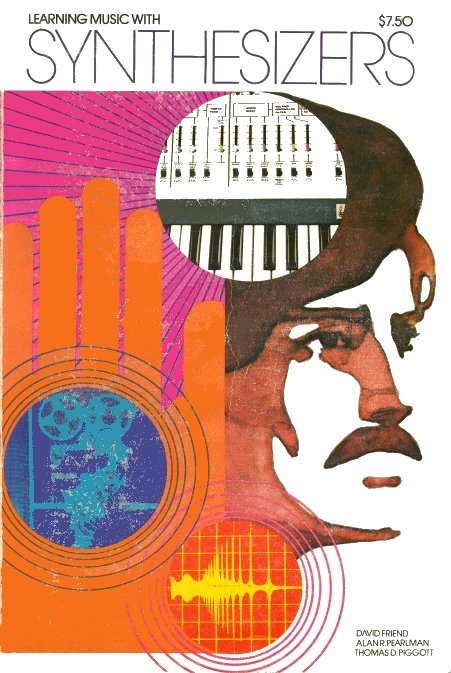
Take the first item in the order form: "Odyssey - Learning Music with Synthesizers". Over 200 pages of experiments and electronic music discussion based on the ARP Odyssey! One quick Google search and you are taken straight to the comprehensive Web site arpodyssey.com. That Web site provides images of the covers of both the first and second editions, and goes on to describe the book:
"Part I of this book is a theoretical introduction to the the science of synthesizers. Part II is a hands-on guide that walks you through principles learned in Part I on the actual ARP Odyssey. Part III gets into experimentation and studio techniques (admittedly of the 1970's).
Now I know exactly what to look for in my eBay search. :o)

Yup - the more I think about it, the more I like this ad.

Thursday, November 19, 2009

ARP Family Dealer Ad Sheet, 1970s


'The ARP Family of Electronic Music Synthesizers' dealer ad sheet (front and back) from the 1970s including the Soloist Mk II, Pro-Soloist, 2600, 2500, and Odyssey.

I don't have an exact date on when this dealer ad sheet was printed, but my guess is around 1972 or 1973 since the Pro-Soloist is mentioned alongside the Soloist Mk II... What? Soloist Mk II? What is this piece of kit? Why have I never heard of it!?!

Looking at the Soloist Mk II description and photo from this scan, it looks to be the evolutionary 'missing link' between the original Soloist and the Pro-Soloist.

First, a bit of info about the original Soloist and the Pro-Soloist:
  • The Pro-Soloist Wikipedia page and Mark Vail's 2006 article on the Pro-Soloist have some good history of these two instruments and inform us that the original Soloist was entirely analog while the Pro-Soloist used digital read-only memory chips to program all of its internal functional modules. If I'm not mistaken, neither mentions the Soloist Mk II.
  • Images of the two instruments from the Vintage Synth Explorer page clearly show that the Soloist had a light-coloured panel of toggle switches located underneath the keyboard while the Pro-Soloist's switches were located on a dark panel above the keyboard. Again, no mention of the Soloist Mk II.
Now, compare the features above to the description and picture of the Soloist Mk II included in the dealer ad sheet, and you can clearly understand how it could be the electronic love-child of the two:
  • light-coloured panel like the Soloist
  • toggle switches on the main panel are above the keyboard like the Pro-Soloist
  • layout of switches seem to resemble the Pro-Soloist
  • controls beside the keyboard have a white lever or toggle switch in the middle of the darker sliders like the Soloist
  • 15 instrument sounds like the Soloist
  • digital design like the Pro-Soloist
I found two references to the Mk II online in forum and comment posts - both by who seems to be the same person - who I now dub thee Soloist Mk II expert.
- a 2008 comment by Micke on the Vintage Synth Explorer site mentions that the production dates for the Mk II was between 1972 and 1973.
- a 2006 BlueSynths forum post by Micke (Mikael L) where he describes it as a cross between the original Soloist and Pro-Soloist.

There is also a mention of the Mk II in an ARP 2500 brochure PDF on Tim Stinchcombe's Web site. The last page of the brochure contains the same list and images of the ARP instruments in this dealer ad sheet and lists the Soloist Mk II for $995 US.

But other than those references above, I can't seem to find much on this instrument. I even failed to get Google images to bring up a photo. I'll have to add it to my list of Wikipedia updates I need to do.

End note: Aren't you proud of me for not mentioning the ARP name-dropping thing that appears on the back of the ad sheet?. Oh... I guess I just did... :o)