Showing posts with label artwork. Show all posts

Wednesday, August 6, 2025

Octave Plateau Sequencer Plus "State of the art shouldn't create a state of confusion" advertisement, KCS 1986


Octave Plateau Sequencer Plus advertisement from page 17 in the February 1986 issue of Keyboards, Computers and Software (KCS) magazine. 

As you know - I'm a fan of illustrations in synth adverts. Ads like Sequential's Ear Force, Octave's Cat synth ad, or Vibronic's drawing of a Moog modular, all should be put on T-shirts as far as I'm concerned.  I even have an artwork tag that I've hopefully kept up to date that will help you find more. 


The illustration in this ad (which would also make a great t-shirt) shows a frustrated, overwhelmed man standing over a reel-to-reel machine with more complex recording tools including a mixer and various effects in the background. There is also an illustrator's name - "Stau '85", but some quick google searches didn't bring up any other illustrations but the person. Dang.  

The good... the ad title is large and bold, and it's a clever and memorable play on words that tee's up the key message that technology can be easy to use with OP's software. The subtitle below the image is also of a good size, and includes the product name - Sequencer Plus. It also supports the key message. The copy also includes a clear call-to-action - contact us to get a brochure. 

The bad... I find the ad to feel cramped - the title, subtitle and copy all seem to almost fall over each other as well as with the imagery. Another half inch of white space around everything would have made all the difference. 

My only other beef with the ad is the amount of ad copy. Probably could have cut a few lines with a bit more editing to make more room around everything, including the two paragraphs. 

BUT, if someone actually tries to cut down the text, DO NOT get rid of the Voyetra Eight name drop that occurs in that second paragraph. If readers get that far, its a great flex. 

I'm a little sad that one of the rack units in the illustration doesn't resemble a Voyetra Eight. :(

Thursday, January 16, 2020

Moog Sonic Six "Moog makes the scene" ad, Rolling Stone 1973


Moog Sonic Six "Moog makes the scene" half page black and white advertisement from page 51 in the February 1, 1973 issue of Rolling Stone Magazine.

After the great response to my early 70's ARP ad from Rolling Stone, I thought it would be fun to post this Moog Sonic Six ad from the same issue... just two page flips away!

The Sonic Six doesn't get a lot of love when it comes to advertising compared to its siblings like the Minimoog. Although Moog did come out with a lovely colour brochure in 1974.

Its interesting to note that in the brochure, Moog is not just going after the live musician looking for a light-weight synth in a carry case, but its also using up as much ad copy targeting the classroom as well. Now compare that to the Rolling Stone ad... no mention of classrooms at all.

Moog definitely knew their audience and stayed mum on the school angle.  :)

The ad copy is top notch - there is so much said in such a tiny amount of space. I liked it so much I've typed it all out...
"The synthesizer that started it all is the one behind the innovative new music groups like Emerson, Lake and Palmer and Mike Quatro, Jam Band. Behind the restless exploration of new sounds, rhythms and tone colors by Gershon Kingsley's First Moog Quartet. Now Moog quality and engineering are available in the Sonic Six, the complete electronic synthesizer in a compact carry-along case. And the famous Minimoog that brings studio quality to your live performances. For name of your nearest dealer, write Moog Music Inc., Academy Street, P.O. Box 131, Williamsville, New York 14221."
It uses phrases that have since become synonymous with Moog such as "the synthesizer that started it all" and "Moog quality and engineering", and for good measure references the Minimoog (smart move!). But even more exciting is the name dropping - Emerson, Lake and Palmer. Mike Quatro and ... one of my favs... Gershon Kingsley.

Gershon Kinglsey is probably best known for his song Popcorn.


Love that song. He also formed the First Moog Quartet, who were -  according to Wikipedia - "the first to ever play electronic music in Carnegie Hall." With Bob Moog there too! Kingsley passed away last December at the age of 97.

Now, I'm embarrassed to admit this next bit, and that's that I had a bit of a mind-blank for the first few minutes while staring at that lovely artwork in the ad. ELP, Kingsley and Quatro were all bands mentioned in the ad-copy, but I was struggling to remember the other two bands - Trilogy and Paintings.

Yeah... then it clicked. Trilogy is an album from ELP, and Paintings is an album from the Mike Quatro Jam Band. Duh.

And speaking of the illustration, I *love* the artwork used for this ad. There's even a signature there - Lawson - but I haven't tried looking it up to see if I can find anything interesting on the artist.

If you know more of Lawson's work, send me a note!

Monday, January 13, 2020

ARP Odyssey "Conduct an Arp" ad, Rolling Stone 1973


ARP Odyssey "Conduct an Arp" half page black and white advertisement from page 47 in the February 1, 1973 issue of Rolling Stone Magazine.

Sometimes I'll take an hour or two and just look through my archives, when all of a sudden something new will jump out at me. And so it is that after more than sixth months of brochure posts, it's time to fall back in love with a synth advertisement.  In this case, a lovely Arp Odyssey ad from Rolling Stone. I've never actually seen this ad in the wild anywhere else - in another publication or online as a scan. It has just somehow managed to hide in plain sight from me.

A happy surprise.

And not-so-coincidentally, The Alan R. Pearlman Foundation / ARP Archives happens to be at NAMM (booth #8600) soonly. Make sure to check them out and show your support - financially and otherwise! 

Before Contemporary Keyboard came on the scene in 1975, many Americans would find synth ads popping up in the pages of Rolling Stone - what founder Jann Wenner described as a cross between a magazine and a newspaper that wasn't "just about the music, but about the things and attitudes that music embraces". She also described it as "reflecting what we see are the changes in rock and roll and the changes related to rock and roll".

What better product to advertise in such a magazine as a synthesizer?  Synths had begun to change the landscape of rock with many musicians embracing the technology, and the Odyssey, released just a year earlier, was already creating buzz (pun intended) on stage and in studios.

A perfect match.

The ad itself it quite tall - it spans the full vertical of the page making it over 17" high. And half the width of the page, about five inches. At the top of the ad is the lovely and large, bold ad title. And right underneath that we get that first large image. Even with the big illustration, there is still lots of space, so its not surprising that there is a fair amount of content, but it is surprising how technical that content gets. After an initial introduction, readers come across this...
"Add such state-of-the-art firsts as phase-locked oscillators, digital ring modulator, sample and hold circuits, and a lot of the functions of a complete studio synthesizer, and you've got yourself a genuine space age instrument."
ARP obviously believed there were some pretty technical musicians reading the mag, and quite frankly, even those that didn't understand the lingo would probably be impressed by it. I still am. :)

And if the buzz words didn't impress you, then the very bottom of the ad might...
"ARP ... conducted by Stevie Wonder / Pete Townshend / Ike & Tina Turner / Frank Zappa / The Beach Boys / Elton John / and many others"
ARP name droppin'!  It's an effective marketing technique and if you've read any of my earlier blog posts about ARP ads, you know I think ARP was one of the best name-droppers in the biz.

But the real joy of this advertisement is obviously the illustrations that play off the "orchestra conductor" theme and content of the ad. I'm a big fan of illustrations in synth ads, so much so that I've created a blog tag so you can see some of the other lovely artwork to be found in synth marketing material.

Here we get two lovely pieces of art. The top image is that of a conductor in a auditorium with just an Odyssey on the stage, and, even better is the second image of the conductor standing beside the ARP.

Tell me that ain't gorgeous. I dare ya!

I just wish there was an artist's signature included with the ad. If you recognize the work, please send me a note!

Thursday, March 29, 2018

Moog Song Producer 12-page introductory guide, 1985


Moog Song Producer 12-page introductory guide/brochure from September 1985.

Clockwise from left - box, manual with floppy disk on top
Song Producer hardware with connection cable/cartridge attached, 
warranty card, introductory guide, quality control slip, technical 
service info leaflet (including schematics), service location poster
Today I thought I'd keep the whole Moog Song Producer fixation going by focusing on one of the documents that apparently came packaged with every unit - the introductory guide. That's the yellow folded document in the bottom right corner of the photo. I've labelled the other pieces in the caption below the photo in case anyone is interested.

I'm sure I'll get to some of the other documents in future posts, but for now, lets unfold that introductory guide and see what's up.

Once unfolded, it's the photo on the front page that directs the eye's attention. This is the same photo that gets passed around *a lot* in Facebook synth forums and elsewhere - yellow paper background and all. Who can't appreciate that Song Producer hardware sitting atop a "portable" Commodore SX-64, with a large 5 1/4 inch floppy sitting askew on the keyboard?  For me, it doesn't get much better than that.

I'd always wondered where that image had originally come from. So imagine my surprise when I unfolded this brochure for the first time and there it was! Made me quite happy. 

The document itself is quite long - some may say "wordy". And that might be an understatement. But, it is a quick-start guide in the same vein as the also-wordy 250+ page manual, so its not really a surprise that it gets into so much detail itself.

Point being, I'm gonna skip everything between page 1 and 11 in this post. Read it all at your leisure to learn a great deal on how Song Producer worked. For now, jump right to back page., because that's where the real fun begins.

First, I'd like to take a long lovingly gaze at that image in the middle of the page.


Did you see it? Isn't it twenty kinds of awesome? No. It's not.

Its twenty-one. :)

Moog has a history of creating great illustrations to promote their products, like this one from 13 years earlier (see right). Love both images so much I tweeted both pieces of artwork the other day.

Okay, enough drooling... let's move on. Also on that back page is a great little summary, providing us with some historical insight into how Moog Electronics was positioning Song Producer in a market place that was quickly becoming crazy about MIDI.  I've typed it all out so you don't have to go looking for it in the scans above:
"At Moog Electronics, Inc., we believe that MIDI interfaces with only MIDI IN, OUT, and THRU connections should NOT become the "standard" for musicians. The Song Producer's MIDI/DRUM/SYNC module and bundled software package are an important step that extends the usefulness of many devices orphaned by simpler MIDI interfaces. It also solves many of the problems with MIDI. 
Significant third party software is now available for this interface. The general nature of the system will attract OTHER software programmers who have nothing to gain by supporting only one interface. The Song Producer Interface simply has more to offer the talented programmer.  
In the final analysis, musicians will vote--with their purchases--for the limitations they wish to live with."
Sure, a few other MIDI cartridges had good old fashion sync, but as far as I know the Moog Song Producer was the only C64 unit that included trigger outputs - and not just one or two... but EIGHT. This is a great addition to anyone that has kept their pre-MIDI drum brains or even synths such as a Modular Moog around.

But it wasn't just  hoarders of pre-MIDI gear that Moog was marketing to - they were also directly targeting third-party programmers in order to entice them to write their own software for Song Producer. They say there is third party software that is already written, but I haven't tested any other Commodore 64 software with this hardware either. I'll put that on my to-do list. :)

Ominously, Moog ends the brochure suggesting that musicians will vote with their wallets, and sadly Moog Electronics would loose the MIDI interface battle a few years later when the company was sold and the manufacture of all proprietary products was halted. 

Dang.    :(

Wednesday, December 25, 2013

Synthony Music's "Have a synthsational holiday! (Santa will)" ad, Keyboard 1983


Synthony Music's "Have a synthsational holiday! (Santa will)" quarter page black and white advertisement from page 20 in the December 1983 issue of Keyboard Magazine.

Taking a break from the rum and eggnog to bring you this piece of lovely history.

You know how much I love hand drawn artwork in my retro synthesizer advertisements! And this one pretty much sums up this holiday season! And I really am hoping that this is what Santa is doing on December 26 (look for the calendar date in the ad) - rocking out on Keyboards now that he's played (and wrecked) his toy train set while his rain deer peer through the window in obvious wonder and delight. :)

 Its a great piece of artwork and goes well with some of the artwork I've posted in the past. You can just check out the label "artwork" on the blog. Like many of those others, this one belongs on a t-shirt. Or if anyone can knit me a Christmas sweater with this image I would be very grateful.  :)

A quick Google search brought up the Synthony Music Web site, or what has now become "Synthony Music's Synth & MIDI Museum". On that home page was link to a letter from the founder of the company - Bill Cone (or as he called himself... the Zoo Keeper).

The company originally started 1982 with the goal to "provide the best products available, technical assistance, guidance, and a forum for those brave enough to embrace the then new technology in music." Unfortunately, they closed their doors in early 2004 after nearly 22 years in the business. The online museum does provide some good info, but was last updated back in 2010 according to the museum's home page. Still a great resource.

Time to get back to the rum and eggnog.

Merry Christmas and happy holidays to everyone.

Retro!

Monday, June 17, 2013

Garfield Electronics Mini Doc "When Your Automatic Drummer .... Isn't..." ad, 1984


Garfield Electronics Mini Doc "When Your Automatic Drummer .... Isn't / And Your Sequencer ...Won't." full page black & white advertisement from page 41 in the February 1984 issue of Keyboard Magazine.

I last blogged about Garfield Electronics back in 2010 when I featured their Dr. Click introductory advertisement as well as their more descriptive follow-up ad. Together, those two ads ran from December 1982 to January 1984 before this advertisement took over. And this advertisement would continue to show up monthly through to June 1984. Five months - not a bad run.

So, why the renewed interest? Well, about a week or so ago, I blogged about one of Garfield's rather unknown competitors - the Polysync Rhythm Controller by Byter Incorporated. And in that same issue was this advertisement for the Garfield Mini Doc. Next thing I know I'm digging through old Doctor Click posts to play catch-up.

I don't want to spend too much time on the specifics/differences of the Doctor Click with the Mini Doc - I just don't have the time to do the comparison. And Jon Sonnenberg through his Art of Travelogue blog has already taken care of that dirty business in a small but well-writing post from back in July 2012. Click on the "About" tab on his blog and you will learn his band has opened for The Human League, Pink Dots, Anything Box, Solvent and others. Nice resume! Go Jon!

Why didn't I have the time to compare the two? BECAUSE I'M TOO HYPNOTIZED BY THAT AWESOME ARTWORK.

You might not be aware, but I'm a sucker for great artwork in a synth advertisement. Just click on the label "artwork" at the end of this blog post to see some other great artwork featured in ads on the blog. Some of the more recent Retro Synth Ads blog posts that have included ads with great artwork include those from Boss and the Yamaha Producer Series.


Go further back and you will find great artwork companies big and small, such as ads for Sequential Circuits, Dennis Electronics, Oberheim, Korg, and Octave. All brilliant in their own way. And they all should have somehow found their way onto t-shirts.

This is the first time we see artwork from Garfield and I'm excited by it. What is interesting and different about the artwork for this Garfield Mini Doc ad is that it DOESN'T actually include the Mini Doc itself. In most if not all of those other company's advertisements, the gear for the most part plays centre stage in the artwork - on its own, being played by musicians or personified in some way. But not here. Garfield does include a photo of the Mini Doc, as well as it's flagship Doctor Click, but its rare indeed for a company to spend money on artwork that doesn't include their own gear.

And I love how all the gear in this advertisement are angry at each other - it's only a matter of time before a battle royal breaks out. I'm pretty sure the artist even seems to have used real instruments as models - I think I can make out a Roland TR606, Oberheim DX and a Drumulator (?) drum machine. I am a little disappointed that none of the keyboards look more like old synths with lots of knobs.

Unfortunately, as is often the case with advertising artwork, there is no artist's signature hidden away within the drawing.

Or at least my old (and grouchy) eyes couldn't find it.   Maybe the next ad...  :)


Monday, April 22, 2013

Boss Dr. Rhythm DR-110 "Lousy guitar playing" ad, Keyboard 1983


Boss Dr. Rhythm DR-110 drum machine "Lousy guitar playing" full page colour advertisement from page 7 in the December 1983 issue of Keyboard Magazine.

Wow, if my blog labels are any indication, this is my first ever Boss post. It's even more of a wonder this ad hasn't been posted yet since I have such an infatuation with vintage (and not so vintage) drum machines. My drum machine shelf is overflowing but the collection just keeps growing. Its a good thing that many of these 80s drum machines are so small.  :)

I distinctly recall this ad from 1983 - that's gotta say something. Maybe I identified with the teen struggling as a bedroom musician. Or maybe I was already infatuated with drum machines. Or maybe it was the comic-style artwork used to market to its target audience with pin-point accuracy. Probably a bit of all three. And those are the exact same reasons I like this ad today. Especially the artwork (see the blog's "artwork" label for other ads based around artwork).

The DR-110 seems to be at or near the beginning of what I call the third "wave" of compact drum machines. I don't know if you can actually call it "waves", but my mind always wants to categorize everything.  In my head, the initial wave included first gen machines like the Ace Tone FR7L or Roland TR-33/55/77 series. Then the second wave included more compact machines like the Boss DR-55, Korg KR-55 (1981), Sound Master SR-8 (1982) and Clef Master Rhythm (1982).  And the third wave included drum machines like the Roland TR-606 (1982) or Korg KPR-77 (1983).

Well then, you may ask, where does the LinnDrum fit in? Or the Roland TR-808?

That's the thing - they don't fit into those waves. To me it seems like after that first wave or so, drum machines split off into two streams. The first stream consisting of lower-priced drum machines like those above. The second stream consisting of higher-priced professional drum machines like the Linn LM-1 (1980) and the Linn Drum, as well as the Roland TR-808 (1981), and Oberheim DMX (1981). And then later drum machines like the Sequential DrumTraks (1984).  But as higher-end technology such as sample memory got cheaper, the two streams merged again later in the 80s to bring us drum machines like the Korg DDD-1 (1986), Roland TR-505 (1986) and Kawai R-100 (1986).

Now, like I said - this is how my mind categorizes them - and not necessarily how they should be categorized. Don't email me angry letters.   :)

So, like I said, I kinda fit that DR-110 into that third wave of cheaper drum machines that weren't necessarily made for professional use. You only have to look at this DR-110 ad to know Boss was also thinking along these lines. The whole theme of the ad is NOT one of a professional musician in a studio, recording a hit record. Nope. It's one of a father telling his "98 pound [bedroom] musician" that his rhythm sucks donkey balls. And although the ad-copy does describe the sounds of the DR-110 as "studio quality", even Boss doesn't go as far as saying it could be used on professional records. 
"Whether it's a bedroom jam, or a drum sketch for the studio..."
Luckily, myself and many others didn't listen to the ad and didn't stop at just using it to form drum sketches.

My DR-110 gets used regularly, either sampled clean or pumped through my modular, or my ever-growing Boss half-rack effects tower (see right with my 303). I bet they could make those effects racks even smaller now - maybe 1/3 or 1/4 racks with itty-bitty knobs. How adorable would *that* be attached to a Monotron.

 I really enjoy the sound of the DR-110 and often when I'm asked about it, I compare it favorably to the TR-606. And it looks like I'm not the only one that makes this comparison. Through Vintage Synth Explorer's DR-110 page, I came across a nice short video by AnalogAudio - a lovely way to end this blog post:


End note: You can also listen to my 303 being pumped through that Boss micro-effects rack tower on the Retro Synth Ads SoundCloud page. Scroll to the bottom and look for "Short bit" and "Boring stuff" (which includes a few notes so you can tell when each effect is applied).

Thursday, March 7, 2013

Yamaha "Producer Series" 12-page brochure, 1983

  
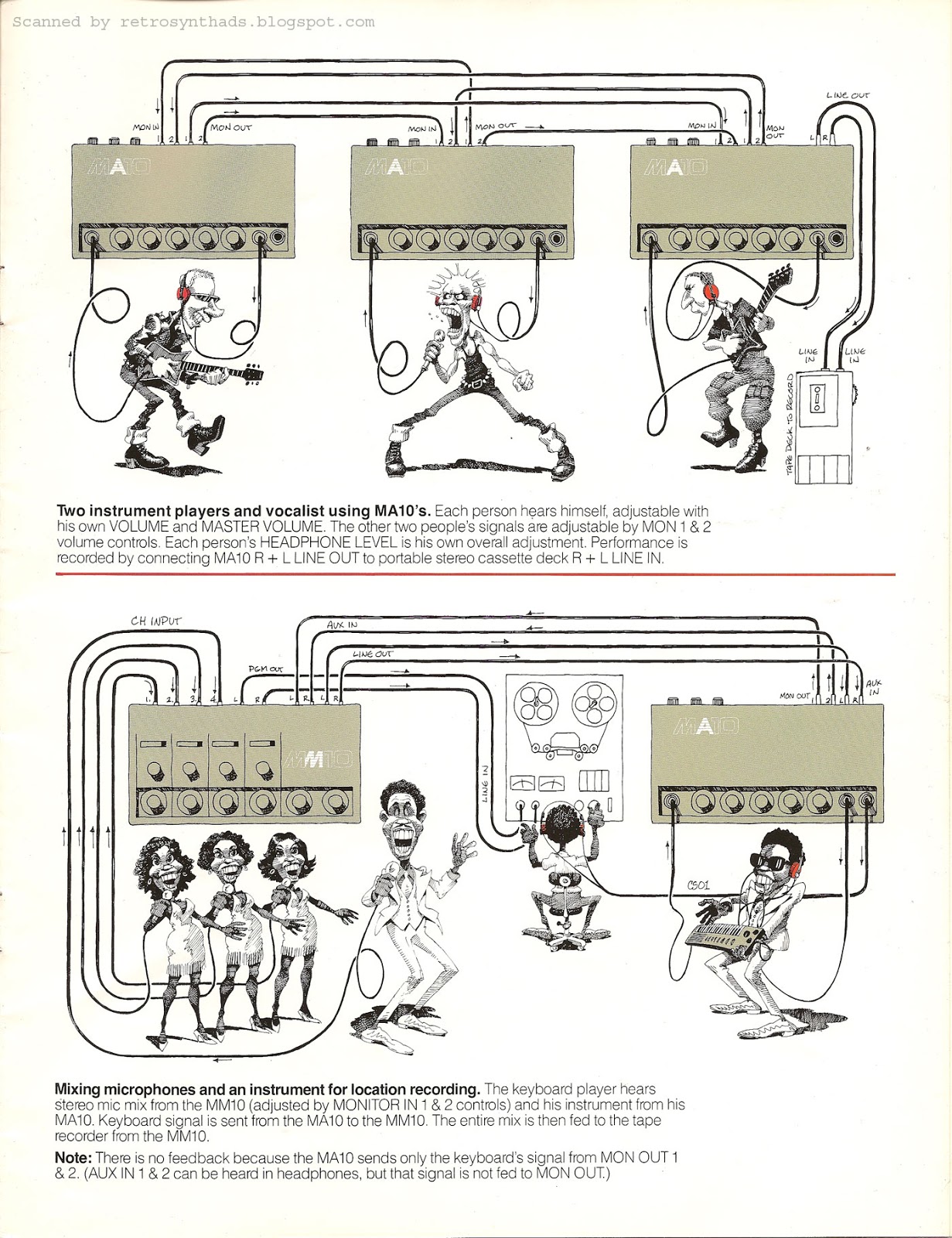
Yamaha "Producer Series" 12-page brochure from 1983 featuring the MA10 Headphone Amplifier, MM10 Mic/Line Stereo Portable Mixer, and CS01 Micro-Monophonic Synthesizer.

Just in case you couldn't get enough of the illustrations from Yamaha's 1982 "Producer Series" ads that ran in the June, August and October issues of Keyboard Magazine, I thought I would post this awesome 12-pager.  It took a bit more time than normal to scan, but I figure that allows me to blog a little bit less.  :)

Illustrations aside for a second, this brochure is also currently in my top 10 because it also gives readers an up close and personal look at each piece of gear. Labels for every knob, lever, dial and input and output are all clearly visible. And each piece of gear has a page or two devoted to detailed info. Can't beat that. 

But as much as I like that first half of the brochure, its the last half that is a joy to read. I really like diagrams. But I *love* these diagrams.  I'm talking about the "Six  Producer Series set-ups". The illustrator that sketched the imagery in those Yamaha ads was clearly running on all cylinders when asked to come up with more imagery for this brochure.

To me, the punch line comes in that sixth set-up (bottom of page 10) for "Amplifying TV sound". Two couch-potatoes lounging in front of a TV, beer and cigarette in hand, and head-phones securely on their heads so they can listen to their TV "privately and in synthesized stereo". Brilliant. And I'm also kinda crushing a little on the country singer in the second set up. Those are some serious birthin' hips.

The brochure was the perfect end to this series of illustrated Yamaha ads. If they had kept them going on longer, they might have become as epic as the John Mattos period of Sequential Circuits ads and brochures. Almost.

My biggest problem now is trying to decide which one of these illustrations to make my avatar on Facebook and the Cakewalk forum I just joined.

Monday, March 4, 2013

Yamaha CS01, MA10, MH10 and MM10 Producer Series "Before. After. Affordable Alternative..." ad, Keyboard 1982


Yamaha CS01 Synthesizer, MA10 Headphone Amplifier, MH10 Stereo Headphones and MM10 Stereo Mic/Line Mixer "Before. After. Affordable Alternative..." Producer Series two-page colour advertisement from page 8 and 9 in the October 1982 issue of Keyboard Magazine.

Okay, it definitely wasn't Yamaha's original intent, but I *really* want that synthesizer the dude in the bucket is playing in the "Before" illunstration. It's like a cross between a Kord MS20 and some computer panel from an early James Bond flick that some anonymous henchman would be controlling. It actually brings back some great memories of a time when all my available income would go towards that one... special... synth (which would change when the next best synth came out). A time when I would honestly consider wearing a bucket if it meant I could buy it. Although I'd never not pay for a good haircut.

But Yamaha once again does a fine job of literally illustrating their point - the Producer Series gear wouldn't cost an arm and a leg. It was truly an "Affordable Alternative".

This was the third and final ad in this particular series of "Producer Series" ads. If you recall, each in the series dealt with one particular advantage that the gear held over its competitors. The "Rolling Sound" ad was all about the mobility of the gear, and the "Private Practice" ad pushed the idea of being able to practice without disturbing others. 

Rolling Sound.                             Private Practice.

Each of these ads appeared only once - June, August, and October 1982. And its a shame, because the illustrations are really nice and they all deserved more airtime. But I'm sure part of the problem was that Yamaha was pumping out tons of gear all the time, and needed to advertise all those products. To make the point, during the time these ads were running, Yamaha was also throwing advertising dollars at Keyboard Magazine for the CS70m, Electone 7000, CE20 combo, CP11 and CP12 electric pianos, and PS10 and PS20 portable keyboards. They were running two to four ads per month.

All those different products probably made it a little confusing for the consumer. And I'm not the only one who thought so.

Dominic Milano says as much in the introduction of his March 1983 Keyboard Report on three Yamaha offerings - the PC-100, MP-1 and the lovely CS01.
"Companies, as they get larger, tend to split themselves up into smaller divisions internally, for administrative reasons. This may make perfect sense for their own purposes, but it can be confusing for anybody from the outside who deals with them. Case in point: Yamaha International (which is itself a division of Nippon Gakki Co., Ltd.) has no less than three separate divisions selling keyboard instruments. Depending on what instrument you want to talk about, your phone call may be routed to either the Keyboard Division (pianos and organs), the Combo Division (rock and jazz keyboards), or the Special Products Division (portable battery-operated keyboards)."
Over-lapping departments in a large organization is never a good thing. It just leads to silos. I've not just seen it, I've experienced it.

So, guess which division the portable, battery-operated CS01 synthesizer was a part of. Nope, not the Specialty Products Division which specialized in portable, battery-operated keyboards. It belonged to the Combo Division, which includes rock and jazz keyboards. Go figure. Well, enough griping about that. 

Dominic's report on the CS01 is pretty standard, concentrating on the functionality of the synth. And he did touch on one aspect of the CS01 that really interests me - the breath control. The VCF and VCA can both be controlled with Yamaha's $35 breath controller accessory.
"This handy little accessory, which you blow into, turns the CS01 into a very expressive lead instrument. The amount of signal from the breath controller that is opening up the filter or VCA can be continuously adjusted with a pair of knobs at the left end of the keyboard. Thus you can easily use the ADSR to control the loudness while your breath controls the filter cutoff, or vice-versa. Or you can mix the two for some subtle inflections."
Yeah, sure, you might look a little odd running around the stage with the CS01 around your neck and a giant soother in your mouth... wait... actually, now you wouldn't look that odd.

I'm going to have to investigate that breath control a little further...

Thursday, February 28, 2013

Yamaha CS01, MA10, MH10 and MM10 Producer Series "Before. After. Rolling Sound..." ad, Keyboard 1982


Yamaha CS01 Synthesizer, MA10 Headphone Amplifier, MH10 Stereo Headphones and MM10 Stereo Mic/Line Mixer "Before. After. Rolling sound..." Producer Series two-page colour advertisement from page 36 and 37 in the August 1982 issue of Keyboard Magazine.

Yamaha must have known they were on to a good thing with the artistic direction taken for the Producer Series of advertisements, and decided to keep the ball rolling after the first ad appeared in the June 1982 issue of Keyboard Magazine - ---see right  --->

In that first advertisement, Yamaha focused on the theme of "Private practice", where using only Yamaha Producer Series equipment, a band could practice without annoying the neighbours, or apparently, the pet dog.

In this second advertisement, again appearing only once, this time in the August 1982 issue of Keyboard, the theme switches to "Rolling sound", aka the ability to take your music on the road. And not on now-fasionable inline skates, but old-skool roller skates - toe-brakes and all. Whether we are talking about the skates or the... ahem... cleavage... it is truly all in the details.  Hubba!  The point is, this battery-operated gear is light and easy to take on the road.

Both this ad and the previous one follow the same "Before/After" layout, with only two splashes of colour to be found. In the "Producer Series" name and the gear itself. Those splashes of colour save the ad in some ways, allowing the readers' eyes to find a focal point. Something that could be rather difficult without the colour in a two page advertisement this busy.

I have to give Yamaha credit. They went to great lengths to make these ads unique. And not just the imagery, but the ad-copy as well. The story pulls each piece of gear from the Producer Series into the ad, even if it is not part of the artwork. Nice.

At some point I'll pick up all these pieces just to fiddle with, but as can be seen in my previous blog post, my obsession is really all about the CS01 synthesizer.

Side note: I went through a period where I was really fascinated with mini-synthesizers and at one point was ignoring all my other gear and creating music based only around my CZ101, DX100, MC202 and Prophecy. Kind of concept album. Never went anywhere, and probably a good thing since that last one I mentioned, the Korg Prophecy, may not be a true mini. Someone would have called me out on that. But it is monophonic. And great sounding. And adorable - just like the rest in this group. :)

Anyways, my obsession is really about the CS01. But the others were definitely along for the ride. For example, all four pieces appeared in the same Spec Sheet promo in the May 1982 issue of Keyboard (a month before the ads started to appear). The promo focuses on the most important aspects of each piece - the size and weight. Plus, us historical freaks get some retail pricing info too!
"Yamaha products. Four new miniaturized sound reinforcement components have been introduced by Yamaha. The portable battery-operated CS01 Monophonic Synthesizer, is 19 3/4" wide by 6-3/8" deep, with a 32-note keyboard, pitch and mod wheels, LFO, variable glissando, pitch, and waveform controls, pulse width modulation, full VCF, VCA, and envelope generator controls, an octave selector for adjusting keyboard range, and an interface allowing modulation of both VCF and VCA functions by breath. A build-in amp and speaker system is also included. Price is $249.95. The MH10 Headphone Amplifier, weighing 17 ounces and measuring 8-3/4" by 5" by 2-1/16", features four line inputs and outputs, separate volume controls, bass and treble controls, and input and master volume controls that permit intentional distortion effects. A built-in analog delay line can create a stereo-like effect. The MA10 sells for $124.95. The MH10 Stereo Headphones weigh two ounces, and feature adjustable headband and a 9' cable. Price is $29.95. Finally, the MM10 Mic/Line Stereo Portable Mixer weighs 17 ounces, measures 98-3/4" by 5" by 2-1/16", with capability of mixing up to four signals. Each powered product runs on either AC or battery. Yamaha, Boxx 6600, Buena Park, CA 90622."
$249.95?!?! That's an amazing price for what the portable CS01 can do. And the timing couldn't have been better either. In this May issue alone, we have advertisements for the Roland TB303/TR606 and SCI Remote Prophet. And the article on Jonathan Cain (Ex-Babys Keyboardist touring with Journey) features a large photo of him with an ARP Odyssey strapped around his neck (and looking like he's experiencing severe back problems). Technology was getting to the point where the luxury of portability was starting to kick in. Yamaha was catching the wave.

I'm curious though... can I really get a power generator harness for my dog? I could see how that could come in handy.

Monday, February 25, 2013

Yamaha CS01, MA10, MH10 and MM10 " Producer Series: Before. After. Private practice..." ad, Keyboard 1982


Yamaha CS01 Synthesizer, MA10 Headphone Amplifier, MH10 Stereo Headphones and MM10 Stereo Mic/Line Mixer "Producer Series: Before. After. Private practice..."  two-page colour advertisement from page 8 and 9 in the June 1982 issue of Keyboard Magazine.

This advertisement was the start of Yamaha's "Producer Series" two-page ads that would begin appearing in Keyboard Magazine in the summer of 1982 and run intermittently through the fall. Above all else, the reason these ads are so awesome is the great artwork - and you know how much I love synthesizer advertisement artwork. More on that in future Producer Series blog posts.   :)

Today I'm posting this advertisement for one reason: Celebration! Lately I've kinda resembled the dude playing the guitar in the "Before" picture. Like life had just kept kicking me in the 'nads. Or maybe I resembled the dog more...

No matter. With life going the way it is at the moment, I have to take any "win" that I can get. And right now, this one is about a 7 out of 10 on the "celebration" scale.

Have I built up the suspense enough yet? Probably too much.

You see, I recently re-found an old non-functioning Yamaha CS01 synthesizer in my basement. I had originally picked it up so long ago I can't even be sure where I got it. I think it was a freebie that came along for the ride when I locally purchased another synth. I'm sure I had high hopes of taking it in one day to see if it could get repaired, but in the end it quickly ended up out-of-sight and out-of-mind.

Fast forward 20+ years later (no kidding!), I'm searching for a hacksaw blade - don't ask - and this thing literally drops on my head.  At least it wasn't a Jupiter 8 that fell on my head... although that would have been worth the concussion. I brought the CS01 upstairs and there it sat on my living room table for a week or so when I finally decided to take a closer look.

First I decided to wipe off the decades of dirt with a damp cloth. That took a while in itself. But it looked almost like new after I was finished. Only faint letters written on each key in permanent marker remained.


I then plugged the sucker in to see what would happen. The red power/volume light instantly came on, but there was no sound from the keyboard whatsoever or out of any of the controls. Just the way I left it oh so long ago.  I even tried the "Author Fonzarelli" - gently tapped the back of the unit a few times.  From his Wikipedia page:
"Fonzie would at times demonstrate an almost magical ability to manipulate technology with just a nudge, bump or a snap of his fingers for things such as starting a car, turning on lights, changing the song selection on a juke box or getting free sodas from a vending machine."
No such luck.

So I figured it was time to take out my screw driver and see what was happening inside.


One word - rust.

It was like one side of the synth had been dipped in water. Ugh. You can see the damage in the close up picture. Cool thing about this circuit board is everything is labelled well. Envelope generator, VCF, VCA, Osc - everything. Very cool. There is even smaller labels indicating inputs and outputs of different functions.

Now, please remember - I don't know what I'm doing. I'm not a technician. But I figured if I could at least get it to make a sound then I would know it was probably worth taking it in to get fixed.

I unscrewed the keyboard mechanism and everything looked fine.  I took a cloth and wiped all the dirt off everything and screwed the keyboard back on. Then, without closing it back up, I plugged it in ... and... noise! And musical noise even! The keys even seemed to be functioning fine.

I put everything back together and started testing the controls.

VCO - check.

VCF - check.

VCA - check.

LFO - check.

Pitch bend and modulation wheels - check. 

EG - check. Well, kinda.

Turns out everything is working except the Glissando (portamento) in the VCO section, and the attack time and release time in the Envelope Generator. All the keys except for the highest and lowest work as well, although they are a little dirty still.

So, maybe I do have the Fonzie-touch afterall. Excellent. I look forward to dating twins at some point in my future.

All  that good news means one thing - this CS01 is definitely worth saving. I'll take it in to my tech along with my Minimoog (which for some reason just konked out on me) sooner rather than later. 

A pretty good Sunday morning project.