Showing posts with label brochure. Show all posts

Monday, June 30, 2025

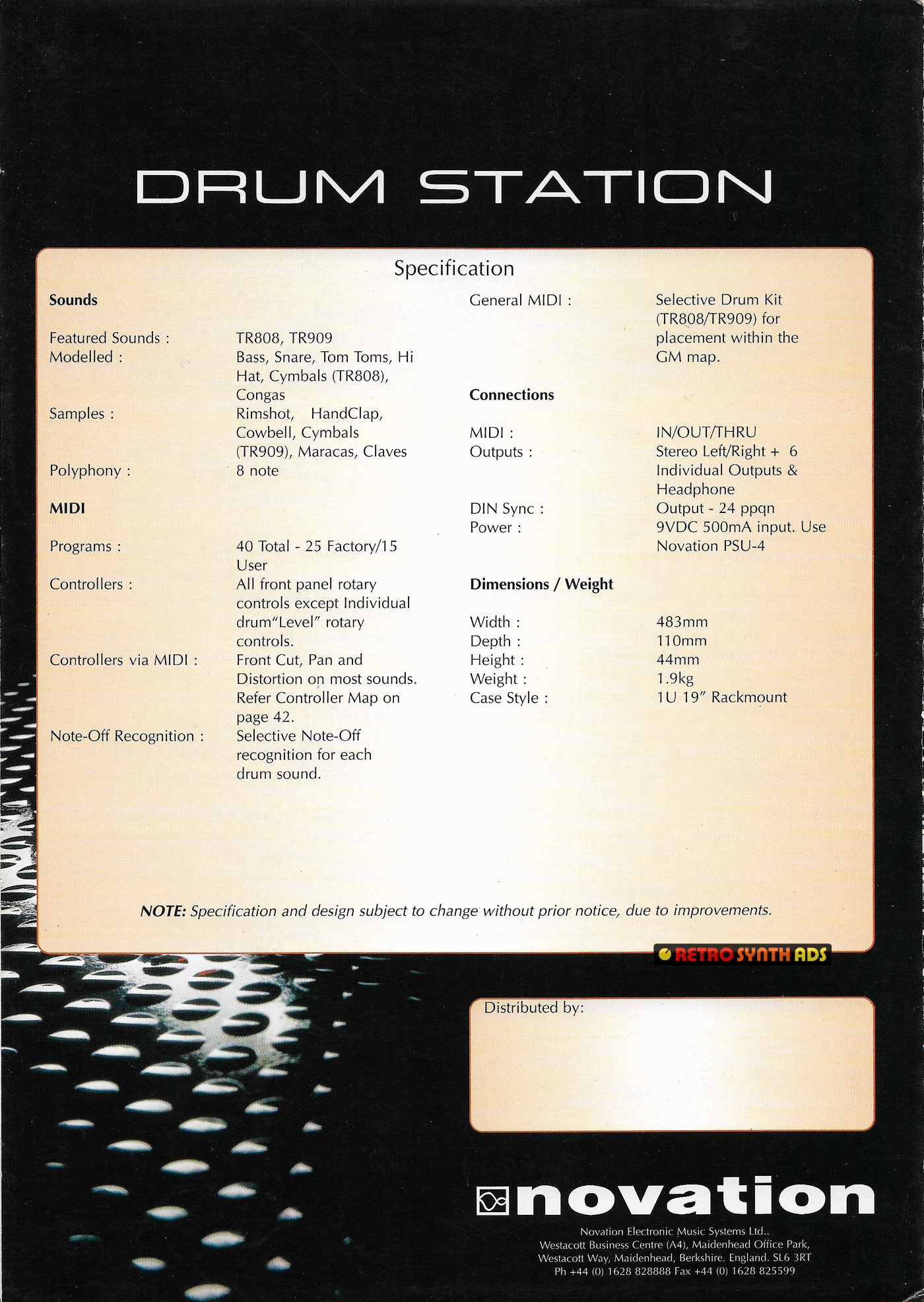
Novation Drum Station brochure, 1998


Novation Drum Station two page colour brochure from 1998.

Gonna keep it short... it's been a while since I've blogged and I've kind of forgotten how to do it. No really. I'm trying to get my mojo back, but this is really hard. 

A while back in 2021 I posted a four page 1996 Novation Drum Station brochure. Fast forward a year or two, and Novation has taken a shrink ray and bumped that brochure down to a two page reference sheet. One page, two sides to be exact. 

Gone is that lovely front cover image. Instead, Novation has taken the Future Music Platinum Award that used to live on that cover, and plunked it onto the front half of this brochure. But, They have also added a little blurb from the June 1997 issue of Electronic Musician. Go them!

Believe it or not, the rest of the content is almost exactly (if not exactly) the same between the two. The same bullet points. The same sub-titles of the different section. Same order. 

Oh wait... one other big different... NO BLOCK DIAGRAM.  BOOOOOOO!!!!! I do love me a block diagram. 

One other little thing that is bugging me. That marble-y texture Novation chose to have in the background of the front and back of the page. Not a fan. Too distracting. 

Okay - like I said. Keeping it short. Probably for the best because I'm grumpy. If you didn't notice.  :)

Tuesday, November 30, 2021

Roland JX-3P and PG-200 "Programmable/Preset/Polyphonic Synthesizer" brochure, 1983


Roland JX-3P synthesizer and PG-200 programmer "Programmable/Preset/Polyphonic Synthesizer" four page colour brochure from August 1983.

Well, well... another "We design the future" brochure. I got a million of them. Okay - maybe a few are duplicates. 

Can you blame me? Look at this beauty. All the signs of a Roland brochure from this era - like this JX-8P brochure I published back in 2020 - and the blog post that holds the record by far for hate mail regarding my position on the statement "Too much gear reduces your creativity". But that's another story. 

Where was I... oh yeah - the multitude of other We Design the Future brochures (and those that came after the tagline was dropped, but kept the same design format). At least 11 tagged on the blog to date, and as I find others - like that JX-8P brochure I've scanned, I add the tag to those posts too. 

The centrefolds in these things never disappoint. Flip the cover page open and you get that big gorgeous photo. I don't care if you love or hate the sound or the programming of this thing... it looks awesome. This is what an 80s synthesizer front panel should look like. Yeah yeah... knobs are great - but I equate those with 70s synths. A real 80's synth has one big data knob. Or at most, one or two sets of up/down button. Think Yamaha DX7. Or Oberheim Matrix 6.  :)

But the real history here is Roland's introduction of MIDI to their brochures. The tech was so new, companies were still fiddling about with their buzz words.

"MIDI BUS"

"... can be hooked up with..."

"MIDI BUS connector". 

All oddly awkward and satisfying at the same time.

Roland gives up a bit of real estate on the back page (not enough in my opinion) to discuss MIDI even more. 

"Today's modern digital technology has made it possible to automatically control and synchronize a remarkable variety of electronic instruments. A personal computer can even be incorporated in such systems which usual require no special knowledge or operational techniques. The only problem is that individual makers have in many cases employed mutually incompatible connections and this greatly reduces the performer's potential. A new universal BUS system called MIDI (Musical Instrument Digital interface) solves this problem. It accepts all connections from instruments and devices of a standard signal. Now any standard musical instrument or computer can be connected using DIN cords for both input and output. Thus, MIDI expands the potential of performers and brings unprecedented convenience to the realm of electronic music. The Roland's JX-3P and Jupiter-6 are equipped with the MIDI Bus terminal. "

Probably a few more months before the words "MIDI" and "cable" are finally strung together in a sentence. 

And I love it.

Monday, August 16, 2021

Anatek "Pocket Products Catalog" brochure, 1991


Anatek "Pocket Products Catalog" 10 page fold-out colour brochure from 1991.

Since moving into the new house, I've taken the few opportunities I've had to go through some of the boxes of brochures I've acquired over the years but never put into their protective sleeves. And just yesterday I did just that, and came across *this*.

Now'r days, people will joke that Eurorack modules are the synth-equivalent of Pokemon. 

"Gotta catch 'em all."

But, I submit this brochure before the court as evidence that the original synth-equivalent of Pokemon were these little babies. 

I can vividly recall going into my local synth haunt and seeing these stacked into their swiveling wire display stand. Okay, "vividly" may be a strong word. Maybe it didn't swivel. And now that I think about it, maybe it wasn't a wire frame. Was there even a stand?!?!? Gah. I'm old. 

Point is, they were there. And they left an impression. And the urge to collect. 

There was no date on the brochure, so of course I started Googling to try to remember when exactly these popped up on the radar. Didn't take long to find Creation Technologies Wikipage and some great info. 

"1989 - Creation Studios, a high end music recording studio is built in North Vancouver by Barry and Jane Anne Henderson. Barry Henderson was also Music Products Division Manager at Anatek Microcircuits, a hybrid manufacturer in North Vancouver, BC with revenues of $1M USD. He and his team developed the Anatek line of MIDI and audio products including the now famous line of small MIDI signal powered MIDI processing accessories called "Pocket Products". "

Boom! Further reading explains how in 1991 a partnership lead to the name "Creation Technologies", which is the name you will find on this brochure, and why I decided to date this brochure to that year. 

And look at that - Oh Canada!

Two other great historical facts can be gleaned from that wiki page. The first is this: 

"The most famous of the Pocket Products, Pocket Merge, sold close to 10,000 units and generated over $1.6M in revenue in 1989, the product launch year."

Niiiiice! What a great little tidbit of knowledge to blurt out next time you are in someone's studio and they happen to have a Pocket Product sitting around. One thing I'm always interested in when it comes to vintage gear is the number of units manufactured. 

The second great historical fact is this:

"Creation had a vision for becoming a high quality global contract manufacturing enterprise and developer of RADAR, the world's first multi-track digital recording system for professional recording studios."

Say what now? I had no idea the peeps behind some of the simplest midi/audio tech devices of the time period were also responsible for one the most complicated and expensive pieces of audio tech at the time as well.

Surprisingly,  my squirrel instincts never kicked in even though they still cost less than those Boss half-racks on eBay and there is always at least a few of them for sale.

*looks at eBay again*

Dammit! 

Tuesday, July 27, 2021

Roland TR-727 drum machine "The Rhythm Composer that keeps you in the groove..." brochure, 1985


Roland TR-727 drum machine "The Rhythm Composer that keeps you in the groove..." four page colour brochure from October 1985. 

Hey! Has it really been 20 days since 707 Day!?!?! Well golly-geeeee! 

Happy 727 day, peeps!

No better way of celebrating than by scanning this lovely beast from the archives. (Yes, I also flinched when I used the word "beast" to describe a vintage brochure of a vintage drum machine). But there ya go. What's done is done.

The 1984-1986 period was an awkward one for drum machines. It was like watching your teenager go through puberty. You wanted to look away, but had to keep one eye on 'em to ensure no one got anyone else pregnant, make sure they washed their face, and wait it out until they grew into a fully (semi) functioning adult. 

In the case of drum machines, it was watching them make that transition from analog to digital, while keeping one eye on the cost of memory as it slowly came down.

Okay, not the best analogy. Let's just say there was a lot going on and a lot of moving parts. 

As 1984 ticked by and 1985 reared its ugly teen-age head out of the bedroom after a three day binge of Fortnite and McD's, it was just a matter of time before the intersection between the cost of memory and the cost of manufacturing hit that sweet spot. Someone got the bright idea that they could just swap out the digital sounds in a drum machine they had already manufactured, give the casing a new paint job, and slap it on the back, out the door, onto music store shelves.

And to that end, we had Boss come out with their Super Drums (DM-110) and Super Percussion (DM-220), Yamaha with their RX21 and RX21L, and of course Roland with their TR-707 and TR-727. 

Each pair housed in VERY similarly manufactured boxes, with their sounds switched out for alternative percussion sounds. 

It was an interesting and short-lived (experiment) solution to keeping the price-point of your drum machine down until memory came down to the point you could start really backing one single machine with tons of sounds. If I recall, it was Boss/Roland that managed to get their percussion-based boxes out the door before Yamaha, but feel free to correct me if I'm wrong. 

Anyways, enough about those other two - I've got brochure scans ready to rock for a later date. Today is the day to let the 727 shine. 

Quickly - we've got the classic Roland "We design the future" layout. Cover with large font up top and sexy photo on the bottom. And what a sexy photo this is - pairing the 727 with the Octapad PAD-8, looking longingly at each other in the subdued lighting. I can here the TR-727 softly whispering "come hither". Put some lace on that PAD-8 and this could be a Harlequin Romance book cover. Just saying. 

Let's face it, Roland was expecting a large audience of the 727 to be trained percussionists, and as a friend of many percussionists, I can tell you that they love to hit things. The PAD-8 becomes the perfect companion for programming a TR-727. Although with the rigid timing of the 727, it possibly could have ended up to be more frustrating in the end. 

With their interest peaked, the reader slowly opens the cover to reveal the inside pages. And it doesn't disappoint. The Roland TR font makes me so happy, as do the large photo and diagrams included! What's interesting is the shear amount of text packed into those pages - especially on the right page. 

So much so, that they really had to compromise the negative space of the pages to fit it all in there. 

Compare it to the 707 brochure and you can see what I mean. Subtitles are crowded in the 727 brochure, and even the line spacing of the paragraphs seem claustrophobic. 

But now I'm just quibbling. It's still lovely. 9.5/10. 

Now flip to the back page and we have that PAD-8 again. Coming back for some more of that sweet sweet 727 lovin'. And it looks like it brought it's friend along for a good time. 

Bow-chicka-wow-wow. 

The perfect upsells. 

Have a safe and happy 727 day. 

Wednesday, July 7, 2021

Roland TR-707 drum machine "A brand new digital drum machine" brochure, 1985


Roland TR-707 drum machine's "A brand new digital drum machine from Roland "four page colour brochure from March 1985. 

Hey there! Happy 707 Day. My fifth happiest day after 303 Day, 808 Day, 909 Day and 606 Day. Oh wait... 202 Day. And 101 Day. Wait. 272 Day. Okay, my eighth happiest day of the year. 

But its still a great day! It beat our 358 or so other days. Not too shabby. 

All that aside... let's keep this short and sweet. Just like the 16 beat patterns found on this thing. 

Based on the classic "We Design The Future" brochure style of the period for Roland, this thing is gorgeous. It hits all the right notes. Large images. lots of breathing room. Cool red laser effect when you flip open the brochure. A marble. Yeah... even the marble. 

Like many of the other brochures in this series, the cover has a theme - in this case, some kind of metal thingy behind the 707. It's actually a little freaky on the eyes, ain't it? But that don't matter, because as soon as you open the brochure, you get that large image of the TR-707 and lots of info including the specs. 

But even better than the marble and lazer found on those inside pages is the back page. Because here we have the lovely older brothers of the the 707 - the TR-909 and TR-606. I love that even as MIDI started overtaking previous sync standards, Roland kept that fire burning under the TR-606. I can't fault them for that (606 Day beats 707 Day by three other days!!!

Like I said. Short and sweet. because I have a job now. A real one. And its fun too. 

Have a safe 707 Day! Enjoy!


Thursday, May 13, 2021

Novation Drum Station brochure, 1996


Novation Drum Station four page colour brochure from approximately 1996.

So, it's looking like May could become Novation month. Well, the last half of May any way. I've been drilling down into their brochures and I'm really liking what I'm seeing. But first, a little house-keeping....

I haven't posted anything for almost a month a half. And that last post was my April Fools number - its been about two months since my last real post about the BassStation (one word).  I know I've had droughts before but this time I actually have a reason. I got a job. No really... a REAL job. Digital marketing of course. But this time with a dash of business development involved too.  Anywhooos, point being that time is becoming a little more limiting. Let's hope I can keep this going. Probably means keeping 'em short and sweet. 

Now back to this lovely brochure. 

After Novation's mind-blowing launch of the BassStation (one word) around 1993, it was hard to think they could follow it up with something that, personally, I found even more mind-blowing. Mind-melting even. That product - the Drum Station (two words). 

Novation called their sound creation system A.S.M. - short for Analogue Sound Modelling, and state in the brochure that the technology "re-created with stunning realism the original character and flexibility of the TR-808 and TR-909 drum sounds". Weirdly, although the acronym A.S.M. is peppered about the first half of the brochure, it isn't until halfway down the second page that we actually learn what it stands for. 

Instead of spending time on needless definitions, Novation decided to go straight to the jugular of P.C.M.-based systems on page one, explaining just how crappy and un-variable sampled sounds are. 

"Yesterday's analogue drum machines, while not as authentic sounding as today's digitally-sampled equivalents, have the character and warmth which PCM-based systems just can't seem to replace. What's more, a sampled version of an analogue drum sound loses all the variability of the original as the sound is "frozen" in just one of the myriad combinations of the editable parameters which the original machines offered." 

Bam! That's how you hit 'em where it hurts. 

The intro goes on to explain that this is why there has been a resurgence of analogue drum sounds (true) and that the TR-808 and TR-909 are the much sought after "dream machines" (also true). 

And with full control over parameters, these sounds could be as varied as the originals. 

So how did it sound...? Unlike the BassStation (one word), which I'm already on record saying it doesn't sound much like a TB-303, this thing was a dream machine. Sure, no sequencer - it had to be controlled through MIDI (and most likely a computer sequencer). But who cares. It cost a lot less than a TR-808 and TR-808 - even at 1995 prices. 

So yeah. Love it. 

The brochure itself is lovely too. A gorgeous front page that has the Drum Station (two words) floating over top a black reflective texture of some sort. Very reminiscent of Roland textures from their "We design the future" period of the 80s. Inside we have a really large photo spread of the front face, a cool block diagram and lots of juicy info. Back page - the specs in a black font in a large light yellow box with rounded corners. 

I mention the colour and shape of that box because I have an older version of this brochure that is slightly different. On the back page that box is square and black, with a white font. Exact same info in the exact same order. Just a different colour theme.

And that's not the only difference. This version of the brochure has that cool "Future Music Platinum Award" logo and blurb on the front page with a July 1996 date. The other version of the brochure doesn't have that award info, suggesting it probably came out earlier - maybe even 1995 when the machine was first released. 

If you can find one of these (the machine, not the brochure) for a decent price. Definitely worth picking up. Great sounds. Rack mountable. Lots of tweaking. 

Yum!

Friday, March 19, 2021

Novation BassStation "Analogue for the 90s" brochure, 1994


Novation BassStation "Analogue for the 90s" six page full colour brochure from 1994.

So... I decided to just randomly pull out a brochure. When I reached my hand in, all I knew was that I was in the "Kawai" - "Oberheim" section of the shelves, but that was it. 

The result? 

Novation BassStation! 

Not Bass Station. Not Bassstation. 

BassStation. 

Now, before I get into a bit of history, I thought I'd explain my scan placements above. This is one of those (technically termed) crazy-fold brochures. So, the top scan is the front page. When you open up that front page to the right, you see the two pages I've put up next. Then, what happens is you flip that second page out to the right (again), revealing two more inside pages - so I've got the second page again, but this time it's shown with pages 4 and 5 as it would if laid out in front of you. And finally the back page.

Get it? Good. 

I remember when this sweet machine came on the scene in 1993 - is was around the time that "Big Synth" was starting to dig the vintage stylez again. For example, in 1991 Roland rolled out the JD-800 with its distinctly analog-style interface. Used analog synth prices were also starting to rise (we complained back then!). 

And all of a sudden... Boom. Novation, outta what seemed like nowhere, pulls the covers off their BassStation. 

To hear Novation tell the story...

"When creating Bass Station, synthesiser developer Chris Huggett took the outer shell of MM10 and added the same Filter and VCA as his now legendary Wasp synthesiser to develop an instrument with it’s own unique sound and instant pedigree."

Nice. Wasp guts are cool. 

But what's not so nice? Novation's own use of  the two-word "Bass Station" in that online article ON THEIR OWN SITE. Wussup with that? I want consistency, dammit!

Anywho - it wasn't the Wasp guts that me and so many others were drooling over... it was the idea that this thing could sound like a 303!

More from the article 

"It was particularly celebrated for its ability to mimic the Roland TB303: a synthesiser that played a crucial role in the development of contemporary electronic dance music and helped define house music as we know it today." 

And those 303s were really starting to rise in price. An analogue MIDI synth that could sound like a 303 brought stars to my eyes.

But did it really sound like a 303? 

REALLY?

Look, I have two TB-303s, and a wack of clones. And when people ask me about my views on the clones I'm usually pretty generous with my compliments. "They are close enough" sums up most of my remarks.  

So... the BassStation? 

Close enough.  ;)

Wednesday, March 3, 2021

Roland "Roland Rhythm Machines & Sequencers Vol. 1" catalog, 1985


Roland "Roland Rhythm Machines & Sequencers Vol. 1" eight page full colour catalog from March 1985.

Happy 303 day! The most happiest of happiest days! 

I'm gonna try and get a little 303 video ditty created before March 3 (I did - and posted!), but figured I'd scan something a little bigger than the normal one page advert or four page brochure and yap a little bit less about it. 

So here we have Volume 1 of the "Roland Rhythm Machines & Sequencers" catalog, containing not just the lovely TB-303, but also the TR-707, TR-909, TR-606, CR-8000 & CR-5000, SBX-80, MSQ-100 & MSQ-700, and JSQ-60. Say all that in one breath. 

One of the most interesting things about this brochure is the date - 1985. Roland was well on their way pushing the new MIDI standard, but they still had a few of their DCB and DIN devices on display.

But even more interesting is the inclusion of the TB-303. Most online resources would tell you that 303 production stopped, and the rest of the stock was sold off cheaply in 1984... so to see it pop up in a 1985 brochure makes me more than a little happy. Someone in a 1985 boardroom was saying "This MIDI thing is really taking off... but... just... in... case... we still have a few more of those 303s kicking around out there, let's put it in a catalog one more time. 

Enough yapping. Back to 303'ing. :)

Tuesday, February 2, 2021

Roland "We design the future" MC-202 Microcomposer brochure, 1983


Roland "We design the future" MC-202 Microcomposer 8-page colour brochure from 1983.

Happy 2/02 day! And I got a doozy for ya. Behold the magnificent MC-202 "We design the future" brochure.

Over the last couple of weeks, we've heard a lot of about hedging. In particular, GameStop's share price skyrocketing, messing with hedge funds that poured huge amounts of cheddar into shorting Gamestop's stock. And then those hedge funds having to hedge those shorts by buying stock at an ever increasing price, making the stock go even higher. Or, at least that's how I understood it. Don't @ me if I'm wrong.

Point is... Hedge. And I'm thinking this MC-202 brochure is kinda symbolic of Roland's hedge against MIDI. I'm not saying Roland was against MIDI - NOT AT ALL! They were definitely on the forefront of the technology. I just think, like any good company would and should, they were hedging their bets. 

More on that in a bit. But first, for some background info (and because its simply amazing!), we need to flip through the brochure.

Like most of the "We design the future" brochures, we get that classic front page - a large red title, large artistic image, that lovely logo top left. Flip to page 2 and 3, and we continue Roland's classic brochure format with a large image of the featured piece of gear and some great marketing info. Yum!

But then something weird happens. We turn the page to what should be the back of the brochure.

WHAT THE? 

More info? That's right - no back page here. Instead we get two more pages on how to use the MC-202 specifically. So awesome. Lot's of diagrams. Lot's of info. Read through that an you are pretty much an expert on programming the MC-202. 

*throws manual in garbage* Thank you very much. 

Okay...  NOW let's flip the page and take a look at what's on that back page...

SHUT THE FRONT DOOR! EVEN MORE INFO!

First a page titled "Play Bach" that puts those programming chops we just memorized on the previous two pages to work to actually churn out some Bach on the MC-202. No kidding.   And across the street we get a page devoted to the "Expandability of the MC-202" which includes a Who's Who list of kick-butt Roland products while describing what's going on on the back panel of the 202.  

Wicked. 

Then. FINALLY. We turn the page and get the classic brochure back page that Roland is known for. Info on Roland's TB-303, TR-606 and SH-101. 

Interestingly, all these devices on that page have one thing in common (besides being Roland gear):  

No MIDI. 

MIDI was just around the corner and by 1983 Roland, who was a big developer of MIDI technology, had already started on the design of Roland's first MIDI interface - the MPU-401. But what if MIDI didn't take off? What if it was a dud? 

I believe Roland spent significantly more resources, print ink and page real estate on this MC-202 brochure to hedge that MIDI bet. I realize, in the grand scheme of things, the cost of this brochure would pale in comparison to the cost of the development of that MPU-401 interface. It's really more of a symbolic hedge after spending significantly more money on developing Roland's next gen non-MIDI gear - the TB-303, TR-606 and SH-101. 

Yeah, sure, I have no data to back any of this up. It's just a hunch. 

But I did just hedge my comment by saying I have no data to back any of this up. :)


Aaaaah. Hedging.

Thursday, January 28, 2021

Roland MKS-50 Polyphonic Synthesizer Module "The newest Juno synthesizer..." brochure, 1987


Roland MKS-50 Polyphonic Synthesizer Module  "The newest Juno synthesizer..." four page colour brochure from 1987.

Oh man - first post of 2021 - and what a way to start! The MKS-50!

Like the Alpha Juno 1/2 brochure that came out the previous year, and that I blogged about back in September 2019, this little feller follows Roland's classic (and consistent) "We design the future"... eeeer... design. My favourite part being a lovely front page that includes a large title and creatively placed featured piece of gear.

In this case the MKS-50 is floating above what looks to be silvery sheets of paper of some sort. This ties back nicely with the photograph used on that Alpha Juno brochure where the two synths are sitting on top of a similar type of paper.  

Okay - let's talk about the elephant in the room. That huge burn mark that starts on the front page, and actually makes it's way to the second and third page as well. It was sent to me this way. Honest. I don't even smoke. Now, usually I would do a little photoshop magic to remove these types of blemishes, but in this case I kept it in. Sure, that's partly laziness on my part, but also because its indicative of how many brochures are sent to me in this type of condition and, well, I kinda cool in its own way. This brochure has seen some dark times. It encapsulates 2020.  Poor thing. 

Thinking back, I'm pretty sure the MKS-50 was my first Roland module. I had a a few Roland keyboard synths including an Alpha Juno 2 at the time, but as space started getting slim, I began to actively hunt down rack version of synths that I already had and then would dump the keyboard version when I found it's rack equivalent. And it was when I stumbled across what eventually became my MKS-50 that I first came in contact with another most incredible piece of gear - the PG-300 Programmer (it's in the brochure, too!). 

I cannot stress enough how important Roland programmers were to me and many of my friends. You gotta understand that many synths from this time period replaced the visual feedback that came with one-control per function operation for some type of small display - the DX-7, Sequential Six-Trak, Korg DW synths, Kawai K's... the list goes on.  The Alpha at least had the giant alpha wheel to help quickly dial in the specific parameter you were looking for, but it was still annoying as heck.   

Having that PG-300 gave me the immediate visual feedback I'd been missing with the Alpha Juno - and I was hooked! And it's built like the MKS-50 - like a tank! I started tracking down other programmers for my other synths, managing to grab the PG-800 for my MKS-70 as well as the PG-1000 for my D-550 before the secret was out of the bag and prices of the programmers started to skyrocket. Never managed to grab an MPG-80 programmer for my MKS-80 and now that prices are hovering around the $2000 mark, chances are slim I'm ever gonna get one. 

I don't even think there are any hardware alternatives. I've read that the Virus TI can be programmed to pump out the right sysex to program an MKS-80, but like I've already stated above... I'm lazy. 

And don't even start on software editors. Ugh.