Showing posts with label reference sheet. Show all posts

Thursday, December 31, 2020

ARP 2600, Omni-2, Piano and Quartet infosheets, 1979


Set of ARP 2600, Omni-2, Piano and Quartet infosheets from 1979.

Catalogues, info-sheets, brochures? I just don't know which is which anymore. I definitely haven't been consistent over the last 11 or 12 years that I've been yapping on and on through this blog. And my tags are a dog's breakfast because of it.

In my head, catalogues are usually larger marketing documents that contain a little bit of everything, bound together in some way. Saddle stitch, glue or whatever.

Love 'em. 

I got a lot of 'em. 

Roland. Korg. Casio, Akai... they even have covers that say "catalog" or "catalogue" on 'em with a year/date and volume number - very official looking.  But scanning large catalogues takes a lot of time and I'm an "efficiently lazy" person by nature, so you don't see a lot of them on the blog.  

Info-sheets, on the other hand, are those one-pagers (often two-sided) that contain a lot of information and specs on one instrument. Often, they are part of a larger group of similarly designed info-sheets like the ones above.  And usually I scan these similar documents all at once, and then spread out their posts over time so that in my head I feel like I'm being more productive. 

I gotta tell ya, lately I've been feeling like I'm running out of things to say. 

How many times can I say...

"Lovely!" 
"Consistent design!"
"Logo!" 
"Font!"
"Large photo!"
"Diagram!"
"Did I mention diagram!"

Now, I gotta say that all of the above applies here and posting them all at once really shows off the lovely consistent design with large photos and diagrams. I could literally post a scan and just write LCLFLDD underneath the images and call it a day.  

There isn't much else coming outta my head these days synth-related. 

Hence, lets continue on with my original thought. Where was I? Catalogues. Info-sheets... oh right...

Brochures. 

Brochures, in my head, are usually smaller that catalogues, but larger than info-sheets. Maybe stapled if they are more than two pages. 

Sometimes they tell the company story and feature more than one instrument - I'm thinking in particular of that 1974 "Arp Story" brochure that I had posted earlier this month. 

But, isn't this just a catalogue? 

To make it even more confusing, each of those pages can also be found in the wild as individual "info-sheets", and ARP even created addition info-sheet inserts for this brochure of newly released instruments to increase the shelf life of the original brochure. 

But how about those Roland "We design the future" brochures I fetishize over?


Drool. 

*tick tick tick*

(Its literally two hours later because I started looking at these lovely beasts. I still have so many to scan from this series.)

Anyways, like those ARP info-sheets above, these Roland brochures feature one instrument and usually contain a diagram or two, some specs, and are part of a larger group of similarly designed documents. The only real difference between those ARP info-sheets and these Roland brochures is a fold. Seriously. A FOLD. 

I guess my point is that I have no standardization. 

Hey... I'm surfing around the blog now... what about this ARP "promo/datasheet"...?


Or these Moog "reference sheets"... ?


Do I go back and change them all to "fact sheets" now? 

So much work. 

Double ugh.   :)

Wednesday, August 26, 2020

E-mu Systems Inc. Vintage Keys "Classic Analog Keys" synthesizer brochure, 1993


E-mu Systems Inc. Vintage Keys "Classic Analog Keys" two page colour synthesizer brochure from 1993.

Hey... its been a while. Almost two months. Haven't been in the mood for much writing. But when the topic of the E-mu Vintage Keys came up with a group of friends recently, I remembered all those E-mu brochure scans that have been sitting in draft mode for an unusually long time - even for me. So, here's a short and sweet post to share with my friends. 

While the previous E-mu Morpheus sheet I posted last December is one of my favs in this marketing series from E-mu, I gotta say the Vintage Keys also brings a twinkle to my eye. And yes, the dude with the keytar on the front of the brochure is *definitely* part of that twinkle. 

As mentioned - the sheets for the Morpheus and Vintage Keys (along with the other four or five I have in the series) are from the same series, so it makes sense they all follow the same format. Large title and image up top. Propaganda below. And then on the back - more details. In the case of the Vintage Keys brochure, a good amount of that back page real estate is made up of the list of preset names. Because this machine is all about those presets. 

Let's face it, E-mu was ahead of its time with this module. Or maybe right on time, because most of my friends owned one (even those with original Moogs, Arps and Oberheims) and soon after the vintage synth craze really started to take off. Although I'm sure others will argue with me over that arguably arguable statement of the timing of the actual start of the vintage craze. 

The point being that this rack mount was in-arguably the cheapest way to cram the classic sounds of a Moog Modular, Minimoog and Taurus Pedals,  Fairlight, ARP 2600, Oberheim Matrix-12, Sequential Prophet 5 and many other amazing classic synths into 1 U of rack space.

Sure, 8 megs of sounds (expandable to 16!) doesn't sound like a lot by today's standards, but considering I was probably using less memory running Photoshop on Windows in 1993 in grad school, it packed a rompler of a wallop for it's time.  And did I mention 32 voices, 16 bit sound AND multi-timbral? Sweet.

There is a great review of the Vintage Keys in the May 1993 issue of Music Technology written by Peter Forrest - the always amazing Mu:zines has it online - and he admits that a lot of compromises had to be made to get that many great sounds into 8 MB, but states near the end that...
"Overall, one would have to say that Vintage Keys is an absolute must for any studio - possibly the most essential piece of equipment and the best value for money since... well, something like the SPX90, or the first DAT machines - and equally useful for any professional keyboard player, even if only as a high quality back-up for the real thing."

A great value for sure. 

During the write up, Peter also made a few other comments that I actually had never thought about until re-reading that review.

The first is that he notes that "perhaps the strangest omission is that of any Emulator sounds - or, come to think of it, of anything from the early E-mu modular systems, especially given the slight American bias to the selection."  

Interesting. 

Although I'm not surprised they didn't include E-mu modular samples (can you think of a famous E-mu modular sound?), its a good point about not including Emulator sounds. Of course, that may be because they knew that in a year or so they would be coming out with an expansion kit / Plus version that would, in fact, include some of those Emulator samples. But still, one or two wouldn't have hurt. 

The other more interesting comment - and one I should try to do a deep-dive on in the future, was this:

"The other rather puzzling thing is the question of copyright and trademarks, etc. For years, no manufacturer dared to call the clavinet imitation on their synth or sampler 'Clavinet' - presumably for fear of litigation. And yet here are E-mu apparently quite happy to name all the products exactly, and even have adverts with photos of the original keyboards plastered all over them. Maybe they agreed a royalty system with the trademark holders, or maybe there's no problem after all - I haven't been able to find out. The only concession to this possibly thorny question comes in the manual, which says "The names of the above-mentioned instruments may be trademarks of third parties"."

Dang. As soon as I read that, I immediately started to try to go through old synth and sampler presets in my head to see if/when companies started to include competitor brand names in their patch or sample names. Sure, I could buy patch sets from third party sound designers that would include names like "Moog Bass" to describe their carefully crafted Casio CZ patch.   But did Yamaha or Roland ever use "Moog" as a descriptor in any of their bass synth preset patch names? Or even more of a thorny question - if/when did one sampler's sounds make it into the factory presets of another sampler, or in a synth that used sampled waveforms? 

And if so, when did that start? That Kawai K1 Fairlight-sounding Aaaaah patch does come pretty close. Okay, not that close. But it could have if Kawai had the balls.  :) 

A deep dive for another time indeed.

Anways, back to the machine itself. For me, it's the Vintage Keys strings and choir samples that are especially nice - the actual samples that make up the patches. Like sample sound 57 - ARP Strings sampled from an ARP String Ensemble or sample sound 58 - AHHs from the Fairlight. Slap on some chorus or reverb and enjoy the ride.  

You can head on over to the E-mu Vintage Keys page on the Emu Mania website to hear the four factory demos.

Stay safe. And, in an unrelated note, if you have a few extra bucks, buy some electronic music from someone deserving. They will appreciate it. 

Monday, September 29, 2014

Moog 902 Voltage Controlled Amplifier brochure, 1976


Moog 902 Voltage Controlled Amplifier four-page brochure from 1976.

Voltage Controlled Oscillators aka V. C. A.  aka Y. U. M. :)

If you are keeping track - this is the forth brochure in the series I've posted. You can view the other posts by clicking on their images below.

http://retrosynthads.blogspot.ca/2014/09/moog-921a-oscillator-driver921b-voltage.html http://retrosynthads.blogspot.ca/2014/09/moog-921-voltage-controlled-oscillator.html http://retrosynthads.blogspot.ca/2014/09/moog-903a-random-signal-generator.html

Like all the brochures in this series, the front cover includes a nice close-up shot of the module itself.  The 902 VCA brochure resembles the VCO brochures in that it includes four pages of deliciousness. Flip open that gorgeous cover and you are greeted with the brochure copy on the left and some official looking diagrams on the right. And ultimately, specs on the back page.

One thing I haven't been freaking out about lately is that Moog logo. I love logos. Especially the old-skool logos like Moog, ARP, Sequential and the like. In all of these brochures, that lovely Moog logo is right there at the top.  And the best part is, that Moog logo design is the one still used today. Nice.

But, did you notice that the location of the Moog logo on these brochures isn't constant. It's always on the opposite side that the module photo is on. Module on the left - logo on the right. Module on the right - logo on the left. Interestingly, the one brochure where the logo is on the right is also the only brochure I've posted so far that was printed in 1974 - not 1976 like the rest of them. Not sure where I'm going with that - just an observation. As I post more, we'll see if the pattern sticks.

I've never paid too much attention to VCAs until I really got into modulars. On most "regular" (read: non-modular) synths they usually just kinda sat there, almost invisible, next to an envelope generator or whatnot. They really do get the short end of the stick on most synths.

Comparatively, VCOs have wave form selection buttons, octave knobs and various other doo-dads. VCFs have, at their most basic, cut-off and resonance controls. More advanced VCFs even let you choose the type of filter -low pass, high pass, bandpass...  lucky ducks.

But VCAs... Maybe a volume knob. Waaaah.... waaaaaah.... On an Korg MS20 it's just an image of a triangle. No, really. The Yamaha CS15 has one control to adjust initial volume (besides the modulation controls for LFO and EG).

I guess my point is that its not surprising how little we pay attention to them.

I was lucky that my Moog Modular came with three VCAs, each sitting next to an envelope generator. So, it dawned on me early on how important their role was. More importantly, it dawned on me *before* I started creating my Eurorack modular. It's quite common out there to get a Eurorack system started without figuring VCAs into the equation. 

Aside: speaking of Eurorack, one of my favorite VCA-type modules at the moment is local (to me!) Eurorack module designer Hexinverter.net's Galilean Moons. And yes, I've paired it with his Jupiter Storm module too. Together they are almost too much fun in a box to be legal. He includes some great sound examples on those pages. Check 'em out.

But back to the point. VCAs *are* important, especially as your system grows and you start creating more complex patches. Don't believe me... Just read through this "Do I really need a VCA" thread on Muff Wiggler.

Some great quotes:
  • Filch: "The general motto around here is : "You can never have enough VCA's""
  • fredguy "I started out not using vca's much and then came to understand what they brought to the party."
  • robkramble: "I totally derped and overlooked the use of a VCA as a CV router... "
  • Matos: "No, you don't need a VCA. You need many VCAs!  "
  • boramx: "i personally think you should have about 2 VCAs per 3u of modules."
And, I'll end this post with one other quote from forum member monobass:

"vcas are the next level shit y'all"

Yup.

Monday, September 22, 2014

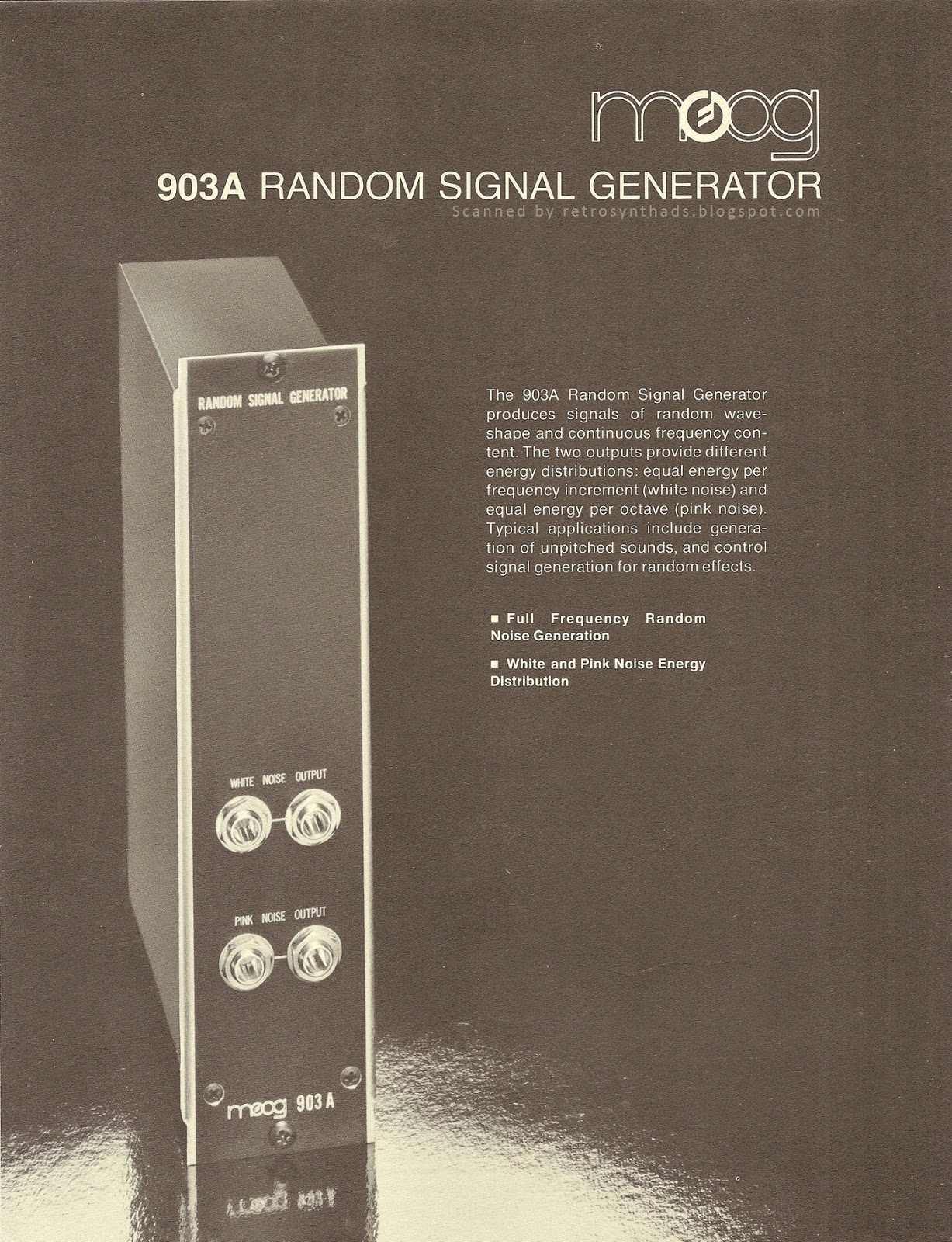
Moog 903a Random Signal Generator brochure, 1976


Moog 903a Random Signal Generator two-sided brochure from 1976.

For the last couple of weeks I've been swooned by a series of Moog module brochures. This 903 Random Signal Generator brochure is the third in the series - after blogging on the Moog 921a/b oscillator bank and the Moog 921 voltage controlled oscillator module.

http://retrosynthads.blogspot.ca/2014/09/moog-921a-oscillator-driver921b-voltage.html http://retrosynthads.blogspot.ca/2014/09/moog-921-voltage-controlled-oscillator.html

I gotta say, this series is shaping up to become a handsome set of brochures with those lovely front covers. Sweet.

There is one little difference with this latest brochure though. Those first two brochures each included four pages of juicy Moog-y goodness, but this latest 903a random generator module brochure consists of only one two-sided piece of paper. It's not a surprise though - that 903 panel is sparse-city, consisting of just dual white noise and pink noise outputs.  No big dials, switches or flashing lights in the local vicinity.

That may give someone not familiar with noise generators the wrong idea. A noise module is a MUST for any modular. The back of the brochure goes into some good detail on how noise can be used effectively within a patch. Percussive sounds - check! Sound effects - yup!  And of course there's the signal control applications as well like their involvement in creating randomly timed and tuned beep, boop, boop, beep, boops.

Growing up I loved noise. Not the really loud variety of clanging and banging (that came later) but that soothing noise that I find described so well by William Gibson in the opening line of Neuromancer:

"The sky above the port was the color of television, tuned to a dead channel."

I love that quote. and I also love the sound that often accompanied that screen "color" late at night when a television channel went off the air. SSHSHSHSHSHSHSHSH...

It wasn't until I got my Moog modular that I realized there was different "colours" of noise. And even then I wasn't too curious what the differences were for a long time. If you Google the topic you will soon learn there are a wack of different "colours "of noise - and as math is introduced into the equation (pun intended) if you are like me your head will begin to hurt a little bit.

According to Wikipedia, noise tends to be divided into two groups.

The first group are those colours of noise that have precise definitions:

White. Pink. Brown(ian). Blue. Violet. Grey.

In the case of this module, White noise has a "flat" frequency spectrum - "the signal has equal power in any band of a given bandwidth... when the bandwidth is measured in Hz". The example they use is that the sound power between the frequency range of 40Hz and 60Hz is equal to the sound power between 400Hz and 420Hz. Here's the chart for white noise from the Wikipedia page.


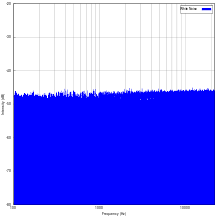
Pink noise, on the other hand, is linear in logarithmic space - "it has equal power in bands that are proportionally wide". Using the same example above, there is the same amount of sound power between 40Hz and 60Hz as there is between 4000-6000Hz. Now compare its spectrum chart below to the one for White noise above.

The visuals definitely help. :)

The second group are those with less precise definitions, synonyms for formally defined colours, or have multiple definitions - Red. Green. Black. Noisey White. Noisey Black.

I'm not even going to pretend I know *exactly*what they are talking about, but I get the idea.

I'll let you read the Wikipedia page to find out more info.

My head hurts.   :D

Monday, September 15, 2014

Moog 921 Voltage Controlled Oscillator brochure, 1974


Moog 921 Voltage Controlled Oscillator four page brochure from 1974.

Last week I posted the brochure for the 921a/b VCO bank from the same series. This 921 VCO is like the Simon to the Garfunkel of the 921a/b bank. The Captain to the Tennille.

Actually, maybe I should be using synthpop references. The Annie Lennox to the Dave Stewart of Eurythmics. The Vince Clarke to the Alison Moyet of Yazoo. The Neil Tennant to the Chris Lowe of Pet Shop Boys. The Marc Almond to the Dave Ball of Soft Cell. The Rob Fisher to the Peter Byrne of Naked Eyes. The Neil Authur to the Stephen Luschombe of Blancmange.

Okay, think I milked that one. Point is, chances are you will find both 921s and 921a/b banks making beautiful music together in a Moog Modular.

I mentioned in my last post how researched seemed to indicate that the 921 series came to be in part because the Moog Modular was transitioning from an experimental machine found mostly in music "labs" to that of a musical instrument to be found in some of the top professional recording studios. In particular, the 901 series was replaced by the 921 series with their better temperature stability, tracking accuracy and extra functionality - requirements when trying to churn out the next top 40 hit.

But these modulars were highly technical machines. And they required some technical knowledge to get up and running (and keep going).  Thus, this brochure is NOT marketing Moog modules to the average musician. And I'm not even sure if its directed towards the average studio tech either, although I wasn't hanging around in studios back in 1974 so can't really comment to their technical knowledge. The highly technical content leads me to believe this series of brochures was still being targeted towards the music lab gurus - and probably only the ones with the whitest lab coats, biggest pocket protectors and (in reference to the men) the biggest beards.

Aside: before you knock me for my nerd-bashing, I will have you know that I wear a pocket protector every day at work, and usually a different every day. Geeez - how else do people protect their pockets these days?!?! So, if you have any vintage (or new!) pocket protectors, please contact me! I'm serious.

Back to the point... were was I... oh yeah... targeted audiences.

To make my point, let's compare this brochure to the marketing material of another one of Moog's legendary products - the Minimoog.

http://retrosynthads.blogspot.ca/2012/10/moog-minimoog-you-know-what-this-is.html
Minimoog

No text whatsoever. :)

Yeah, I know - silly comparison. By 1979, the Minimoog was such a standard tool in the studio that not only did it not need more than 10 words of marketing content, but Moog didn't even have to slap a logo in their ad. So, okay, a totally shitty comparison.

A better comparison might be Minimoog's 1972 brochure. Here's the inside scan that links to the blog post.

http://retrosynthads.blogspot.ca/2010/05/moog-minimoog-brochure-instrument-of.html

So, this Minimoog brochure was printed TWO YEARS before the 1974 921 VCO brochure.

Let's compare the first real line of content of the two brochures:

921 VCO
"The 921 Voltage Controlled Oscillator generates periodic waveforms within a total frequency range from .01 to 40,000 cycles per second."

Minimoog
"Brutal, caustic, volcanic - Evocative, flirting, caressing - crisp, powerful, biting - Entrancing, embracing, exhilarating!"

Yup. Definitely different audiences. :)

That 921 VCO brochure content is definitely targeted towards those pocket-protected white-lab-coat-wearing music technicians while the text in that Minimoog brochure was obviously meant for the  tight-shiny-gold-pants crowd.

To be fair, there was some cross over between these two groups. And I have to say, those men and women in the lab coats *and* tight gold pants were definitely the most awesome.

I'm not saying Moog didn't create modular marketing material for a musician audience, I'm just saying this series of brochures was definitely not. 


Monday, September 8, 2014

Moog 921A Oscillator Driver/921B Voltage Controlled Oscillator brochure, 1976


Moog 921A Oscillator Driver/921B Voltage Controlled Oscillator four page brochure from 1976.

I knew it had been a while since I last published a blog post, but I didn't realize it has been about a month! Honestly, I have a wack of ads and brochures scanned, but just haven't been able to find the time to find the words. Summer and its ups and downs have gotten in the way a little bit.

But fall is now here! And although its been a pretty rainy one to date, this morning I'm happy to report I'm blogging from my sunny back deck, coffee in hand.

Perfect blogging weather. :)

I've been wanting to start posting this series of Moog module brochures for a while and the 921a/b was an excellent one to start with because there is some great history behind it.

As you may know from previous posts, I'm a big fan of Moog. I'm also an owner of a Modular Moog (see right). Although my modular contains the 901a/b VCO bank - the predecessor to the 921a/b bank - it provides a great back-story to existence of both.

Let's back up a bit. As you can see in my modular's patch diagram (created by Bob Moog himself!), there is both a 901 Voltage Controlled Oscillator as well as the 901 a/b bank that contains one 901a driver that is wired up to control (drive) three 901b VCOs. What's the point of having the 901a/b bank if you could just have 901s?

For a long time I thought the only reasons the 901a/b bank existed was because it was a great way to cram more VCOs into a smaller space. The 901 takes up a lot of room, so getting three or four 901b VCOs with multiple waveforms into the same space really was one convenience of its design. But then I found an even more valuable reason for the a/b driver system a while back when doing some research on my modules.

A PDF article titled "The 901a/b story"  found on synth-werk.com (a company that is building Moog modules!) explains that as the Moog Modular transitioned from a piece of experimental equipment to more of a musical instrument to be found sitting in professional studios and on stage, the 901's thermal instability and older electronic components resulted in problems with tuning. This was fixed to some degree by driving multiple 901b modules from one 901a controller. But, they were still pretty unstable, so Moog eventually replaced the 901 series with the 921 series giving musicians a lot more temperature stability, tracking accuracy and extra functionality.

Great stuff. And so is synth-werks as far I can tell. Definitely going to look into filling that top space in my modular. :)

The brochure/spec sheet is almost as much of a work of art as the 921a/b modules themselves. First and foremost, we get a great close-up of both modules on the front page. Then when you open the brochure up you are greeted with a wealth of knowledge - in fact, pretty much everything you've ever wanted to know about the control panel features and musical applications of the 921a/b. There is even a full page of technical charts and graphs. I'm not even going to pretend I know half of what Moog is talking about there. I'll take their word for it. Finally on the back page we get all the information specs.

I'm a fan of this whole series of module brochures, and you can expect to see more of them soon. But right now its just too nice out. Time to make the most of this gorgeous Sunday. 

Monday, February 17, 2014

Sequential Circuits Inc. Prophet-10 "The Most Complete Keyboard Instrument Available Today" reference brochure - 1980


Sequential Circuits Inc. Prophet-10 "The Most Complete Keyboard Instrument Available Today" four page reference brochure (spec sheet) from approx. 1980.

Wait! I know it looks familiar.

http://retrosynthads.blogspot.ca/2014/02/sequential-circuits-inc-prophet-5.htmlYou might easily mistake it for the Prophet-5 spec sheet I posted last week. But trust me, it ain't.

Flip open this spec sheet and the first thing you'll find is that classic Prophet-10 photo seen in books and all over the Web. And even though this brochure is over 20 years old and that photo is in black and white, you can smell those wood side panels.

At first glance, it might look like Sequential did a bit of recycling of photos between the Prophet-5 and Prophet-10 brochures, especially that second photo on the left-inside page of the Poly-Mod/LFO/Mono-Mod sections. But closer inspection will show that they are indeed two different photos, with knobs in different positions.

Where possible, some content has been recycled - the Poly-Mod, the LFO, Mixer and Filter sections in particular. But there is just so much more content to pack into the Prophet-10. That back page is especially packed with some goodies including the Polyphonic Sequencer Option section. For some reason, I was never aware of the built-in micro cassette for sequencer and program storage. I knew it had a sequencer, but internal micro cassette storage on a 1980's synth kinda blows my mind.

Like that Prophet-5 spec sheet, I have given this reference sheet a print date of 1980, but it could just as easily been printed as early as mid-1979 when the Prophet-10 specs appeared in Contemporary Keyboard's July 1979 spec-sheet write-up. I originally included that write-up, as well as the Prophet-10 advertising timeline back in a January 2011 post for the instrument. Definitely worth a look back if you are interested.

So - because I ended the Prophet-5 post with a YouTube video, I thought I would share this dual Prophet-10 video one with you. Dude is really rockin' it.

 Enjoy  :)

Monday, February 10, 2014

Sequential Circuits Inc. Prophet-5 "The Completely Programmable Polyphonic Synthesizer" reference brochure - 1980


Sequential Circuits Inc. Prophet-5 "The Completely Programmable Polyphonic Synthesizer" reference brochure (spec sheet) from approx. 1980.

Four pages of comfy, warm Prophet-5 goodness. What's not to like when your eyeballs can be sun-bathed in hip retro-font front-cover goodness, awesomely bright and sunny up-close and personal photography and, best of all - lots of tropical, beachy, sand-in-your-toes, reference informa... eeeer....

So, re-reading that above paragraph, one might guess that my part of the world may be going through an unprecedented looooong stretch of snowy, blizzardly, winterly coldly-cold weather.

Yes, COLDLY-COLD.

And after that stupid ground hog bolted back into his hole after seeing his shadow a week or so back, I'm trying desperately to incorporate fuzzy, warm thoughts into everything I do as I eagerly await the return of the warmth of Spring.

But back to the Prophet-5 - and one of the things I love most about it (and other Prophets too). Which is to say that there is something to be said for a clearly laid out front panel. Design is design is design - whether you are talking about the white space in an ad so it can be clearly read and processed, or a logically organized front panel with high-contract controls and labels that are easy to see and reach for when needed.

As I get older and have less time to actually hunker down and play in the studio, I find that when I do have time to work on music I tend to reach for gear that will give me quick access to sound editing - and that usually means keyboards with knobs. And a clearly and logically laid-out panel helps keep me in the zone while i'm doing this.

Compare that nice, simple Prophet-5 front panel to say... a Roland JP8080. I love my JP8080. Its fun. Its powerful. And it has a great sound. But, like most gear in the studio that I can't bring to the bedroom with me (I know you do it too!), I don't get to play on it a lot. And when I do have a hankering for some smooth Roland bubbly goodness, I reach over to the front panel and... [SCREEEECH!]

Yup. I'm suddenly out of the zone. I have to look around to figure out where everything is again. My brain has to take time away from music making to re-learn that front panel display.

To be clear, this isn't necessarily a JP8080 problem. It has to pack a lot of controls into a relatively small 19-inch rack space. All I'm saying is that the less I'm in the studio, the less and less I reach for this piece of kit. So, yeah - this definitely isn't a JP8080 problem. This is a "me-problem" of not spending enough time in the studio. :)

Well, enough complaining. I'm old.

Although there is no date stamped anywhere on this Spec Sheet, I've dated it 1980 for the simple fact that the font panel photo includes the cassette interface found standard on the Rev. 3 Prophet-5s in the top-right corner.

I did a quick search and found this great video (well... audio) of the Prophet-5's original factory program interface cassette. This is the DATA cassette, so I don't recommend listening to it unless you really like the sound of 90's dial-up modems. But, I couldn't resist posting due to the fact that the background of the video looks really really warm and sunny.

Hurry Spring, hurry... faster Spring, faster.