Showing posts with label string ensemble. Show all posts

Thursday, December 17, 2020

ARP "Meet the Carpenters new string ensemble" ad, Downbeat Magazine 1975


ARP "Meet the Carpenters new string ensemble" black and white advertisement from the March 27, 1975 issue of Downbeat Magazine 1975.

I'm a cookie addict. As someone who likes to eat. As an online marketing professional. As a curator/archivist. Yum! But more about that in a sec...

Following hot on the heels of my post about ARP's 1975 advertisement that featured Pete Townshend of The Who and his 2600 is this lovely promo featuring the Carpenters and ARP's String Ensemble. As far as I can tell, this advertisement showed up in various issues in a few different publications in 1974 and 1975, but I've even seen it referenced in 1976 as well. 

It's interesting that it got so much page time, so rather than blog about The Carpenters, a band I unsurprisingly know very little about, I thought I'd take a look at the marketing side of things. In particular, the little "cookie" that followed this, and many other ads around like gum on a shoe to tell the company where someone saw this advertisement.

In a way, it's similar to the common digital cookie that can end up following you around the web, annoying you with an ad for a Home Depot lawn mower you were looking at earlier in the day. ARP placed a cookie in the mail-in section of many of their ads, so if you bothered to fill it out and mail it in, ARP knew you were responding to this very specific advertisement.  You can see that cookie in the close-up below (red box). 


DB 1-16-75. 

Downbeat, January 16, 1975. 

I can hear you say "but you said this advertisement was from the March 27, 1975 issue!" It sure was, but the advertising campaign or budget utilizing this ad probably first appeared in the January issue. Smart. 

If you look closely at the Pete Townshend ad I posted, it has a DB 6-5-75 cookie, so that particular ad campaign probably began in the June 5, 1975 issue of Downbeat - the one I scanned! And, if you compare it to the same ARP/Pete ad that appeared in the May 22, 1975 issue of Rolling Stone, you can see it uses a different code - RS-142. 


So, RS = Rolling Stone. But what the heck is that 142? Well... 

I'm not sure. No, really. Not sure at all. 

The May 22, 1975 issue of Rolling Stone was issue 187. Since Rolling Stone was produced bi-weekly (I think?!?!) at that point, it would mean that if that number referred to the issue number, the first appearance of this ad would be almost two years before. Which doesn't appear likely. So, yeah. Still a mystery. 

But the point is, when all those cut-out return forms start making their way back home, those little cookies let ARP have a better idea of which ad in which magazine worked best to get you to respond.  

When I first started noticing these cookies in magazines, I first thought maybe the code wasn't a company code at all - maybe it was included by the magazine as a courtesy or to show the company that got the form back that the reader saw the ad in that particular magazine. To try and solve this question, I started looking at other ads that included mail-ins. 

Sure enough, many other ads included a little cookie in their clip-out sections as well. But, the cookie in different ads were often in different formats. For example, in that same issue of Rolling Stone that the ARP RS-142 cookie is found, we also get the company below using a fictitious department called "Dept RS" as the cookie. This is interesting because if the reader decides they don't want to cut out the form from their precious magazine, they would still use this address to write to the company and the company would STILL know how the reader found them since the address on the letter would have included the cookie. 


Another ad for a reggae record from the same Rolling Stone mag used the PO Box (Box 6/RS) for their cookie:


"Feelin' High". Ha! Yes, I'm nine years old. 

And finally, this Monty Python ad below from the same mag has just a little "rs" in the bottom right corner. Adorable. 


I've seen them in all manner of magazines. Those I collect - like Contemporary Keyboard/Keyboard, Electronic Musician, Electronics & Music Maker,  etc... as well as magazines I just happen to be flipping through at a friends house or online. From the 70s to the 90s and beyond. Those little cookies are everywhere. 

I get especially excited when I see an ad with a cookie, but the cookie is for a different magazine entirely. It's like someone forgot to update the ad for the new mag.  That's pure adrenaline! Makes my day.

Once I started looking for them, I couldn't stop, and to this day I still look for them.

Now you will too! You got lots of time during your covid lock down anyways.

Thursday, May 27, 2010

ARP family of products, Contemporary Keyboard 1976


ARP Family of Products advertisement from page 24 and 25 of Contemporary Keyboard Magazine, May/June 1976.

ARP took a very interesting approach with this two-page ad.

The two previous issues of CK included an ARP 'family' advertisement that focused squarely on ARP's road-reliability, along with a good-sized helping of classic name-dropping.

Then they come out with this advertisement. Although it starts off with another big dollop of name-dropping, it soon takes a totally different sales approach than the previous ad.

ARP first points out a few facts about performance and quality. Never one to pull a punch, they take direct aim at Moog with the ever-popular slider-vs-rotary argument:
"ARP slide controls outperform hard-to-read rotary knobs".
(Moog's response: "Just try to accurately tune an all-slider instrument!")

ARP continues the attack on many of their competitors with:
"We build ARPs with expensive, industrial-grade circuitry. You won't find any chrome-plated plastic or paper based circuit boards inside an ARP."
Kapow!

With the bad-cop routine over with, ARP then goes into the soft-sell approach by providing a few educational facts, letting you know how easy it is to learn to play an ARP synthesizer and how you can grow your studio by 'adding-on, not trading in'.

And then. Finally... they hit you with the real pitch.

Buy our manuals for only a couple of bucks and see for yourself.

Like I said - it is an interesting approach and a common sales technique I've seen used in stores and at trade shows. Always try and put whatever you are selling into the hands of a potential buyer. And if you can't get the real thing in their hands, get the info into their hands.

In this case, ARP is enticing readers to buy an ARP manual BEFORE buying a synthesizer. Let's get this straight... they aren't asking you to send in for a free brochure with a bit of promotional material - they are actually getting readers to spend real cash on a manual. And once a reader has an ARP manual in their hands, it will be much easier to convince that reader to buy an ARP synthesizer.

I've bought enough synthesizers in my lifetime to know that I can justify a purchase if I've convinced myself I've done the research. And if I've spent money on that research, I can now convince myself to call that research an 'investment'. :o)

Smart thinking on ARP's part. And even smarter to sell 'learning synthesis' books that focus on their synthesizers. The more I think about it, the more I like this ad.

But you know what I like most about this advertisement?

It's like my own personal checklist of ARP stuff. Seriously - if you are into ARP paraphernalia like I am, this ad pretty much spells out some, if not most, of the great stuff that was available from ARP at the time. Even better is that the list in the advertisement is a great starting point for online searches for more information.

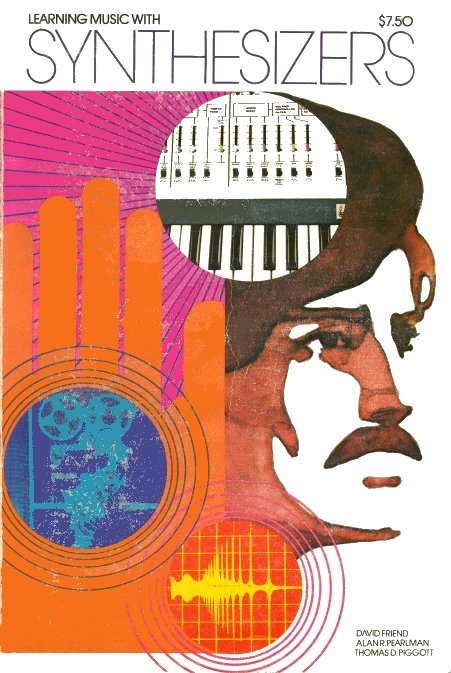
Take the first item in the order form: "Odyssey - Learning Music with Synthesizers". Over 200 pages of experiments and electronic music discussion based on the ARP Odyssey! One quick Google search and you are taken straight to the comprehensive Web site arpodyssey.com. That Web site provides images of the covers of both the first and second editions, and goes on to describe the book:
"Part I of this book is a theoretical introduction to the the science of synthesizers. Part II is a hands-on guide that walks you through principles learned in Part I on the actual ARP Odyssey. Part III gets into experimentation and studio techniques (admittedly of the 1970's).
Now I know exactly what to look for in my eBay search. :o)

Yup - the more I think about it, the more I like this ad.

Thursday, October 15, 2009

ARP 1976 family of products, Contemporary Keyboard 1976


ARP advertisement of its 1976 family of products including the ARP Odyssey, ARP Pro Soloist, ARP Axxe, ARP String Ensemble, ARP 2600, ARP Explorer, and ARP Little Brother from back inside-cover of Contemporary Keyboard Magazine March/April 1976.

Time to add another family photo to the blog!

As noted in previous blog posts, ARP used musician endorsements more than most to help sell their instruments and this ad is no exception. But they satisfied the gear-heads as well by providing a delicious family photo that included all of ARP's latest wares.

The ARP marketing team must also have known that this was a great issue of CK to showcase their whole collection, because it just happened to also include a good-sized article on one of the big-wigs of ARP - David Friend.

The article, written by Hans Klein and simply titled 'David Friend of ARP Instruments' is a great read from a historical perspective of the company. It is also a great journey into the mind of David Friend. The Article starts with a bit of Friend's history including his work towards a double major in music and engineering at Yale, and how he came to meet ARP's founder Alan R. Pearlman (ARP). As I continued to read through the article, it became clear why Friend was "credited with ARP's 'human engineering' in synthesizer design."

For example, it is obvious that Friend cared about designing synthesizers that would be easy to perform with. He knew it would take time for most of the musicians who were still used to the relatively non-expressive electric pianos and organs to become familiar with the expressive performance tools and techniques available with a synthesizer:
"The surface has barely been scratched... Since 75% of the synthesizers sold have been sold in the last three years, it's not surprising that most of the people using them today are still doing so in a fairly unsophisticated, elementary way."
Friend also had (what CK called) some 'provocative comments' about monophonic and polyphonic synthesizers and their separate uses, including:
"Polyphonic and monophonic instruments are played completely differently, and have to be used in different types of music. A melody is by its very nature generally one note at a time. People who play trumpet, saxophone, or other traditional lead-line instruments have never felt any resentment about the fact that they couldn't play a chord, because that's not what the playing of that instrument is all about. "
His recognition of musicians other than keyboardists was most likely what led Friend to try to find ways to get non-keyboard musicians interested in synthesizers:
"For many musicians, the keyboard may be their second instrument, or they may want to process their first instrument's signal through the synthesizer. I expect that as time goes on, more specialized types of synthesizers will be available, that can be played using techniques that are more familiar to people who play other instruments."
In my mind, this thinking led directly to the production of the ARP Avatar - an instrument that was developed to be used by guitar players to control a synthesizer. But the pitch-to-voltage converters weren't the greatest and the instrument didn't do well in the marketplace. According to an April 1983 Keyboard article entitled 'The Rise and Fall of ARP Instruments' by Craig Waters, Pearlman recalled later about the Avatar - "Essentially, we blew our brains out on that instrument." Ouch.

Friend's comments in the article often reached outside the world of synthesizer design. For example, he also observed how the synthesizer was going to expand upon and become an important part of the familiar 'hook' to be found at the beginning of many future hit songs:
"A skillful musician can use the synthesizer to create a musical signature for a song that makes it immediately identifiable to the listener, and that instant recognition factor seems to be one of the necessary ingredients in making a hit record."
It was Friend's ability to look at synthesizer design from a musician's point of view that helped ARP build performance-friendly instruments and this article captures this point of view perfectly.

Lastly, one more quote from the article - a single sentence by Friend that pretty much explains the current state of my bank account:
"Every keyboard player I know has more keyboards this year than he had last year, and I think that's a healthy trend that should continue."
Could he really have predicted 'gear lust'?