Showing posts with label modular. Show all posts

Friday, September 4, 2020

ARP 2500 modular "The ARP electronic music synthesizer" brochure and mail-in insert, 1970/71


ARP 2500 "The ARP electronic music synthesizer" 8 page colour brochure and mail-in insert from approximately 1970/71.

Oooooh boy! Here's a doozy. Such a doozy that this post got rather long-winded. My apologies in advance. 

"What? What's so 'doozy' about this?!?!", I hear you say... "I've seen this brochure on tons of sites! BORING!!!!!" 

Well, yes. But no. 

Take a closer look at that front page. That's not ARP's treble clef logo!  And the company name and address is listed as... "Tonus Inc. 45 Kenneth Street, Newton Highlands, Massachusetts. 02162"

TONUS INC. 

Now go take a look at all those other ARP 2500 8-page brochures with a similar front page image. They all have "ARP Instruments, Inc. 320 Needham Street" as the company and street name. 

So, for example, the front page of this September 1972 "The ARP 2500 Electronic Music Synthesizer" brochure on the Internet Archive has the same image, but the title is slightly different, it includes the new more familiar treble clef ARP logo instead of the older Tonus/ARP logo, and it has the later Needham street address at the bottom (see image at right). 

Interestingly, it seems that this same set of September 1972 scans pops up on a few sites, including the ARP 2500 page on soundprograaming.net, but can be traced back to Tim Stinchcombe's awesome set of old synth brochure scans, including this 2500 brochure that was originally scanned by Ben Ward and sent to Tim for posting. Good work!

An even later version of this 2500 brochure dated September 1974 recently went up for auction last August on eBay and some photos can be found on the fabulous MATRIXSYNTH website. Although only six of the eight pages were photographed in the auction, I've managed to find a few differences between the 72 and 74 version. 

For one, in the 1972 brochure, there were five different keyboard models available for the 2500 - 3604, 3001, 3002 3212 and 3222, but in 1974, that list seems to have shrunk down to three models - 2604, 3002 and 3222. And this has lead to some small price differences on four of the six sample systems featured a few pages later. 

Another difference is on the back page where ARP does a little cross advertising of their other synths. In the 1972 brochure, the Odyssey, Pro Soloist, Soloist Mk II and 2600 are featured. But in the 1974 brochure, we see the 2600, Odyssey, Pro Soloist and Explorer. 

But I'm getting off topic... let's get back to *my* brochure.  Not only is the front page different, but so are guts. For example, there is no other instruments being promoted in this earlier brochure. And we definitely don't have as much pricing info scattered throughout. 

All in all, the biggest takeaway from this brochure has gotta be the design. Those lovely colours. That lovely fat font used for much of the titles. And of course those lovely graphics and close-ups of the modules.  I've never taken a closer look at that angel - did you ever notice the different wave forms coming out of the trumpet?!?! GAH!!!

Take my word for it - its worth going down the rabbit hole of the different iterations of this 2500 brochure  - ALL OF THEM!

I gotta say I was pretty proud of myself thinking I had *the earliest* version of this 8-page brochure. So proud I've been strutting down the street like the dude from Saturday Night Fever. But after doing the research, someone out there, of course, happens to have an EVEN EARLIER VERSION!!!!

This earlier version is dated 1969/1970 and I found it as a featured eBay auction from 2017 on MATRIXSYNTH! Unlike my 1970/71 brochure, the front page doesn't include any ARP logo on the front page. Even more cool, is that some of the modules on pages 4 and 5 don't even have photos yet! They are just white spaces with the name of the modules. 


Seriously, just how cool is that. 

And the last page is totally different as well. My version of the brochure has a lot more information about the modules available, and that cool map that we see in future iterations of the brochure as well.

As angry as I am that MAXTRIXSYNTH has outdone me AGAIN *shaking my fists at you!!!!*, I thought I'd return the favour by include two other scans in my post! I haven't seen the mail-in insert that was included in my brochure ANYWHERE else online (although I'm now afraid to look). Either way, its another two pages of cool ARP history. 

Well, that's the end of another blog pos... wait a second!!!

One last point I'd like to make has to do with that map on the back. The one of the left from my brochure (1970ish) has the Kenneth Street location. The one on the right (from the 1972 brochure) is the Needham Street location. 


The new location is literally just down the street - a ten minute walk! And in that 1972 map, they include the location of the "old ARP location" as a reference point. Sweet. 

Maybe more interestingly is looking these locations up on Google Maps. 

The Kenneth Street location looks to be still there, but there's a few differences from the map in the brochure. The house to the Northeast of Tonus Inc. has been replaced by Salon Fabio. And the Power'd Equp building is now the Loyal Companion pet store. But the Liquor store seems to have managed to stand the test of time!


The 1972 Needham Street location is definitely still there. There is even that notch in the south corner that is drawn into the building in the map from the brochure. Looks like its now Inflexxion - a business consulting business, among other things. 


Now, I'm not asking anyone to stalk these location, but the first people to send me a photo of themselves (preferably with an ARP synth) in front of the doors of either location - or inside getting your hair done at Salon Fabio - will get added to the blog post.  :)

This is exactly why I love historical documents such a these. Not just the location info, but having a date on the later document allows me to more accurately estimate print dates of other undated ARP brochures that came after it. 

Okay. I think I'm done now. Phew. 

Monday, April 27, 2015

Aries Music Inc. AR-328 Stereo Reverb and Output module "Make some space for your sounds!" ad, Contemporary Keyboard 1978


Aries Music Inc. AR-328 Stereo Reverb and Output module "Make some space for your sounds" 1/4-page black and white advertisement from page 46 in the March 1978 issue of Contemporary Keyboard.

It's been almost three years since I've blogged about Aries and their ads. Too long.... too long...

As I've mentioned in the past, Aries ads fell into two main categories - general ads about Aries instruments and ads dedicated to the promotion of individual modules.

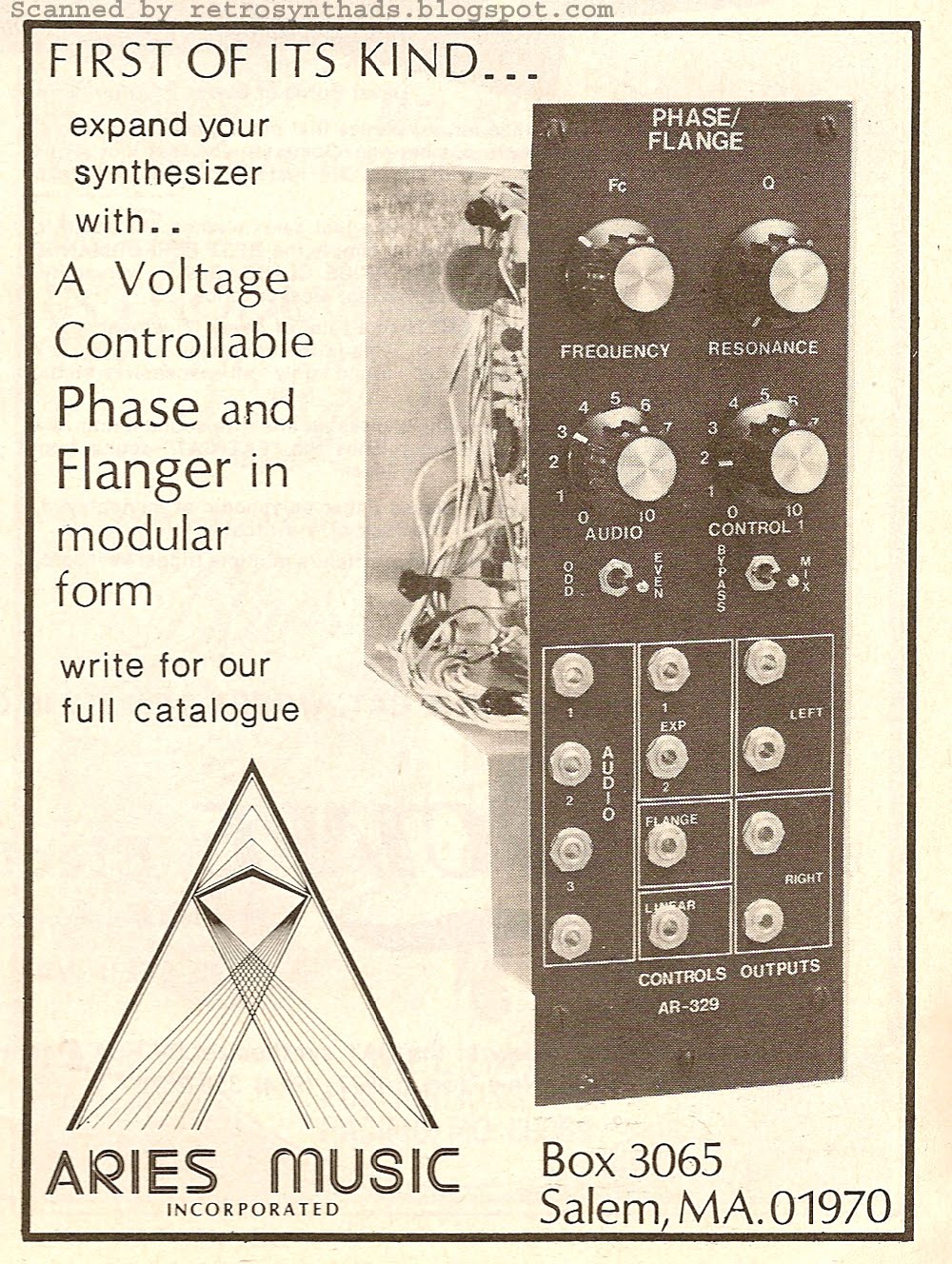
http://retrosynthads.blogspot.ca/2010/07/aries-ar-329-voltage-controlled.htmlThe Aries AR-328 reverb module is the second individual module from Aries to be promoted in Contemporary Keyboard magazine. The first module showed up in the magazine four months earlier in November 1977 and interestingly was also an effects module, labeled "a first of its kind" - a voltage-controllable phase/flange module. (see image right --->)

That first module-specific ad didn't really have too much to say, but this second AR-328 reverb module ad is another story - the ad copy, over time, has become historically interesting for a few reasons.

The first is that it directly mentions the designer of the module - Ron Rivera. According to several sources on the Web including former Aries employee Mark Styles in a "tell me more about Aries modulars" thread on Muff Wigglers, Ron "started doing modifications, and then went on to design some modules" for Aries.

Ken Perrin, commenting on an August 2006 MATRIXSYNTH auction post thread for what can only be described as a mutant ARP/Aries modular monster built by Rivera, said that "Ron Rivera worked at Arp and designed many of the later modules for the Aries Synthesizer. Ron's company was called Rivera Music Services (RMS) and in addition to designing the Aries modules Ron designed a series of modifications and enhancements to the Arp 2600 and the mini-Moog". Indeed, a few RMS ads popped up in Keyboard magazine in the early eighties.

So, that's kinda cool.

Another historical reference in the ad is for a company called O. C. Electronics. "2 Cascade spring delays by O. C. Electronics are included -- giving this the cleanest and most realistic reverb we have found anywhere." A quick Google search brought up some great info on the company.

Accu-Bell Sound Inc's Web site includes a highly information "History of Spring Reverberation" page that includes some great information on the formation of O.C. Electronics from the previously Hammond-owned Gibbs Manufacturing in Jansville, Wisconsin in 1971. When Hammond moved their reverb production to another facility [called Accutronics] "employees at Gibbs decided to start their own reverb manufacturing company called O.C. Electronics, giving Accutronics major competition in the reverb market."

According to the site, O.C. Electronics was known by many service technicians because "of the popular sticker attached to each of their units stating: Made by Beautiful Woman in Janesville, Wisconsin."

Sure enough, another quick Google search brings up this slightly uncomfortable label image from an eevblog.com discussion thread:


Apparently there are "beautiful girls" in Milton, Wisconsin too.

Its hard to make out the actual 238 module in the ad photo. So ModularSynthesis.com comes to the rescue with some great hi-res photos of theAR-328 module itself, including side views with the circuit board. The site's general Aries page is also very informative.

Interestingly, the O. C. Electronics label on the reverb unit itself  does NOT have the "beautiful girls" sticker.

Maybe someone finally figured that one out.

End note: Effects modules make fun modulars.

You'd think I would have figured that out sooner considering I've had my Moog Modular with its lovely spring reverb module for a few decades or more. But honestly, in the early days I hardly ever hooked the reverb up. I was young... naive... I usually just pulled the audio into my mixer dry and sent the signal off to an effects rack. 

What can I say - I was set in my ways.

But now with my Eurorack modular (27U and growing strong!) I've started appreciating the large number of effects modules out there and how they can fit into the signal and control flow of a patch. The Moog Modular reverb module has just two jacks - input and output. But today's units are so much more controllable and I find there is something satisfying about controlling effects using control voltages.

Time to get back to the modular. 

Monday, February 11, 2013

Steiner-Parker Microcon "complete synthesizer" ad, Synapse 1977


Steiner-Parker Microcon "complete synthesizer" black and white 1/2-page advertisement from page 7 in the July/August 1977 issue of Synapse Magazine.

It's been a while since I last blogged about Steiner-Parker. April 22, 2010 to be exact - a half-page advert for S-P's Synthacon and their multi-magazine promotion of a free sequencer with every purchase.

Definitely a good deal.

If there was one thing I remembered about many of S-P's earlier ads, it's that they had balls. Whether it was throwing in a free $500 sequencer with a $1395 synthesizer or going head-to-head with the King of synthesizers. In my mind they were a scrappy bold company ready to take on the world.

But a six-month break from advertising has Steiner-Parker maturing as a company. Out with the bravado. In with the specifications. *A lot* of specs.  This new advertisement for the Microcon is *all* business.

Reading through those specs today, you realize just how ahead of the game they were. The name of the instrument says it all. This was a micro- or smaller sibling of  the big-brother Synthacon synthesizer. And Steiner-Parker managed to package all the basic functions of a synthesizer - VCO, VCF, VCA, LFO, EG - into one compact module. It's a great way for a musician to quickly and easily add to their existing musical set-up while also saving a wack of studio space.

Case-in-point - when first deciding to build my own Eurorack modular to keep my Modular Moog company when I'm away on business, I purposely chose to include a Doepfer A-111-5 Synthesizer module to help save space. A VCO, VCF, VCA, ADSR, and two(!) LFOs in one compact module.  I loved that A-111-5 module so much that when PatchPierre.Net informed me last year that Doepfer was changing the design due to the discontinuation of the CEM3394 chip, I immediately got my dealer to order another one for me. 

But back to the ad - it wasn't just the ad-copy that matured - it was also the design. It's not perfect, but it is a lot more eye-catching than some of their earlier ones. Font sizes are balanced and we get a generous helping of white space. Everything is there - ad-title, ad-copy, large photo, specs. All grown up.

The logo also matured after a brief mid-life crisis. S-P did the adult thing and made the conscious decision to bring back the waveforms image after the name in the logo. They had stopped using those waveforms after the first couple of ads, maybe as a way to save space. But as can be seen in this ad, there is away to fit everything in nicely if you try hard enough. Just feels more like a logo this way.

But the best thing about this ad is the photo. Readers see what appears to be two incarnations of the Microcon -  a stand-alone version in a nice little case as well as a version that looks like it would feel right at home in a modular system.

Reaching in from out of nowhere, the hand looks a little creepy. But having the hand there actually performs two functions. The first is to provide a human element to the Microcon. Now those Microcons aren't sitting all alone and a musician looking at the ad can literally visualize him or herself using the Microcon. The second reason they probably included the hand is to help get across the idea of the Microcon's size. It is about the size of a hand. Itty bitty.

Actually - when I first saw the photo with the hand, I was immediately brought back to the late 1970s. But not in a synthesizer way. In a "Mr. Bill" way.

Mr. Bill was a recurring sketch on Saturday Night Live in the late 70s, and as Wikipedia puts it, "each Mr. Bill episode would start innocently enough but would quickly turn dangerous for Mr. Bill. Along with his dog, Spot, he would suffer various indignities inflicted by 'Mr. Hands,' a man seen only as a pair of hands".


 Every time I see this ad, I expect that poor Microcon to suffer various indignities. Giggle.

This particular Microcon advertisement only seemed to have appeared once, but there were more Microcon ads to come. Next time!

Thursday, January 10, 2013

Dennis Electronics "Expand your synthesizer!" ads, Synapse 1978


Dennis Electronics "Expand your synthesizer!" 1/9th-page black and white advertisements from page 39 in the March/April 1978 and page 38 in the May/June 1978 issues of Synapse Magazine.

If you've been reading the last few posts, you know Dennis Electronics about as well as I do. Sure, I'm interested in the gear the company manufactured, but it's also been about piecing together as much of the history as I can. I wanted to find out as much as I could about Dennis, and get the info online and into search engines with the hope that someone with more information, even Dennis himself (if he is an actual person), would come across it and fill in a few blanks.

So far I've posted the initial VCO module 1/4-pager that appeared in the July/August 1977 issue of Synapse and the rather dull follow-up Control Voltage Processor 1/12th-page ads that appeared in the two following issues. And in all that time I've learned very little about the company and the modules.

But finally, these slightly larger 1/9th-page ads provide the space required to give us a lot more information about the Dennis 201 Control Voltage Processor. And, just like in the those earlier two 1/12th-pagers, the copy-writer had twiddled the ad a little between the first and second version to make in more effective.

In the first March/April 1978 advertisement ("13 modules in 1") readers finally got to know exactly what a Dennis CVP module contains. And, they get to see what it looks like too. That photo may be small, but you can still pick out some of the jacks, dials and switches. And there were more than a few of them.

Other tidbits of knowledge:
  • a call to action - ORDER NOW
  • a price -$299.00  (jackpot!)
  • and the accessories that come with the unit - power supply and mahogany cabinet
Not too shabby, and it gets better.

In the follow-up ad, the description turns from what is available on the module to what the module can process. And, as noted above, we gain a few more tidbits of knowledge from the tweaked ad-copy in this later version.
  • comes with detailed instructions
  • a catalog was available for 25 cents
All that juicy information, packaged up and nicely organized into that small little space. With room for white space to boot.

And it could be said that Dennis had good timing too. With that first ad in the March/April 1978 issue, we also find out in the Notes from the Editors section that Synapse had grown from its humble beginnings to over 7000 subscribers. And that doesn't include all the non-subscribers out there picking up the issue from their ever-expanding list of distributors. A sizable module-synth-loving audience.

Unfortunately, this looks like the beginning of the end for Dennis - in Synapse anyways. These were the last two ads that I could find. The company kept appearing in Listings section up to and including the January/February 1979 issue. But by the Summer 1979 issue, Synapse had done away with their "Listings" section, I'm guessing because in a way it was giving away free advertising.

I did do a bit more of an exhaustive search online once I could include "control voltage processor" in my searches and came across a few online references. Interestingly, the more common reference was in relation to the creation of the Sequential Circuits Prophet VS!

Side note: For those not familiar with the awesome Prophet VS, it was awesome and rather unique mid-80s synthesizer that allowed the programmer to use a joystick to blend four different waveforms over time. The results are some seriously awesome sounds.

 Lord Frito (I'm not kidding) posted an article by Chris Meyer, ex-employee of Sequential from the VS WaveWrangler User Guide from 1991 (and updated July 1999 and June 2001 by the author) called "The Birth of the Prophet". Simply put, the author was looking at the way the PPG handled waveform cross-fades and he started thinking about how to cross-fade in two dimensions rather than one. He ended leaving the office to "patch it up at home on my rag-tag modular synthesizer".

That "rag-tag" modular he is referring to is an amazing assortment of synth components. The full article is an interested read, but if you are too lazy or don't have time time to click on the link, I've included those paragraphs below:
"For some reason, I was originally convinced that all four waveforms had to be at exactly the same frequency, with their only differences being their waveshape (and therefore, timbre). I plunged into my already heavily-modified Oberheim TVS 1-A (Two Voice Synthesizer - a pair of old SEM modulars, a sequencer, and a three octave keyboard in a road case) and found a way to sync all four oscillators. I then dialed up four different waveforms by playing with the waveshapes, sync tuning, and filters. Since the TVS has only two filters, to create more variations I used my hand-built linear-based PAiA modular for the other two, employing a Korg MS-02 exponential-to-linear control voltage converter to make sure they all tracked the Oberheim's keyboard together.

I then patched the four resulting VCAs from a custom cabinet built by Gentle Electric, using the various control voltage mixers built into it and the inverters and bias offsets in a Dennis Electronics Control Voltage Processor to perform the crossfades. The timbre mix was animated by envelopes from a Sequential Model 700 programmer and an LFO patched in from the Oberheim. This was all mixed together and fed into a final VCA, also controlled from the Oberheim. In the end, one voice took up almost my entire collection of analog synths, spread across modules from six different manufacturers."
D. R. O. O. L.

How awesome is that!  I haven't seen name-dropping like that since a late 1970's ARP post.  :)

The second reference could be argued to be almost as historically significant as Dennis Electronics role in the development of the VS. 

An Electronotes index listing from Tim Stinchcombe's Web site includes the name of an employee - D. Genovese - in an article title in Volume 10, issue 88 (1978)
"A. Envelope Follower With Improved Ripple And Response Time (D. Genovese, Dennis Elect.)"
 Further searches didn't bring up anything noteworthy. But I didn't spend a lot of time (work, work, work!) - so there could be more to dig up for those with time to spare.

But that brings my Dennis Electronics fact-finding missipon to an end for now. Dug up some good info, but  unfortunately didn't end up finding out where Dennis Electronics ended up. Did they get out of the business completely? Did the owner or employees end up working at larger, more successful companies?

Like many creatures of the lost ages, they popped up onto the timeline for a brief period and played their role in the evolution of synthesizers.

And then just disappeared.

Monday, January 7, 2013

Dennis Electronics "Expand/Increase your synthesizer's capabilities..." ads, Synapse 1977/78


Dennis Electronics "Increase your synthesizer's capabilities..." and "Expand your synthesizer's capabilities..." 1/12-page black and white advertisements from page 36 in the November/December 1977 and page 50 of the January/February  1978 issues of Synapse Magazine.

If you recall, my last blog post focused on a small Honolulu-based synth manufacturer called Dennis Electronics. I had been following a trail through old issues of Synapse Magazine to see if I could find out more info about them.

By the end of the post (and up to the time their first ad appeared in the July/August 1977 issue) I had figured out that they had recently redesigned their "system" and were blowing out their old stock. Their new module was a VCO that used an envelope input to continuously modify the timbre from a sine wave to a "big fat" pulse using a technique the company described as "Dynamic Depth FM technique (through 0)".  I also learned that, unlike some of the other smaller manufacturers of the time period,  Dennis Electronics was not offering their modules as kits.

But oddly, even with the publication of that advertisement, we still didn't have a module name or model number. Just "VCO".  This time, all we get is "Control Voltage Processor". More on Dennis in a second, but  first a small history lesson about the magazine Synapse itself.

Let me back up a bit...

When I first got by grubby little paws on the 1977 and 1978 issues of Synapse as a full lot, I was told it was a complete set. But, the September/October 1977 issue was missing. For a magazine squirrel like myself, missing an issue is a rather troubling matter. It gets under my skin like a creature from Alien whenever I'm flipping through old issues, trying to track down some information. What info was I missing? What nugget of gold was in that issue that I don't know about.

It was until a while later that I learned the truth. There simply was no September/October issue. And the answer had been there in the volume numbers at the top of the mags, and on page 2 of the November/December 1977 issue in the notes from the publishers - Doug Lynner and Chris August.
"Don't get nervous. You haven't missed the September/October Synapse. With our move to increased newstand distribution cover dates have become a bit more critical, so this issue became November/December - no one missed an issue. Volume numbers are still the same. Why don't you relax, buy a six-pack with the cash you'll save by subscribing or renewing  before the end of the year..."
Anyways, the point being that Dennis Electronics continued to be included in the ever-expanding "Listings" section under "Synthesizer Manufacturers" in the November/December 1977 and January/February 1978 issues of Synapse. And so telling that little cover-date story will make sure I don't get accused of glossing over a missing September/October issue by some eagle-eyed reader.

And, more importantly, the fact that its an awesome little piece of Synapse history! Much like when Keyboard misprinted the date on their October 1982 issue or dropped the word "Contemporary" from their title.

So, where was I... oh yeah... Dennis continued to appear in the "Listings" section at the back of the magazine. Unfortunately, unlike that Listings section, Dennis ads were NOT expanding. The exact opposite. The next two ads to appear in the magazine were these two 1/12th-page advertisements.

Although they are simple little ads, they are also simple little examples of how a good copy-writer can make all the difference.  In that first advertisement, the copy is a little awkward with a touch of verbal diarrhea. In comparison, that second shorter version just flows like melted butter in a reader's mind.
"Increase your synthesizer's capabilities many fold"
compared to
"Expand your synthesizer's capabilities"
So it will expand my synth's capabilities. Okay.

But how? Even a 1/12-page ad can contain too little information.

And now what? There is no call to action.

Even a simple "Write for more information" or "Write for a free catalog" would have helped this ad out. I'm all for white space, even in smaller ads, but a little bit more information and a call might seduce just a few more readers to slap a stamp on an envelope.

I'm not saying you have to go full-on-used-car-tv-commercial-like on reader's @sses like this CFR Associates/Tau Systems 1230 VCO module advertisement from the same issue as the first Dennis ad I've posted today. It may contain more fonts that a 1991 rave flyer and verge on unreadability, but it is more visually interesting and contains other bits of info like price, call to action and so on.


Luckily, it wouldn't be long before Dennis finally figured it out. But would it be too late?

Thursday, July 12, 2012

Aries Music Inc. Modular Synthesizer ad, Contemporary Keyboard 1978


Aries Music Inc. 1/4-page black and white modular synthesizer advertisement from page 38 in the February 1978 issue of Contemporary Keyboard.

I gotta say this Aries ad really starts to freak me out after a vodka cooler or two. Yes, vodka cooler. Don't judge.

The last Aries ad I posted didn't have any type of imagery included, and the ones before that, like this voltage controllable phase and flanger usually included a photo. I've included a few examples below.


But this latest one puts Aries ads on a whole new psychedelic level. My ex is a scientist, and those images look like phytoplankton or algae or whatever drawings she would create after peering into her microscope. No kidding.

I'm not saying I hate it - in fact I'm drawn to it. Like a moth to a flame.

Any ways, I think one of their best messages gets a little lost in this advertisement:
"We think musicians want performance over packaging".
 It's surrounded by all that talk of kits and choice and stuff. Those are good messages for sure - but not as snappy as "performance over packaging". Neat and tidy.

It makes me think back to those Pepsi Challenge taste tests, where Pepsi removed the packaging from both the Coke and Pepsi bottles and asked consumers to compare the taste. True performance over packaging. And no, I'm not getting paid by Pepsi. I think I actually prefer Coke most days. Been a long time since I've had either in a non-diet form.  :D

That second paragraph kind of gets back on message in terms of performance with the promotion of that Aries manual that the Boston School of Electronic Music created.  I wrote a bit about the manual in my last Aries blog post, but quickly got sidetracked by surfing around looking for more info on that electronic school in Boston as well hanging around Robert Leiner's most awesome Aries Web site's home page. That site just happens to have tons of information, scans of catalogs and stuff - and also a mention or two about the manual.


For example, Robert's site has transcribed certain parts of different catalogs and manuals, and the "introduction" link on the left navigation bar will take you to an Aries Music / Series AR-300 Systems Introduction page written by Aries President Bob Snowdale. Near the end of the intro is a good little piece of reference material about the evolution of the manual and what was to come.
"We offer software support for our instruments. We have expanded our Owner's Manual to 143 pages of information, patches, experiments and instruction in the use of the AR-300 Series modules. As we add more modules we add supplements to the manual including information on the new modules. Written by Ken Perrin, our manual is designed to offer basic understanding of and instruction in the use of our instruments.

We have additional manuals planned. One is a series of laboratory experiments in Fourier synthesis for college-level physics instruction. This manual was written by Jerry Lemay and is based on the use of the AR-332 phase-modulated sync VCO's included as part of the Aries Music "Physics" system. Mr. Lemay uses both the manual and the system in classes at Southeastern Massachusetts University. The manual will be available to our customers in the summer of 1979."
Nice! The manual has grown from the original 93 or so pages up to 143 pages - and was to continue to expand!  That introduction also provides some other great information about Aries' business model and customer service. A definite read.

But one of the coolest pieces of the Web I came across while doing a little bit of Googlin' on Aries and manuals was on preservationsound.com. There I found a modular synthesizer article PDF scan from the May 17, 1979 issue of Down Beat, with the rather witty title SynthesizeIt Yourself - Erector Sets for Grownups by John Balleras. Back in 1979, John had this to say about the manual:
"Aires, incidentally, distributes one of the best operating  manuals I've come across. Written by Kenneth L. Perrin and the staff of the Boston School of Electronic Music for use on the Aires 300 system, this text is both theoretically and practically adaptable to any modular synthesizer and to many prepatched ones as well."
The article also mentions other modular manufacturers including EML, Paia, Heathkit, Blacet as well as drops other familiar names and companies such as Craig Anderson, Moog and others.

Go read it.

NOW!  :)

Monday, July 9, 2012

Aries Music Inc. synthesizer manual ad, Contemporary Keyboard 1977


Aries Music Inc. 1/4-page black and white synthesizer manual advertisement from page 50 in the December 1977 issue of Contemporary Keyboard.

I can't believe it's been over two years since I posted my last Aries ad - on July 1, 2010 - Canada Day! It's odd to think that much time as gone by, but then again I knew it was just a matter of time before I was pulled back to that awesome 70's string-art-inspired logo. Yum.

The laws of Aries advertisements (in Contemporary Keyboard Magazine anyways) go something like this:

1. Must include cool logo.
2. Don't run any advertisement more than two or three times, tops.
3. Keep that blogger guy thirty-five years into the future guessing as to what we can advertise next.

This ad follows these rules to a T.  Cool logo? Check. Cool as a cucumber.  Keep ad-run to a minimum? Check. This one seems to have only ran once. And keep me guessing? F@&$ yeah! Will it be their modular? A new module? Kits? A manual... wait... what?

Yup! A manual. For $9.50. But this was apparently not your ordinary manual.

When you are a small company with a limited ad budget, you have to be creative and look for alternative sources of revenue. And if you've spent the time (or asked someone else to spend the time) creating a really good resource - why not pull in some extra cash. But from everything I've heard about Aries the company, I've no doubt that they were sincere in releasing this manual as a "real teaching tool, not a sales tool". Especially if it is coming from the Boston School of Electronic Music.

I did a quick search and although I couldn't find this owner's manual anywhere online, I did find reference to it on Google Books. Or, I'm assuming this is it. The author is listed as Kenneth L. Perrin - who's association with Aries is well known. He can be found in an Aries group photo on Robert Leiner's most awesome Aries Web site's home page.

Top row, far left.

Cool lookin' dude.

The publisher on the Google Books page is listed as The Boston School of Electronic Music - also referenced in association with Ken's name next to the photo on that Aries Web site.

So, what about this Boston School of Electronic Music? BSEM comes up often when I'm doing research on vintage synthesizers and turns out it was a electronic music school in the 70s founded by Jim Michmerhuizen. And speaking of manuals, Jim Michmerhuizen is best known to me as the guy who wrote the ARP 2600 manual. Still sells that on his site. Also on his site is his introduction to BSEM from their 1977 catalog. It's a good introduction of what exactly went on within the walls of the school.

A quick Google search provides more evidence of just how wide the connections between BSEM and vintage synths went. For example, Cynthia Webster, founder of Synapse magazine and creator of Cynthia modular synth modules went there. That same Google search will also bring up Flickr photos of the studio - nice. And although they have not existed for quite some time, they even have a Facebook page with three "likes"! :D

But, back to Kenneth Perrin for a second, because - surprise, surprise - it just so happens that not only was he a writer of manuals, he also wrote a nice little "inside perspective" article on the Boston School of Electronic Music for the March/April 1978 issue of Synapse magazine. Hello!

The article describes BSEM's role - starting out as "an outpost on the edge of a wilderness" to one where students "can learn factual information about electronic music instruments and in which they are exposed to professional standards".

At the time the article was written, the school offered 10 different courses in two semesters dealing with a number of topics including synthesis, music theory, composition and analysis, electronics and math - and was soon to grow to 19 courses over four semesters, including courses on computers (in 1978?!?!?).

There's a lot of other interesting historical pieces of info included in that article - which you can fortunately read online thanks to BSEM grad Cynthia Webster.  :)   And to keep all these connections going... the Aries ad below is printed on the opposite page of that article.


Small world!


Thursday, July 5, 2012

Serge Modular Music Systems brochure, 1981

Outside
Inside
Serge Modular Music Systems mailing brochure from approximately 1981.

I never really dove into Serge gear - maybe because I've never come across it in all my years of synth-ing. Moog and Roland modulars, and more recently Eurorack, were more accessible, and so received most of my attention. This also led me to put Serge on a pedestal somewhat. Or maybe that's not the right word. If I think of it, I'll add it in later.

The next best thing to getting my hands on an actual Serge modular, is to get my hands on Serge documents. Brochures, manuals, etc. And the one that I always came across on the Web - mostly on e-Bay, was this brochure. And I'm sure I was about a day or so away from hitting the relatively expensive "Buy it now" button more than a few times when I came upon this brochure quite by accident.

One of my readers actually contacted me and made a very generous offer to send me a wack of brochures, records, catalogs and sell sheets from the likes of Moog, Aries and Serge - including this beauty - just for shipping costs. After a few back-and-forth emails of me talking him out of it (what?!?!), we came to an agreement that allowed him to make some good money on some really well-kept documents, me winning a few items off eBay and still getting a good deal and a few freebies, and generally good karma all around.

Thanks Stanley! Appreciated!

Like I was saying, every time I saw one of these Serge brochures pop up on eBay I became more and more interested. My curiosity was building to the point that it was almost killing me. I'd seen scans of the brochure's front cover around the Web, and was really intrigued. Mostly, I just wanted to know what that paper felt like in my hand as I read it. It sure looked like it had "weight". Quality. Was it a heavy stock? I had to know.

And I figured if I had to know, others wanted to know too. So, scan it I did. :)

That's front image is actually a little deceiving. I'm so used to Moog-sized modules (even though I've been on a Eurorack streak lately), I always have it in my head that ALL modulars must be huge. But then the other photo with the hand brings it's real size into perspective and I see just how cute this thing is!

The brochure provides a nice overview of Serge Modular, but unfortunately there's no date on it! Luckily, with one quick Google search, I managed to find a transcribed version of parts of this brochure on this Serge Web site that includes the exact same photos. That Web page attached a 1981 date to it so figured I'd give this brochure a 1981 date as well.  That site has a lot of other great info as well including my favorites - history and price lists. Yum. Definitely check it out.

Carbon111 also has a Serge Modular Web page set up with some interesting info including a scan (Zip'd file of PDFs) of "The Original Serge Guidebook" that was apparently shipped with systems in the 70s and 80s. Wow. great stuff.

Quadslope.com also seems to have some good info and is a good jumping off point to Serge forums, music, and videos.

I'm sure a few more Google searches would allow me to dive quite a bit deeper into Serge, but its just too sunny and warm out at the moment. Time to enjoy a nice breakfast outside in the morning sun before starting my work day a little late.

Don't worry, I let my boss know I'd be a little late getting in today.

Just too dang nice out. 

Thursday, May 19, 2011

Moog Modular Professional Systems and modules price list, March 1976


Moog Modular Professional Systems and modules two-sided/three-panel price list from March 1976.

Update: Added to Moog's advertising timeline tool.

Here's one outta the ol' tickle trunk.

This doc just drips with historical info. Sorry it's not in the best of shape - my rather excellent excuse is that it was trashed a long time before it ever got into my hands.

It is definitely not the first Moog doc I've posted with pricing information, but it is probably one of the oldest. And one that comes with a bit more sentimental value, since it came with my modular, along with some other great historical Moog pieces.

Plus, since it came with my modular, it also provides me with a indication of when approximately the system most likely came into the hands of the original owner. Nice.

But to me, one of the coolest thing about this price list has to be that it is Canadian. At the bottom of the middle panel of the first page is a "Distributed by Norlin..." tag, with only a "Scarborough, Ont." location.

I did a quick Google search to try and confirm that the prices were Canadian, and found Synthfool.com's 1974 price list info. Even though that list is from 1974 - two years before this price list was printed - the prices are quite a bit lower, suggesting that the 1976 prices are indeed in Canadian funds.

Even cooler, the price list intro text from Synthfool's 1974 list is very similar to the intro text from this 1976 list. And, the list of modules is almost identical - with the addition of the Bode Frequency Shifter in my 1976 list. This suggests that content for price lists, and probably other Moog materials, were shared between US and Canadian counterparts in some way or another.

A few other interesting historical facts that I hadn't realized until I took a closer look:
  • The System 55 apparently came with "up to 43" patch cords
  • The System 15 and 35 had an alternate version without a Fixed Filter Bank (and was labeled with an "A" after the name; System 15A and System 35A
  • The System 55 had an alternate version without the "Sequencer Complement" and was labeled with an "A" after the name: System 55A
  • Apparently Moog liked the photos of the System 15 and 55 used in this 1976 price list so much that it looks like they used the exact same photos in the 1982 product catalog (last page)!
Great stuff. Time to get back to work.

Thursday, July 1, 2010

Aries AR-329 Voltage Controlled Phase/Flange Module, Contemporary Keyboard 1977


Aries AR-329 Voltage Controlled Phase/Flange Module from page 46 of Contemporary Keyboard Magazine November 1977.

Up until November 1977, Aries ads in both Contemporary Keyboard and Synapse magazine were... well.... they were nothing really outstanding - except for that awesome logo! Take a look at these blogged ads for examples - July 77 CK, August 77 CK, March/April 77 Synapse.

Then, something happened. They found their marketing mojo and came out with this highly-targeted ad in Synapse. Around the same time, the 1/4-page module advertisement you see above came out in CK.

Normally I'm not a fan of smaller ads in magazines, but in this case I'm tempted to make an exception. I think Aries found the perfect format for a relatively low-cost way of advertising single modules - especially if this module was as unique as the ad makes it out to be (and apparently it was). Aries used the space well by including a close up of the module itself, with the text laid out beside, and not on top of, the photo. Clean and simple. The font is almost too simple.

Really, the only real problems with this ad are:

1. As far as I can tell, Aries only ran this advertisement twice - Nov'77 and Jan'78. It would have been much better if this ad had run as many times as possible in succession to get maximum impact.

2. It only ran in Contemporary Keyboard - a magazine that I would think has a more generalized keyboard playing audience. I would be inclined to argue that this ad would have been able to better reach more of its target audience if it had appeared in Synapse. But as was pointed out to me in an email after my last blog post, the average Synapse reader may have been more inclined to take action on an Aries advertisement, but that audience may have been a whole lot smaller than CK. In other words, that small slice of modular owners/builders that read CK may have been larger than Synapse's audience as a whole.

[Reminder to self: find some circulation numbers for these mags.]

So, how unique was this module? Unique enough that Aries though that it deserved its own advertising campaign. And that campaign actually started before the ad came out. You can see the first signs of the promotion in the Spec Sheet section of the previous issue of CK (Oct'77).
"The AR-329 stereo phase/flange module is a voltage-controlled phase shifter with variable resonance. The manufacturer informs us that its signal-to-noise ratio is better than 7-db. the device is compatible with standard 1 volt/octave synthesizers, and both linear and exponential control-voltage inputs are provided. The unit provides 1800 degrees of phase shift at the fundamental frequency. Price is $159.00 in kit form, and $245.00 assembled and tested. Aries Music, Box 3065, Salem, MA 01970"
Synapse included some similar info in their What's New section of the Nov/Dec'77 issue.
"The AR-329 is a voltage controlled phase shifter with variable resonance or "Q" and features 1800 degrees of phase shift at the fundamental."
But, those specs don't tell the whole story.

Robert Leiner, owner of one of the best Aries sites on the Web, has a great technical description of the AR-329 module and specifically mentions how unique it is.
"The AR-329 is a voltage controlled phaser. Usually people think of phasing as a special effect - swooshing, jet-sound, etc. Very few people have had a chance to use a phaser that isn't controlled by an internal oscillator, so fail to discover that a phaser can be uniquely effective timbral modifier."
You can read the rest of Robert's technical description of the module on his Web site.

For more of a musician's description on the AR-329, I naturally turned to Kevin Kissinger, the Aries synthesist from my last blog post. He had some great comments on its unique sound:
"To patch a sine wave to the VC input gives a typical phaser effect -- that is, the comb sweeps up and down as the sine wave's voltage rises and falls. The phased effect is the result of mixing the delayed signal with the primary signal. The Odd/Even switch inverts the phased signal and is very effective.

The "Q" control functions like most "Q" controls -- that is, it controls feedback. The AR-329 is designed to suppress uncontrolled feedback however at the highest Q setting at some input frequencies the AR-329 produces a "glitchy" kind of feedback -- it sounds more like static than clear feedback.

However, if one backs off the input signal (there is a front panel input pot for this) one can run at the highest Q setting and avoid the static. The sound is very throaty -- very colorful -- a lot like a Clavinet.

The AR-329, as are most analog phasers, is a little noisy. When the phaser is at the end of my signal chain, I always noise-gate it with a VCA. If the phaser is fed a steady amplitude signal (i.e., from a VCO or the noise source) then noise is not a problem."
Overall Kevin is very happy with his AR-329 and finds that it can perform outside of its traditional role of a phase/flange.
"Often, I run the module at minimum Q with no CV input and just set it as a form of fixed EQ. This is handy particularly when one wants to vary the amount of "boominess" in the bass.
If anyone else has anything to add about this module, please don't hesitate to leave a comment below or email me.

Oh, and happy Canada Day everyone! :o)

Monday, June 28, 2010

Aries Music Inc. Modular ad #2, Synapse 1977


Aries Music Inc. Modular advertisement from page 42 of Synapse Magazine November/December 1977.

This second Aries 1/2-page advertisement ran in a couple of Synapse issues starting in November/December, directly following the first 1/2-pager. It was an improvement over that first ad in some ways, and not in others.

First, the negative. And it is obvious. White text on a black and white image hardly every works - you really have to darken the image to make it readable. When my eyes glance quickly at this ad, they are immediately drawn to the knobs - not the logo or tag line. Both get lost in a sea of light grays. Aries tries to darken the photo behind the text, but for the most part it fails to make the text readable.

And it is a shame that the readability of the ad is compromised because that Aries logo (suspiciously absent in the first Synapse Aries ad) would look gorgeous against a darker background.

Also, the ad-copy is a significant improvement over the first ad. In fact, its almost perfect for the audience. Usually I don't copy out the full ad-copy, but I really want you to read it...
"Almost every synthesizer has a keyboard, but not every keyboard player is a synthesist.

Aries makes modular systems for the musician who considers the synthesizer to be his primary instrument. Modular design allows complete control over pitching and normalled connections - thus each player can achieve a personalized repertoire of sounds.

Every Aries system is a custom design because every customer gets involved: choosing from our kits, modules and cabinets the kind of system he wants to use.

So if you play the synthesizer, and not just the keyboard, we think you've already made the connection."
As you can see, this ad-copy is totally customized for a Synapse audience. Put this advertisement in Contemporary Keyboard magazine and you would only reach a fraction of that magazine's reading audience. But in Synapse, Aries can target with pin-point accuracy someone that is willing to take the time to plan and build their own personal modular synthesizer. That special breed of musician known as a 'synthesist'.

Someone like Kevin Kissinger - a musician, composer, and recording artist from Kansas City, Mo. who chose to build his modular from Aries kits. He originally built his Aries modular back in the 70s and has a Web page on his site devoted to his Aries modular.

I contacted Kevin to ask him a few questions about his decision to build rather than buy a modular, choosing to go with Aries, and other stuff. Luckily for me, he was quick to reply a nd *very* generous with his answers.

As with most musicians, his decision to build a modular back in the 70s started off with a good dose of inspiration.
"Since I always admired the work of Wendy Carlos one of my goals was to do 'Switched-on' music on the synthesizer. While the Arp Odyssey, 2600 and Mini-Moogs were great for live performers, I wanted something flexible, expandable, and fully patchable."
But inspiration can only get someone so far - eventually you have to sit down and do your homework and financial calculations. Some call it 'research', I call it 'the fun stuff' :o)

According to Kevin, cost-savings played a big role in his choice to go with an Aries kit, but that didn't mean that quality and performance features were pushed aside.
"The Moog and Arp modulars were too expensive for me and I spread the word among my friends that I wanted to build a synthesizer though I had never tackled such a project before.

A friend-of-a-friend gave me a brochure about Paia Electronics. I went as far as to select modules and draw up a mock-up control panel for the instrument. However, I felt the short keyboard would compromise my work, I was uncomfortable with linear tracking VCOs and had heard that the keyboards were hard to calibrate.

So, I held back and then the same friend-of-a-friend sent me an Aries brochure. The brochure touted the pure waveforms, the 61-note keyboard, and the use of precision 1% resistors in the keyboard and the VCO's. At the time, Aries did not have a demo recording however I felt confident about building it. As I recall, the Aries kits were about half the cost of a comparable Moog Modular."
Once built, Kevin was definitely impressed with the quality and the sound of Aries, and was able to compare it to other big-name modulars.
"After I had built the Aries I had the opportunity to work with a large Moog Modular at the university -- at the time it had probably lost some of its original specs -- it was noisy, the VCO's drifted, and audio and control signals weren't compatible. As wonderful as the big Moog was (and is), it seemed outdated compared to the Aries. What the Moog had that the Aries didn't was a trigger-delay and a fixed-filter bank."
Kevin definitely provides a unique historical perspective on Aries - more than any technical reference information you can pull off a piece of paper or Web page. A big thanks to Kevin for taking the time to answer my questions!

Check out Kevin's Web site for more information, including recent and upcoming performances.

Thursday, June 24, 2010

Aries Music Inc. Modular, Synapse 1977


Aries Music Inc. Modular ad from page5 of Synapse Magazine March/April 1977.

This 1/2-page advertisement ran in Synapse for three consecutive issues starting in the March/April issue and I have to say right off the bat that I'm a little disappointed (and surprised) that the ad didn't include the awesome Aries logo that appeared in the two Aries ads in Contemporary Keyboard magazine around the same time period (you can catch those advertisements in my two blog posts from November 2009 and March 2010 ).

But the one thing that definitely excites me about this ad is the photo. Look familiar? If you have ever come across the classic 'Explore Sound - The Aries System 300 Electronic Music Synthesizer' brochure, you will notice that this ad uses the same photo (with the second dude cropped out).

In fact, I just came across the cover image of that brochure in an auction post on MATRIXSYNTH. That post was actually what triggered my memory about this ad and I knew it was time to dig it up.

I'm not 100% certain, but based on this photo from Robert Leiner's awesomely cool Aries Web site, I'm pretty sure the guy in the ad photo sitting in the chair is Jimmy Bastable. He was the partner of Bob Snowdale, who purchased Aries from Frank Fink in 1976. Someone correct me if I'm totally wrong on that.

The 'second dude' that is not in the ad, but is in the photo on the brochure (see MATRIXSYNTH link above), has gotta be Dennis Colin. I'm basing that comment on the crazy beard alone. Dennis was the designer of the Aries 300 - and according to Rob's site, before the Aries, Dennis designed the Arp 2600!

As mentioned in the ad, Aries was one of many modular companies that also sold their modules in kit form. I've never been seriously interested in building my own modular synthesizer, though I'll admit I've day-dreamed about being proficient enough in electronics to build any kind of sound device. But seriously... you don't want to be around me with a hot soldering iron.

I can definitely understand the cost-savings incentive when deciding to buy modules from kits - especially when you consider we are talking about 1970's $$'s. But without the Internet around, and only a few music mags, how did someone get enough information to make an informed choice about which modular company to order from? Why choose an Aries kit over, say, Paia or Serge?

Well, I think I found someone with an answer to these questions... more on that in the next blog post.

Monday, April 19, 2010

Steiner-Parker Synthasystem, Synapse 1976

Steiner-Parker Synthasystem modular synthesizer advertisement from page 7 of Synapse Magazine September/October 1976.

I recently found myself glancing through my Synapse collection more and more - and that's where I first started noticing Steiner-Parker advertisements. So, it is fitting that this S-P ad be first Synapse ad blogged about on Retrosynthads.

The first thing you notice about this full page advertisement is how *big* it is when compared to some of the Steiner-Parker 1/3-page square ads that appeared in Contemporary Keyboard Magazine around the same time period (Blogged: Synthacon II and EVI). Those CK ads had no choice but to look small in that confined space. Small photos.... small fonts... It can be hard to get a reader's attention with a small ad in the back half of any magazine.

But with Synapse, S-P obviously decided that bigger was better. And darn cute too with that "Cooper Black"-type font. But where's the logo with those nice little waveforms? I'm guessing that this ad was probably created by the in-house design staff rather than being supplied by S-P.

There can be no question that it made sense for S-P to spend their advertising dollars with big ads in this magazine. While Keyboard Magazine tried to appeal to a wide range of classic and contemporary artists and enthusiasts during this time period, the core audience of Synapse was obviously hard core synthesizer fans. Seriously, what other magazine in 1976 could you find an interview with Kraftwerk AND Tom Oberheim (not together, silly), schematics to hot-rod your Gnome with a seven stage frequency divider, and an article entitled "Playing Music With Calculators: It All Adds Up To Music" (lets just say it involves calculators, an AM radio, and a touch of dexterity - see link to the article below) ?

I would guess that smaller companies like S-P would have been happy to spend some highly-targeted advertising dollars in a magazine with this type of reader base.

And it also makes sense that a highly-targeted Steiner-Parker ad in Synapse magazine would include a really large photo of a Synthasystem modular synthesizer.

The Synthasystem was a compact, configurable modular synthesizer (thumbs up to carry-case handles) built during the last half of the '70s. According to Vintage Synth Explorer, it couldn't really compete with likes of Moog, ARP and EML, but was great for sound processing and design.

The classic Synthasystem photo in this advertisement can be found on many reference and forum sites, and synthmuseum.com's page has even included an information break-down of all the modules in the photo! The site also tells us that the top row (sequencer, frequency divider, and VC phaser) was optional and photos of the system with the blank top panel can be seen in early reference sheets also linked to from the page.

Synapse Magazine its a treasure chest of historical information - amazing articles and advertisements. I have no doubt that you'll be reading about more Synapse advertisements in the near future.

End note: Cynthia Webster, founder of Synapse and editor of the first few issues before Doug Lynner took over, currently builds Modcan and Serge compatible modules. She has posted scans of many of the magazine's pages on her Web site under the Goodies section. Definitely check the scans out for some great articles!

Especially the article by Craig Anderton on playing music with calculators. Gonna try this next weekend with some old calculators. :o)

Monday, November 30, 2009

Aries Music Inc. Modular, August 1977


Aries Music Inc. Modular ad from page 30 of Contemporary Keyboard magazine August 1977.

This 1/4 page ad was one of the earlier ads by Aries to run in CK, mostly during the summer and fall of 1977 before being replaced with a Phase/Flange module ad.

I have to admit I'm not that familiar with Aries, but I'm always surprised at how memorable the ads are. I don't have to tell my regular readers that one of the reasons is that awesome Aries logo - most likely designed by then-resident designer Jennifer Morris. This wasn't their first logo, but it is a classic.

But other than the logo, I don't know why I'm drawn into these ads. In fact, Aries ads confuse me a little.

In some ads, like the one posted today, Aries is positioned as a maker of modular systems, competing directly with Moog, ARP and others. While in other ads, they only push one or two modules and stress the fact they are fully compatible with other major instrument manufacturers. To top it off, Aries was also trying to sell the modules in kit form like Paia did.

Maybe Aries was trying to be a lot of different things to a lot of different people. Or maybe they didn't know what made themselves great yet and were still trying to find the niche that best fit. Who knows... . But either way, since they only had a quarter of a page to get their game on, they could really only choose one message to fit into that little space, hindering their ability to effectively stake their claim in all the different markets they were trying to compete in.
I came across two great online resources for anyone interested in Aries. Definitely check 'em out.