Showing posts with label 1987. Show all posts

Monday, December 20, 2021

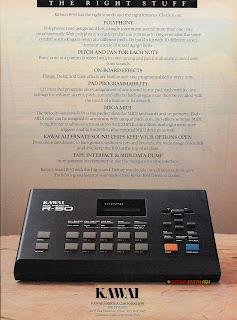
Kawai R-50 "The Right Stuff" advertisement, Keyboard 1987


Kawai R-50 drum machine "The Right Stuff" full page colour advertisement from page 81 in the December 1987 issue of Keyboard Magazine. 

Although it was in June 1987 that the R-50 started appearing in ads alongside the R-100 (see my last blog post), in November of that same year the R-50 finally got the spotlight to itself. This ad above appeared on and off until early 1988, getting bumped periodically by an ad for Kawai's additive synthesizer the K-5. 

This ad was a big departure from the R-100/R-50 80s themed extravaganza that came before it - with a much more standard title/content/photo layout - and the content efficiently spelling out the features of the R-50, including its polyphony, pitch and pan abilities, on-board effects, pad programmability, Midi out the wazoo, and... my favourite... the alternate sound chips. More on that in a second. 

Although Keyboard never devoted a full review to the R-50, it did make the Updates & Short Takes section of the Magazine in the January 1988 issue. Yes, you heard that right. Although the R-50 began appearing in ads waaaaaay back in June 1987, it would be seven months before any kind of review showed up. 

Wowza is right. 

I do give Jim Aikins credit though - its a nice, small compact review - just like the R-50 itself. We end up with about two columns of content devoted to the machine. 

Jim starts by pointing out that the $495 R-100 is about $300 cheaper than the R-50. I like this, because it lets me know that the R-100 was still on the market at this time. Also, I dig historical retail prices in general.  

Much like my relatives would do when over for Christmas dinner, we first get a lot of chatter about what's missing in the younger sibling compared to its bigger brother (okay, maybe I'm projecting a bit). 

  • Buttons not velocity sensitive
  • Half the memory
  • 50 of the 100 patterns are non-programmable factory rhythms
  • Song construction simplified (no repeat loops or tempo changes)
  • No punch-in recording and song overdub features
  • No DIN sync jacks
  • In individual outputs

Geeez... sounding even more like me being compared to my older brother. :) 

But, the R-50 did have a few improvements like those assignable pads I went on about in the last post, some new effects, and some amazing midi tricks including midi triggers. 

And, because I can't, and won't, stop talking about them, Jim also mentions those alternate sound chips. Read what he had to say...

"Two additional plug-in voice chips ($129.00) suggested retail) are compatible between the R-100 and R-50. You have to open up the unit to install the new chips, but we're told that Kawai is planning to market a built-in switcher that will hold all three chips and let you choose whichever one you prefer for the current song.". 

This is the first I've heard that Kawai had planned to market their own switcher for all three chips. I'm my head, I'm thinking this would have been a kit that gets installed at the shop.   

But correct me if I'm wrong - I don't recall this ever on the marketing. And I'm wondering if maybe Kawai decided that rather than market a switcher, they decided to market a new R-50 entirely - the elusive R-50iii - that contained all three chips. 

I just happen to have one of those R-50iii. Time to open 'er up and see how those chips are installed.

Wednesday, December 15, 2021

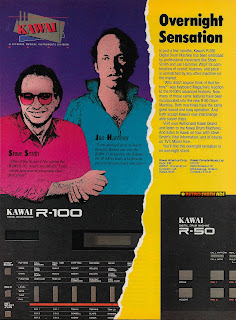
Kawai R-100 and R-50 drum machine "Overnight Sensation" ad, Keyboard 1987

Kawai R-100 and R-50 drum machine "Overnight Sensation" full page colour advertisement featuring Jan Hammer and Steve Smith from page 73 in the June 1987 issue of Keyboard Magazine.

Wowza. There is so much 80s goodness to unpack in this little rare advertisement. It only ran twice in Keyboard - the June and August issues... but should have had a much longer run, dammit.

First - lets look at those 80s design elements. Have you ever seen anything more 80s? Those pink, blue, yellow and purple colours? That "torn page" design element traveling through the middle of the ad? Even the logo for Kawai's "Electronic Musical Instruments Division" with its lines, Keyboard keys knock-out, and other various chunkiness.  Reminds me of Roland ads running around the same time period (see right). 

11/10 for design. 

Next - 80s endorsements! Steve Smith and Jan Hammer - pure 80s peeps endorsing pure 80s drum machines. Jan Hammer, of course known for Miami Vice (did I mention the 80s!?!?!?) and Steve Smith, known for his work with Vital Information and Journey (80s!!!!!).

The ad copy only solidifies the whole 80s vibe with references to Miami Vice, a keyboard review quote, and the trifecta of 80s brand marketing jargon - the "combination of sound, features and price". 

My head is gonna explode!!!!

Here's the thing though - there is just so much going on in this ad, that the whole reason for its existence almost gets lost - and that's the introduction of the R-50 itself. This little guy came out at under $500, and although it lost a few of its bigger brother's great features like velocity-sensitive pads, less memory and, arguably, the fact that half the patterns are uneditable, it did keep all 24 sounds. 

But more importantly, in my head, the R-50 represents what in my mind was a huge leap forward for drum machines:

The sounds are mappable to any button. 

Look at older drum machines, and you see each button has an instrument label under it. Bass Drum. Snare Drum, Hi Hat, etc. Great when memory cost a lot and there was only a limited number of sounds you could fit in a machine. But memory costs were coming down, and programming was improving. 

Some manufactures would get around this button/sound dilemma by stacking sounds on the limited number of buttons. Like the R-100 - only 8 buttons, but three sounds were assigned to each one. But, hard-coded non-the-less.

The R-50 represents that new era of drum machines that were just labeled Pad 1, Pad 2, etc. Like the Roland R-8 or Korg S3. Suddenly, you could have a wack of sounds onboard, and just assign to different pads as needed. Primitive menu diving.

And this brings up to the other really exciting thing announced in this ad almost as an afterthought:

"Both machines have the same great sound and easy operation. And both accept Kawai's new interchangeable sound chips.". 

Say what now?!?!? 

Yup. And those new sounds rawk even more than the standard ones.

There's a lot more to say about those chips... coming up soonly!

Thursday, January 28, 2021

Roland MKS-50 Polyphonic Synthesizer Module "The newest Juno synthesizer..." brochure, 1987


Roland MKS-50 Polyphonic Synthesizer Module  "The newest Juno synthesizer..." four page colour brochure from 1987.

Oh man - first post of 2021 - and what a way to start! The MKS-50!

Like the Alpha Juno 1/2 brochure that came out the previous year, and that I blogged about back in September 2019, this little feller follows Roland's classic (and consistent) "We design the future"... eeeer... design. My favourite part being a lovely front page that includes a large title and creatively placed featured piece of gear.

In this case the MKS-50 is floating above what looks to be silvery sheets of paper of some sort. This ties back nicely with the photograph used on that Alpha Juno brochure where the two synths are sitting on top of a similar type of paper.  

Okay - let's talk about the elephant in the room. That huge burn mark that starts on the front page, and actually makes it's way to the second and third page as well. It was sent to me this way. Honest. I don't even smoke. Now, usually I would do a little photoshop magic to remove these types of blemishes, but in this case I kept it in. Sure, that's partly laziness on my part, but also because its indicative of how many brochures are sent to me in this type of condition and, well, I kinda cool in its own way. This brochure has seen some dark times. It encapsulates 2020.  Poor thing. 

Thinking back, I'm pretty sure the MKS-50 was my first Roland module. I had a a few Roland keyboard synths including an Alpha Juno 2 at the time, but as space started getting slim, I began to actively hunt down rack version of synths that I already had and then would dump the keyboard version when I found it's rack equivalent. And it was when I stumbled across what eventually became my MKS-50 that I first came in contact with another most incredible piece of gear - the PG-300 Programmer (it's in the brochure, too!). 

I cannot stress enough how important Roland programmers were to me and many of my friends. You gotta understand that many synths from this time period replaced the visual feedback that came with one-control per function operation for some type of small display - the DX-7, Sequential Six-Trak, Korg DW synths, Kawai K's... the list goes on.  The Alpha at least had the giant alpha wheel to help quickly dial in the specific parameter you were looking for, but it was still annoying as heck.   

Having that PG-300 gave me the immediate visual feedback I'd been missing with the Alpha Juno - and I was hooked! And it's built like the MKS-50 - like a tank! I started tracking down other programmers for my other synths, managing to grab the PG-800 for my MKS-70 as well as the PG-1000 for my D-550 before the secret was out of the bag and prices of the programmers started to skyrocket. Never managed to grab an MPG-80 programmer for my MKS-80 and now that prices are hovering around the $2000 mark, chances are slim I'm ever gonna get one. 

I don't even think there are any hardware alternatives. I've read that the Virus TI can be programmed to pump out the right sysex to program an MKS-80, but like I've already stated above... I'm lazy. 

And don't even start on software editors. Ugh.

Thursday, September 26, 2019

Korg DS-8 "Eight Advantages" brochure, 1987


Korg DS-8 synthesizer "Eight Advantages" four page colour brochure from 1987.

Well, after posting that relatively interesting Korg 707 brochure back in March, how could I not follow up at some point with Korg's other FM-based synth that came out around the same time - the DS-8.

In that post, I touched upon Korg's easy-to-use interface in order to bring Yamaha's FM synthesis to us simpletons. If you look behind the curtain though, you'll find what's really pulling those FM strings - the Wizard of Opp! Otherwise known as Yamaha's FM Operator Type P (OPP) chip, also otherwise known as the YM2164.

Here - I snarfed this photo from the Wikipedia page for the chip:


The chip could be found in the DS-8 as well as the Korg 707, along with a few Yamaha synths from the time period.

Now, putting aside the amazingly interesting fact that Korg used Yamaha's chips in the first place, I did some research into the chip itself, and quickly learned its actually an "enhanced" YM2151 chip (aka OPM or FM Operator Type-M chip). The 2151 was Yamaha's first single-chip FM sound generator that could be found in the DX-21, DX-27 and DX-100, and interestingly also found its way into many non-Yamaha products such as arcade games and pinball machines, and even a few of Sharp's home computers.

But, the Korg 707 and DS-8's multi-midi support required slightly more enhanced abilities, and that's where the enhanced YM2164 chip shines.

A bit more digging, and I quickly realized that quite a few other Yamaha chips exist. A small sampling include the:

YM2154 - made for the Yamaha RX-15 drum machine, apparently for the PCM sounds of the rhythm samples.

YM2409 and YM2412 -  used in the Yamaha TX16W, Yamaha's first sampler

YM2414 -  found in the purely magical Yamaha TX81Z, which is what gave it the ability to choose from 8 different wave forms rather than just using 4-OP sine waves.

How cool is that! I love learning new things. And makes me want to collect Yamaha synths based solely on chip sets!  Check out this comprehensive list of Yamaha chips/feature sets that someone has begun to put together.  Lots more chips and gear in that list!

I find it interesting that Korg chose to make the DS-8 and 707 look so different from each other. I get that some features had to be different - the DS-8 joystick looks very Korg, but the 707's performance wheels make much more sense when the keyboard is hanging from your neck.

But in a era when so many manufacturers were making a generation worth of instruments look very similar to each other such as Yamaha's DX/TX synth and rack series or Roland's MKS rack series, Korg intentionally made these two synths look *very* different from one another.

Just an observation.  :)

Monday, March 11, 2019

Korg 707 "Performing Synthesizer" brochure, 1987


Korg 707 synthesizer "Performing Synthesizer" four page colour brochure from 1987.

One word - smarties!

I gotta say I love the aesthetics of the Korg 707. For one, it has the same form factor as the Poly-800 with those lovely guitar strap pegs on the sides. But, where that 800 modulation joystick isn't in the best position to bend notes and add LFO while slung around your neck, the 707 has two modulation wheels conveniently located on the top-right edge - the perfect position for your left hand.

But more importantly, the 707 have those delicious smarties buttons. They make my mouth water.

Those in the U.S. may not know what I'm talking about, because as far as the U.S. is concerned, the word smarties conjures up this chalky mess:


But in Canada, smarties are these delicious candy covered chocolate treats:
Mmmmm... yummy.

And so in Canada, and I'm guessing elsewhere, those rounded buttons found on Korg synths like the M1 and 707 have been nicknamed "smarties" buttons. 

And I love 'em. Almost as much as I love the programmers behind the sound of the 707.

The 707's engine is a 4-operator FM synth. But, until like most other FM synthesizers that require physics degrees and unmanageable menus of carriers, modulators and ratios, the creators of the 707 have done away with the complicated programming found on the DX-100 or TX81Z, and replaced them with three sliders for tibre, EG1 and EG2. As it says in the brochure, "these sliders alter many parameters simultaneously". 

I'm hearing your argument already - even just messing slightly with one simple parameter on a classic FM synthesizer can quickly turn your lovely string sound into something really crazy and unmusical.  And now with the 707, attaching one slider to many different parameters all at once is going to lead to total chaos really fast. 

Nope. 

The smarty-pants (see what I did there) at Korg apparently created fixed frequency ratios and algorithms so that the 707 is much more likely to pump out musically useful tones when those sliders are moved.  Sure, if you're Autechre, you may not like this much... but your average musician will dig this simplification lots. 

Beauty.

And speaking of beauty, the brochure is a thing of beauty too. Large cover image, even larger photo on the inside pages.

But two things in particular stood out for me.

The first is that lovely little Korg 25th anniversary "Because We Love Music" logo in the bottom right corner of the front page.  Sure enough, I used my fingers and counted back 25 years from 1987 and yup -1962. Correct! And I like that the logo isn't a big honkin' thing in the middle of the page either. It's nicely sized and positioned. A simple nod to the past. 

The other thing in particular that stood out for me... are you ready for this (it blew my mind)...

The 707 came in FOUR DIFFERENT COLOURS.  

WHAT?!?! Was I the only one that didn't know this?  Black. White. Blue. AND PINK. 

HOT PINK.

I snarfed this photo from a 2-year old Reverb posting.


That thing looks gorgeous. I want one. 

Now. 

Friday, December 21, 2018

Alesis HR16 and MMT-8 "Yes there is a Santa Claus" ad, Keyboard 1987


Alesis HR16 drum machine and MMT-8 sequencer "Yes there is a Santa Clause" full page colour advertisement from page 19 in the November 1987 issue of  Keyboard Magazine.

Surprisingly, very few companies take advantage of the season to customize their marketing message during the holidays. It makes sense since it requires extra time and money to produce an ad that will only get used for one or two months max. But I've come across a few holiday ads that took the chance and made it happen.

Sequential Circuits kept it simple in their black and white quarter-page holiday advertisement that ran in the December 1985 issue. Sequential made the decision to split their marketing dollars into two quarter page ads on two different pages so that they could keep their holiday message totally separate. Nice work.


Oberheim took it a big step further in their full page colour ad in the same December 1985 issue when they took out a full page colour product-oriented ad on the back-inside cover. It's definitely Santa/Christmas themed, but its not a message to readers. It's a full on product-oriented ad.


But Alesis...  they took it one step further.

It's not just a "Merry Christmas and Happy Holiday" message like Sequential's ad.

And it's not a holiday product ad like Oberheim's.

This advertisement is actually THE LAUNCH of the HR16 drum machine and MMT-8 sequencer. Alesis took advantage of the timing of these two pieces of gear to create a holiday season product launch.

Surprisingly, they kept the ad pretty bland. Ad title. Announcement copy. Two photos with some specs. And a holiday message. With some red and green font colours to make it a bit more festive.

But bland or not, those machines were definitely a Christmas miracle. And even more of a Christmas miracle... this is MY FIRST Alesis ad. Don't worry - more to come.   :)

Merry Christmas and Happy Holidays everyone!

Thursday, December 14, 2017

Twelve Tone Systems' Cakewalk "IBM PC/XT/AT OWNERS!!!" advertisement, Electronic Musician 1987


Twelve Tone Systems' Cakewalk sequencer software "IBM PC/XT/AT OWNERS!!!" 1/4-page black and white advertisement from the top-right corner of page 13 in the August 1987 issue of Electronic Musician.

Hey there! This is blog post #2 of my walk down Cakewalk memory lane. If you haven't read the first one... you may want to do that now. Or don't.

If you recall from my previous post, Twelve Tone Systems' first advertisement (right) had run from April through June 1987. If you had picked up that July issue and noticed it missing, you might have thought that was the end of Cakewalk.

But, as you are no doubt aware, it definitely wasn't. And after a brief one month hiatus, this second Cakewalk ad appeared in the August issue and continued to run for four consecutive months through to November 1987.

From that first small advertisement's humble beginnings, Twelve Tone Systems began picking up users a few at a time. But that costs money and a new product can always use a bit of earned media (in other words, free) to help get their legs running in the right direction.

Electronic Musician included a small write-up in its June 1987 What's New section:
"Cakewalk ($150.00), a MIDI recorder/editor for the IBM PC/XT/AT (256K memory and Roland MPU-401 required), features 256 tracks of unlimited length, a pull-down menu interface, a detailed Event View for editing MIDI parameters, and extensive global editing commands. Edit regions can be marked by ear and further refined using Event Filter criteria. A demo disk is available for $10. Twelve Tone Systems. PO Box 226, Watertown, MA, 02272 617/924-7937."
And although Keyboard magazine had yet to publish an ad for Cakewalk, they also gave their readers a taste of Cakewalk within their June 1987 Spec Sheet page:
"Cakewalk MIDI recorder/editor. Twelve Tone Systems' Cakewalk software features 256 tracks of unlimited length, a context-sensitive, on-line help system, and easy pull-down menu interface, a detailed Event View for editing MIDI parameters, and extensive global editing commands. Edit regions can be marked during playback and refined using Event Filter criteria. Cakewalk runs with an IBM compatible with at least 256K, a Roland MPU-104, and at least one MIDI instrument. $150.00. Twelve Tone Systems, Box 226, Watertown, MA 02272."
It's interesting to see just how similar these two little write-ups are. And I don't think that's a coincidence. I'm guessing someone at Cakewalk trotted out a small news release or product announcement. It's every marketing and PR person's dream that you will send out an announcement and the over-worked writers and editors will use your direct wording. Based on the fact these two write-ups are so identical, I'm guessing it worked for the most part. :)

One thing that I did notice was missing, both from this second ad and from these magazine product write-ups, is Twelve Tone Systems' buzzwords that was so boldly... er... bolded in their first ad:  "Aural Editing". They used it to describe how editing regions could be marked by ear during playback. Well, it looks like they decided to drop the term already (but not the feature).  Such is the life of buzzwords. Boooooo!

As for the second advertisement itself, Twelve Tone Systems decided to enlarge the ad space from 1/6-page to 1/4-page, and this was a good decision on their part. Most particularly because it allowed the fun, laid-back personality of the company to shine through.

Phrases like...
"This hot sequencing software gives you lots of power for not much coin." 
"You are guided through all this power by a nifty user-interface..." 
"Or dip into over 100 pages of the clearest documentation you've ever not had to read."  
"Cakewalk is all yours for just $150. Of course, if paying $500 for Cakewalk will make you feel better, we'll play along."
 That's just good branding. I'm reading it 30 years later and it still sounds like Cakewalk to me.

There is one thing I'm still missing. Although the company has now defined their personality, they are still in desperate need of a logo.  But they do have everyone's attention... and so its time for the next step.

Which I'll get to in the next blog post.

Update: The third blog post is now live!

Wednesday, December 13, 2017

Twelve Tone Systems Cakewalk sequencer "IBM Owners!!!" advertisement, Electronic Musician 1987


Twelve Tone Systems' Cakewalk sequencer "IBM Owners!!!" 1/6-page black and white advertisement from the top-right corner of page 57 the April 1987 issue of Electronic Musician.

Before I begin - full disclosure: I've been a Cakewalk user for a *long* time. Not since the beginning (my first sequencer was Master Tracks Pro for the Apple IIe), but my bestie began with Cakewalk for DOS and so I had witnessed it in action in some of its earliest incarnations.

Update: Cakewalk's second ad has been posted! And now the third ad!

Its hard to believe Cakewalk has been around for 30 years. And even harder to believe that the end may be near as Gibson announced on November 17, 2017 that it was "ceasing active development and production of Cakewalk branded products".

There's a lot of rumor and speculation surrounding this announcement, but I'm not gonna get into that here. What I wanted to do was take a little walk down memory lane and revisit some of Cakewalk's early days through a few blog posts. So, yup - this won't be the last you'll hear about Cakewalk.

Anyways, back to this ad in particular - because it doesn't get much earlier than this - what is probably one of the earliest, if not THE EARLIEST, advertisement for Cakewalk.

According to Wikipedia, the first version of Cakewalk appeared in 1987. To track down early ads I first looked through latter half of 1986 and the first half of 1987 issues of Keyboard Magazine. But couldn't find a thing. I then set my sights on roughly the same time period of Electronic Musician and sure enough found what I believe to be Cakewalk's very first advertisement in the April 1987 issue. The ad looks to have ran for three three consecutive months until June 1987.

Most new companies don't have a lot of advertising dollars to spend, so it kinda makes sense that if a start-up like Twelve Tone Systems had to choose between Keyboard and Electronic Musician, they would go with the magazine more focused on software.

The ad itself isn't much to look at - its only 1/6th of a page in size. But it says enough to peak the interest of any musician reading the mag that happened to have a Microsoft DOS machine around at the time. 256 tracks with global and event view editing was impressive software at the time. And almost as importantly, they included context-sensitive help for the many musicians that were just starting down that computer sequencer journey.

One other interesting piece of info from the ad that jumped out at me was: "Unique Aural Editing(TM) lets your ears get involved". After some brief research, I learned that what that was referring to was how edit regions could be marked by ear (I guess while the sequencer is running?) and then further refined using event filtering. I enjoy companies that come up with interesting buzzwords for things.

And of course, most importantly - we got the price! $150.00! That's about $325 in today's dollars. Not too shabby.

Some really good early history of Cakewalk is available in a 2007 CDM interview with Cakewalk founder Greg Hendershott by Peter Kirn. The interview marked the 20th anniversary for Cakewalk, and Peter Kirn was obviously a fan.  The interview gives us plenty of history on Cakewalk, parts of which I believe reference this advertisement in particular.

According to the article, Greg had written the initial program and made the decision to place a small ad to see if he could sell a few copies to other people.
"So I kind of procrastinated, and thought maybe I could try taking out a small ad and selling a few copies. And I did, and amazingly four or five people saw the ad and called up and ordered. And that was enough to pay for the ad and do another one."
In regards to the name Cakewalk, Greg ended up choosing a word that was simple to spell and suggested ease of use.
"Right before I placed the ad, literally two days before the deadline, I had picked another name for the program, and I found out it had been used by other software. I think it was something like Opus. So I had this little dictionary of music terms, and I saw Cakewalk." 
So dig finding advertising references like that. Great stuff.

The interview is filled with tons of great Cakewalk history - how he came about the name Twelve Tone Systems, why the company name was changed to Cakewalk, thoughts on early DOS sequencer competitors like Voyetra, and Greg's philosophy on making his software affordable and free of  copy-protection.

If you are a Cakewalk junkie and electronic music history buff... go read it. Now!

Happy reading!

Update: Cakewalk's second ad has been posted! The saga continues!

Saturday, September 9, 2017

Roland D-50 "A new technology is creating a powerful storm...", Keyboard 1987


Roland D-50 "A new technology is creating a powerful storm in the world of sound synthesis" four page colour introductory advertisement from pages 89 to 92 in the June 1987 issue of Keyboard Magazine.

Happy 9/09 day!

I had a lovely 909-related post ready to rock and then... BOOM! Roland announces their new D-05 Boutique module based off their 1980's best selling D-50 synthesizer. Luckily I had been saving this draft of the D-50 four-page introductory advertisement for a special occasion. And I can't think of a better one right now.

(And bonus! I have a 909-related post ready to go for the next 9/09 day!).

Roland introduced Keyboard readers to the their new D-50 synthesizer in the June 1987 issue with this four-page ad. Its not often you get to see a four-page advertisement in Keyboard magazine. And its definitely not often you see it run for four months in row. That's a lot of advertising dollars. And then Roland just pared it down to a two-page ad and continued to run it.

Although Roland began advertising it in June 1987, its possible the first time that readers of Keyboard were introduced to its existence was two months earlier in Ted Greenwald's winter NAMM article that appeared in the April issue. The D-50 received top billing!
"For a couple of years it took small American companies such as Sequential and Ensoniq to prove to synthesizer players that there is, indeed, life after the DX-7. So it was a surprise to see the big boys grab the spotlight this time around with some exciting new instruments."
Ted goes on to write about Roland,
"The indefatigable Roland led the way with the D-50 Digital Synthesizer, the obvious highlight of their prolific new offerings, and possibly of the entire show". 
Side note: I'm not sure if "indefatigable" is a word, but it definitely described Roland's push of new gear both during that time period, and now with the announcement of so many Boutiques.  :)

The D-50 really did take the synth world by storm in 1987. Ted Greenwald drew the lucky straw and also got to write the Keyboard Report that appeared in the September 1987 issue.

Ted opening paragraph really packages history up nicely and is one of the reasons I love reading through old synth mags. He points out that MIDI was invented to do patch layering and talks about the "sonic richness that could be obtained by combining two" separate synthesizers. He goes on to write:
"While Sequential and Oberhaim addressed the problem by designing polytimbral instruments (the Six-trak and the Xpander), and Roland and Yamaha started packaging two synthesizers in one case (DX-5 and the JX-10), New England Digital gave the Synclavier the ability to layer four sounds, either synthesized or sampled, under one key."
What he was saying is that Roland's D-50 allowed synthesists to add a little sparkle of "Synclavier" into their productions at a fraction of the cost.

The three-and-a-half page Keyboard report gets into all the aspects of the synth including the basics of linear arithmetic synthesis, how the samples are incorporated into the synth, the effects (reverb and delay in a synth?!?!), and the front panel interface. On that last topic, its noted that programming can get complicated with all the menu diving, but luckily Roland decided to keep the tradition of pairing programmers with their synthesizers and offered up the PG-1000 programmer right out of the gate.

Ted concludes his review with some pretty good predictions...
"LA synthesis is a success, and we expect that the D-50 will be as well, even if some corners were cut to get it into such a competitive price range. ... An instrument this capable for under $2,000 would be a strong contender for Keyboard Of The Year even if it didn't include reverb, delay, chorus and EQ effects. In the coming months, we're expecting some of the factory patches to become as ubiquitous as that blasted DX-7 Rhodes sound. Keep your ears open".  
He definitely got that right.

And with the D-05 Boutique I'm expecting and looking forward to a resurgence in those patches! I was a resurgence in Enya cover bands using that Pizzagogo patch. And yes, I'm evening looking forward to hearing how the Digital Native Dance patch is going to be incorporated into synthwave.

Now time to enjoy my 9/09 day!

Friday, May 5, 2017

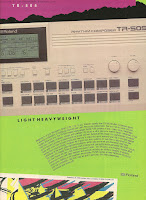
Roland TR-505 "Light Heavyweight" ad, Keyboard 1986


Roland TR-505 drum machine "Light Heavyweight" colour advertisement from page 17 in the December 1986 issue of Keyboard magazine. Also appeared on page 9 in the March 1987 issue of Electronic Musician.

Well, it's Cinco De Mayo today, and I don't want to take anything away from that. But May 5 also has another name - 505 day!

Sure, its not as celebrated as 303, 808 or 909 day, but to me it's part of the XOX family and deserved a little recognition.

Hmmmm... not buying it, eh? Okay - I'll come clean. I have a personal soft spot for the 505. It wasn't the first drum machine I played on, but it was the first one I bought for myself. I spent hours programming the rhythm patterns to songs like Dreaming of Me and New Life by Depeche Mode into it, along with the bass and melody lines into the sequencer of my Casio CZ-5000.

Yup. That was me.

And I'm  not the only one who digs this machine. Although review sites will often give the 505 a relatively low rating when compared to its brothers and sisters, it only drives users like me to become even more fanatical about it.  For example, Vintage Synth Explorer only gives this adorable battery operated puppy two stars, but the user rating is a much higher 3.72 stars. Just look at some of the comments below the review. Yoiks!

The ad itself looks to only have appeared once in Keyboard Magazine and Electronic Musician. I suspect its rarity can be attributed to the fact that it was released after the Super JX and right before the D-50. Roland only had so much ad space to allot to a budget drum machine when sandwiched between those two heavyweights. Technically, the 505 also appeared in another set of Roland Family ads - I'll get to those later.

In fact, it was so far off the radar I don't think it even ever got a review in Keyboard. But, luckily, it did make it into Keyboard's Spec Sheet section back in June 1986.
"Roland Drum Machine. The TR-505 Rhythm Composer features 16 PCM drum sounds, including five Latin percussion sounds. The unit is MIDI-compatible and has a memory capacity of 48 programmable patterns, 48 preset patterns, and six tracks, storing a total of 423 bars. MIDI velocity controls dynamic response. A cassette interface in included. The TR-505 can be powered with batteries or AC. RolandCorp, US, 7200 Dominion Circle, Los Angeles, CA 90040-3647" 
I'm almost as fond of the advertisement as I am about the drum machine itself. Roland had been using this colour pallet for a number of earlier synths including the Super JX and Alpha Juno series ads. In particular, I love the low-res computer graphics that were becoming all the rage in the 80s, as MIDI and personal computers started becoming more common. Alas, this was to be the last ad to use the design style before the introductory advertisement for the D-50 took on a totally new 4-page look and feel.

The text of the ad makes me happy as well. Phrases like "Spunky new TR-505". "Thoroughly modern MIDI instrument". "Our new champ still has a few moves you haven't seen". "Scores an easy technical knockout". And its

Read the whole thing and tell me it doesn't make you happy.

As happy as I am right now on Cinco De Mayo!

Wednesday, March 11, 2015

Akai AX-73 "SYNTHMASTER" ad, Music Technology Magazine 1987


Akai AX-73 "SYNTHMASTER" advertisement from page 47 of the January 1987 issue of The Music Technology Magazine.

Well, if there's one thing this Akai AX-73 ad proves, it's that you can definitely love a synth too much.

Waaaaay too much.

I get it. It was the mid-80s and readers were getting more accustomed to ads that veered towards the artsy-end of the spectrum. Advertisements from across the pond did sometimes take a bit more risk and, let's face it, there were a lot of drugs flowing through advertising agencies around this time period.

But this ad is so unlike any other Akai advertisements that when a friend brought it to my attention last night via a UK eBay auction, I couldn't resist coming out of my winter hibernation to search through my magazine archives and get this thing online pronto. And really - I can't thank him enough for rekindling my blogging passion.

Let's ignore for a second the fact that someone thought this ad would make a good eBay auction and focus on the ad itself.

I don't mind the layout. Again - pure 80s with a large photo, lots of white space and a giant block of run-on text that's a little hard to read.  The one thing that isn't well displayed is the actual name of the synth. Its not in large text anywhere - it's even missing from the photo. It's only written out in the small paragraph at the bottom right of the page.

Also, growing up on the other side of the Atlantic, I find some of the language used in the ad copy slightly exotic. "Velocity sensing" and "For your nearest stockist..." - both stand out to me as a Canadian. And let's not miss "Grasp the energy". Obviously the inspiration for the photo.

I think the Synthmaster is grasping the AX-73 a little to hard maybe.

Now - back to that eBay auction. The description the seller uses is actually quite accurate:

"Retro and vintage magazine advertising is an increasingly interesting subject for framers and collectors. As more and more magazines from the 70s & 80s are discarded , the available stock becomes more and more sought after."

I agree - these awesome magazines are becoming more rare and sought after. Unfortunately, its a bit of a self-fulfilling prophecy when many of the magazines are being discarded by people tearing them apart to sell the ads.

Yeah, I don't like it, but I'm not trying to point fingers either. You buy a magazine, you can do what you want with it. And as the available stock dwindles, eBayers will theoretically be able to get more for each ad. That's just good business. Breaks my heart when a magazine like this is destroyed. But that's just me.

My real astonishment is that the seller believes someone will buy *this particular* Akai AX-73 ad. And maybe even more frightening is that someone will actually buy and frame it.

That Roland Jupiter 8 two-page spread or TR-808 ad from their "Understanding Technology Series" ad run?


Definitely. Frame those babies on the ceiling above your bed for those lonely nights.

Or can I get a what-what for a sexy Moog ad?


Yup. Times 10.

Or how about pretty much any Sequential Circuits Prophet 10/5/PRO-1 ad from the "Ear Force" era?


You can bet your pants those are replacing the cherished heirloom family photos in the dining room.

But as far as this ad is concerned - do your house guests a favour and save your money for an actual AX-73.

Or better yet - the AX-60.  :)

Monday, June 3, 2013

Yamaha TX802 FM Ton Generator "A Truly Collosal Performer" brochure, 1987


Yamaha TX802 FM Ton Generator "A Truly Colossal Performer" six page gatefold colour brochure from approximately 1987.

Summer is slowly making its way here - and I'm loving it. The problem is that when its starts getting nice out, it also starts getting harder and harder to concentrate on writing blog posts. So, it's a sure sign that when I start scanning larger documents it's so I can feel less guilty writing less about them.

So, here's a request from reader of the blog "GinTonic" - a scan of a six-pager for the TX802. He loves his TX802 and has had it for years.

The only other thing I can tell you about GinTonic is that he chose a TX802 over his girlfriend back in the late 80s.  And I quote:
"It's EIGHT frickin' DX7IIs!!!"
Well, there is that.    :)

At the top of this post, I included higher-res scans of each individual page in the order that one would probably read the information. I have also included lower resolution scans below as you would find the pages if you unfolded the brochure.

outer spread
inner spread
Part of fun of designing brochures is the "art" of the fold. There are a number of different folds available and a designer will often choose to use a certain fold type to enhance the design. In the case of this brochure, the six page gatefold was used (third one on the top row below).


The gatefold provides some great opportunities for interesting design. For example, when the reader flips open the front cover of this brochure (scan 1) the first two pages seen before folding out the other side of the gatefold are scans 2 and 3 (see below).


What the reader first sees is a nice little introduction to the TX802 including feature highlights and a really large front panel photo. And even though two pages are not really "connected" to each other, it was designed as one large page, with thw photo of the TX802 spanning the full two pages. And did you notice that the faded background image - a DX7IIFD - also spans the two pages? Nice touch.

Then, when the reader unfolds the other side of the "gate"  to the right (scan 3), it reveals the three-page "inner spread" (scans 2, 4 and 5). The designer set up the page so that the reader still gets that view the photo of the TX802 spanning across two pages.  And now, the "flow" of the design continues with the title (A Truly Colossal Performer) and brochure text spanning across the rest of the inner spread - scans 4 and 5.


Great design work.

Hope my description makes sense and does the whole thing justice. 

Good design in a brochure is one thing. But good design of an actual rack synth is another. Programming an FM synth is hard enough as it is, but it gets even more confusing when you try and cram all those buttons into 19 inches of front panel space.

But Yamaha does everything possible to try and make it easy on the user. For example, using different colour buttons to distinguish the Mode Select buttons and the keypad buttons is helpful.  Better yet, one of the really fun features of this generation of Yamaha racks is their little slide-out reference sheets that attach underneath. I've come across some racks that include reference information on the tops of the racks, but that becomes useless once you've actually racked the thing.

I first came across this feature with the TX81Z and found it really handy to have all the program editing info and the diagrams of the eight oscillator algorithms readily available. And, even better - with the TX802, you get TWO pull-out sheets. One contains all the page editing info, and the other one is dedicated to all 32 wonderful algorithms available on the TX802. I believe the other Yamaha rack unit - the TX812/816 - also included a pull-out sheet (or two?). Or at least it looks like it in photos I've seen online. But I've never had the opportunity to get my grubby little hands on one. YET.

Sadly, that big two-page front panel photo of the TX802 in this brochure doesn't include the pull-outs. They've been removed, leaving a gaping hole at the bottom of the unit (directly underneath the LCD readout).

That's the only flaw I can find in this thing. Now go read it.

Thursday, December 6, 2012

Casio CZ-1 "When you perform, it performs" ad, Keyboard 1987


Casio CZ-1 synthesizer "When you perform, it performs" full page colour advertisement from page 144 in the July 1987 issue of Keyboard.

Choice.

Nope - not talking about hipster lingo used to describe something that they think is awesome, although that applies too - "that CZ-1 synthesizer you are playing on stage is choice".

I'm talking about options.

And Casio gave users a lot of choice. I listed out the wall of keyboard choices available by Casio near the end of the RZ-1 reference sheet blog post to prove some point or another.

Yup. A lot of choice there.

Guess what - I've come to hate choice.

It can really stress me out. Make me stop in my tracks, immovable. But thinking about it, its not the idea of choice that bothers me. Its the idea that having to make one choice will then affect some other choice I will have to make the future. For example, making the choice to purchase a Casio keyboard now could affect my ability to pay for a better Casio sometime in the future.

But I'm getting a bit off topic a bit.

Point is, in my head, I look back thinking I could walk into a store on day-one and choose between the 1, 101, 1000, 3000 and 5000. My brain wants me to believe that all these xZ products hit the market pretty much at the same time. But that was clearly not the case. Looking at the date this ad appeared, its now clear just how long the roll-out of the different CZs lasted. But I have to admit, there is a definite disconnect between how it went down in my head and how it really happened.

My brain just wants to rearrange history to how I would have wanted it to be. All my choices, ready to choose, all at once. No more choices to be made after that.

I hate that. 

I also hate that Casio has officially left the human element behind with this CZ-1 ad. Some of you will cheer, while others like me feel its the end of an era. That era included the first round of CZ advertising for the CZ5000, CZ-101 and CZ-230s.


Let's be clear. These weren't famous musicians appearing in these ads - as found in ARP and Moog endorsement ads from the 70s and early 80s. These were honest-to-goodness models dressed as musicians, used by Casio to bring a sense of humanity into what was at the time, a sterile gear-only landscape of hardware ads. No doubt a theme Casio brought over from its consumer marketing side.

But by 1986, when the second round of Casio xZ ads started to appear, the company dropped the bipeds and decided Keyboard readers needed to focus strictly on the gear. Such as in this 1986 family photo advertisement that the CZ-1 first appeared in.


Even though most of the ads in this new round of CZ advertising only appeared once or twice (this solo CZ-1 ad only appeared twice in the July 1987 and January 1988 issue of Keyboard) the campaign did seem to have the desired affect and phase distortion synthesis made a bit of a come-back.

Round two.

And the reality-distortion effect this marketing campaign caused wasn't just localized around me and my few synth friends... everyone seemed to be affected. It was like phase distortion was new again. For example, in July 1988 (bolded for good measure), Keyboard published an article title Introducing the Casio CZ.

Introducing?  We've seen CZ instruments in Keyboard since 1985. WTF?

The article is actually positioned as part of the "Technology" section, sub-titled "Synth and MIDI basics", but  as the introduction points out, the love affair with the CZ goes beyond one article.
"Plenty of keyboard players got (and still get) their first taste of synthesizer programming through the CZ-101. If you've got a CZ and would like to know more about how to program it, then get it out and blow the dust off of it. For the next couple of months we'll be talking about CZ features, and in particular about the phase distortion (PD) process that Casio uses to generate complex waves."
Dust it off? Just a few years later and it looks to me like CZ is being put into the vintage bucket?

Poor thing.