Monday, June 23, 2014

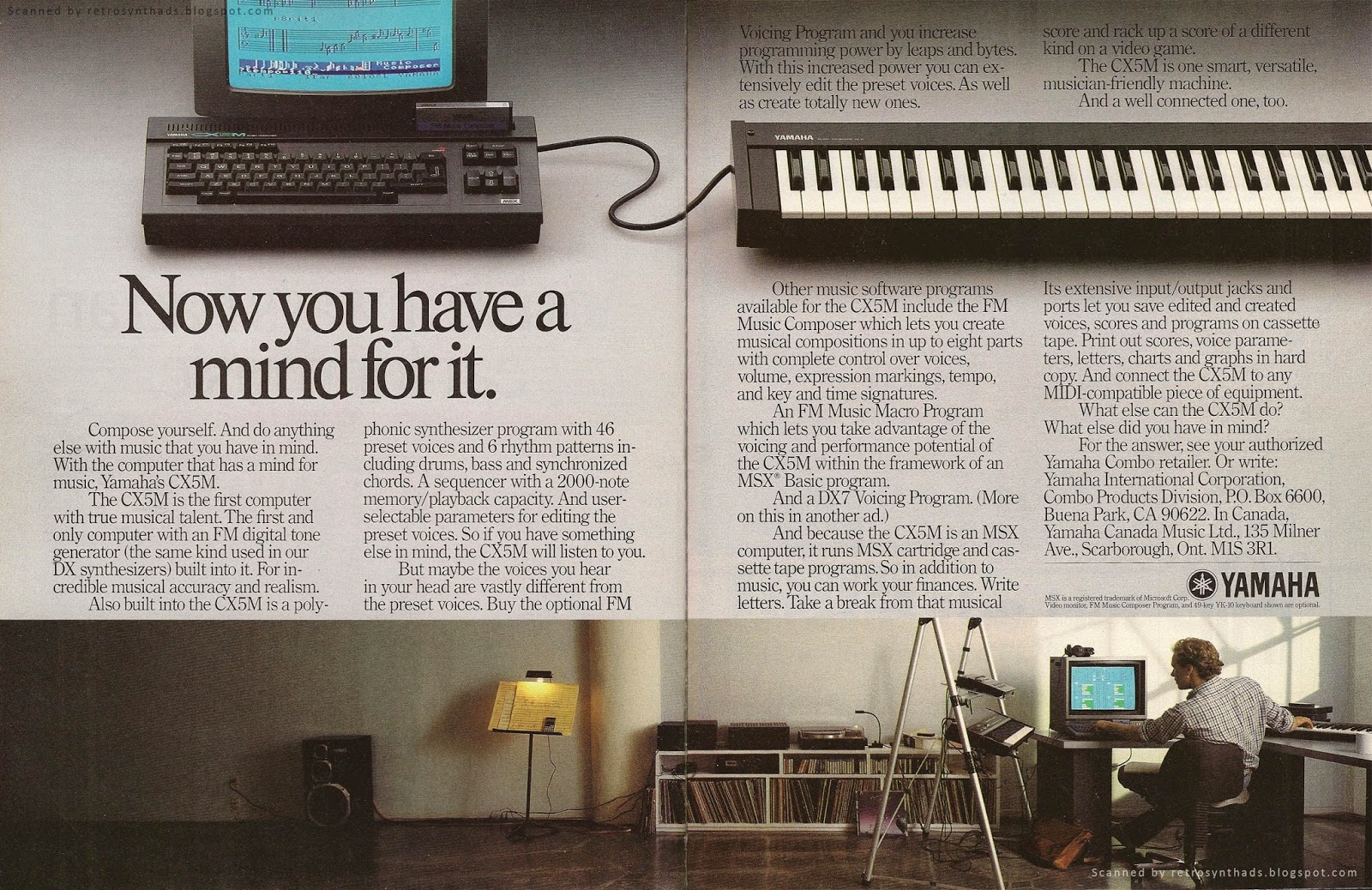
Yamaha CX5M music computer "The world's first music computer now has a broader repertoire" ad, Keyboard 1986


Yamaha CX5M music computer "The world's first music computer now has a broader repertoire" two-page full colour advertisement from pages 84 and 85 in the April 1986 issue of Keyboard Magazine.

http://retrosynthads.blogspot.ca/2014/06/yamaha-cx5m-music-computer-youve-always.htmlOver a year after CX5M's 1985 "You've always had an ear for music..." introductory advertisement started running, Yamaha finally came out with an encore in another two-pager.

This time around, Yamaha had two messages to get across
  1. Show readers how much the music software and hardware had grown for the platform.
  2. Push the business side of the machine.
On the music software/hardware front, there really has been some good developments. In the original ad, Yamaha promoted four pieces of software with the CX5M - their FM Voicing program, FM Composer program, the FM Music Macro program and the DX7 Voicing program. By the time this ad came around, that list had grown to also include, listed in the order they appear in the ad:
  • MIDI Recorder program - compose, edit and arrange music in step-time or real-time
  • RX editing program - for editing Yamaha's RX11, RX15 and EX21 digital rhythm machines
  • DX21 Voicing program
  • Keyboard Chord Master
  • Keyboard Guitar  Chord Master
  • Graphic Artist Program
  • Second generation FM Music Composer
  • Second generation FM Music Macro program
Did you catch that in the middle of this list? They threw a graphics program in there! And they even thought it was such a great addition to the system that they let a screen shot take up some valuable real-estate in the ad.

Hardware for the CX5M also got some good coverage in the ad. And not just in the ad-copy. That big photo of the computer itself has a lot more things attached to it in this advertisement when compared to the original ad. And Yamaha included a whole subsection on the topic of hardware, including the oh-so-description:
  • SFG05 - FM tone generator module with 46 of its own preset voices, an 1800-note sequencer and room for 48 user-programmed voices.
  • YK01 and YK10 keyboards
  • FD05 and FD03 Micro Floppy 3.5" disk drives (with MSX-DISK BASIC language "built into the disk drive interface cartridge" - what ever that means?!?!
  • PN101 dot-impact printer
  • MU01 mouse
Again - Yamaha has made an interesting choice to use up precious page real estate to include a photo of that Yamaha printer, and although that printer is printing out music notation, its clear that Yamaha is also positioning this thing as a business machine.

If that big photo of the printer isn't enough evidence of the business side of things, you only have to look at that ad-copy. Before Yamaha even begins to give readers insight into the new MUSIC hardware and software available, Yamaha spends **two paragraph**s talking about TeleWord - CX5M's word processor.

Teleword featured "advanced" (my air-quotes) word processing functionality such as global search and change, cut-and-paste text transfer and on-screen page layout. On the communications front, it included an auto-dialer with redial, 50-entry digital phone book and complete adaptability with 300 and 1200-baud operations.

Remember - this was 1986. Telecommunications among pleebs like us was still occurring mostly through services like Compu$erve at dial-up speeds and huge connection costs.

Still, I love this line from the ad.
"So whatever you create with TeleWord's word process (or other CX5M programs), you can send to computers anywhere in the world."
And I'm still waiting for a good one to pop up on eBay.

Monday, June 16, 2014

Yamaha CX5M music computer "You've always had an ear for music..." ad, Keyboard 1985


Yamaha CX5M computer "You've always had an ear for music..." three page colour advertisement from pages 63, 64 and 65 in the February 1985 issue of Keyboard Magazine.

This advertisement first ran in the February 1985 issue of Keyboard Magazine as a three-pager. The teaser page - "You've always had an ear for music." - appears on the previous page and although there is absolutely no Yamaha logo to be found anywhere on that page, that large recognizable font has been around long enough in the company's ads that the whole page already oozes "Yamaha".

The bottom photo found on that teaser page is a great one too - a dark room, an empty chair and an instrument known to require a fabulous ear (as well as extreme talent) to play. The best part of the photo is the lighting, and in particular that the darkness of the room is broken by two light sources. The first light source is a lamp that subtly directs the readers attention towards the right. And the second is the natural light seeping in from the right side of the page again drawing the readers' eyes in the direction of the next page. You have no choice but to flip the page.

The two-page ad that follows is, at first glance, a mouthful. There are *a lot* of words on that page to take in. But, if you are like me at all, that first image catches your attention. A computer? A colour monitor with music on it? Yamaha? Yeah - that makes sense... (thinking it over more) yeah... kinda... hmmm... curious...

I'm sure that hook got a lot of people to start reading. I know I read it all. Every word. :)

The ad tells us a little bit about the CX5M itself
  •  FM digital tone generator
  •  built-in polyphonic synthesizer program with 46 preset voices and 6 rhythm patterns including drums, bass and synchronized chords
  • 2000-note sequencer
  • Optional FM Voicing Program to extensively edit the presets and create new ones
  • Cartridge and cassette tape ports
  • Printer port
  • and most importantly MIDI!
The ad also touches on some of the music software that is available for the CX5M, including
  • FM Music Composer - eight part musical compositions
  • FM Music Macro Program - for some type of programming access with MSX basic
  • DX7 Voicing Program
And that last piece of software is interesting because the ad doesn't actually say anything more about it, but actually uses it as a teaser by saying "More on this in another ad".  

The photo on this page is excellent too. It spans the bottom of both pages, and you can see how that natural light coming in from the right side of the page draws the eyes towards the small, well organized studio space and that nicely-coiffed gentleman. He kinda sits like I do at work all day. I wonder if he also has back problems?!?

Anyways, after this February advertisement ran as a three-pager, it was merged down to two pages. But, in order to do so, the designer had to somehow squeeze that first part of the ad-title (the teaser text) above second part found on the second page -  the "Now you have a mind for it". And the only way that was going to happen was by shrinking the text down a few point sizes. And that's exactly what the designer. This two page version ran in March and September 1985, as well as February and March 1986. 

http://retrosynthads.blogspot.ca/2014/06/yamaha-computer-assisted-music-system.html
This CX5M ad came out before the QX1 ad I blogged about previously started running, but there was some overlap between them near the end of 1985. And you can see the overlap it their designs too. The QX1 definitelly got its keyboard look from the CX5M.

Both units resemble computers - eeeeer... actually, the CX5M *is* a computer.

The ad states that it is an "MSX computer". Looking at the fine print and you will see that MSX was a Microsoft computer platform.

I'd never heard of this operating system, but according to the MSX Wikipedia page, the American-based Microsoft first announced MSX in June 1983 as part of an attempt to standardize hardware between manufactures, but surprisingly MSX-based machines didn't really get popular in it's home country. Apparently due to a Commodore-led price war going on there. But, elsewhere the MSX hardware was the bees knees. Places like Japan, the Middle East, Brazil, the Soviet Union and Netherlands. Even more surprisingly, it was a popular choice as a video game platform. Check out this fact - the Metal Gear series was first written for MSX hardware. Bam!

If you live in North America, it might have been hard to look back at this ad and think of Yamaha as a home computer manufacturer - but in fact they made a few different MSX models. Some were marketed as personal computers like the YIS503II that could be found in Soviet schools, while others like the CX5M were marketed as machines strictly for making music (although even in this Yamaha CX5M ad they do mention near the end that you can also do your finances, write letters, and "rack up a score on a different type of video game". Get it... "score"... like music score... hee hee.

Looking at that Wiki page, some of those MSX computers look really damn retro-cool.

Yoiks - I'm getting that "collector" feeling in my loins.

Gak!

Monday, June 2, 2014

Yamaha Computer Assisted Music System (YCAMS) "This is the second most powerful tool for making music." ad, Keyboard 1985


Yamaha Computer Assisted Music System (YCAMS) "This is the second most powerful tool for making music." two-page colour advertisement including the QX1 digital sequencer/recorder, TX816 FM voice generator system and RX11 (or RX15) digital rhythm programmer from pages 48 and 49 in the July 1985 issue of Keyboard Magazine.

Yamaha was advertising *a lot* in Keyboard magazine around this time period. It wouldn't be uncommon to see two or three pages worth of Yamaha ads in any given issue. This advertisement for the Yamaha Computer Assisted Music System began to appear around the summer of 1985, including the July, October and December issues. It also appeared in the January 1986 "MIDI Mania" issue on the back of the "MIDI sequencers: computer based and dedicated hardware" fold-out page. Nice placement! When this ad wasn't running, Yamaha's other two-page ad featuring it's CX5M computer and software system would make an appearance.

To me, just the fact a company decides to go with a two-page ad says something about the product as much as the content of the ad itself. Its a signal by the company to the reader that they are investing heavily in whatever is being promoted. And the QX1 looked impressive enough to be worth a two-pager. No doubt!

That's really all I can say about the QX1 though - that it looks impressive. Ever since I saw this ad years and years ago I have wanted one. But it was way out of my price range at the time (over $3000 in Canada), and I already had an Apple IIe, so replaced my first sequencer - the one on my Casio CZ5000 - with Master Tracks Pro software instead. But that QX1 with its awesome customized computer-like keyboard has never left my mind in the 30 years that have followed.

And before I go further - YCAMS? There was no better, more memorable acronym?

[...ten minutes goes by....]

Okay - I can't think of anything better. YCAMS it is. Nevermind.

Even as I type this, there is a QX1 sitting on eBay that I've been watching. But the only clue to its condition is that they've turned it on, and 'most times' it goes to Disk Imitation (whatever that is). So, I just watch it sit a zero bids. Do I chance it and bid? Gah. 

Ever since choosing Master Tracks Pro over the QX1, I've stuck with software sequencers for serious recording, picking up the odd hardware sequencer such as an MMT8, Roland MSQ100 and 700 only when opportunity, price and curiosity have intersected. Actually, my band mate and I took that MMT8 on stage a couple of times - never failed us. That track mute feature was awesome.

Now that I've been persuaded to think about playing live again, the topic of a hardware sequencer has been stuck in my head. So, I started doing my research looking into a lot of old and new hardware sequencers including the Linn Electronics LinnSequencer that I blogged about last week, and the Yamaha QX1. And again, opportunity, price and curiosity collided to the extent that I fell into an Akai MPC2000XL, MPC1000 and 500 in rather short order.

I think hardware sequencers are attractive to me because they are table-top oriented.  The Yamaha QX1, Alesis MMT8, Roland MSQ700... all of them tabletop. It just makes sense. Similarly, as much as I like the space-savings provided by rack synths, I think tabletop synths like the Kawai K1m, Waldorf Microwave XT and Access Virus modules have equal charm for this reason.

And I think that is why I am now gravitating towards the Akai MPC1000. Hardware. Tabletop. No computer required. And until Akai comes out with a new non-controller MPC, the 1000 seems to be the way to go. Plus you get some killer sampling to boot.  

But if I ever come across a QX1 guaranteed to work - well then... that MPC1000 may begin playing back-up duties.

Time to check eBay again... and again...

Monday, May 26, 2014

Linn Electronics Inc. LinnSequencer "Imagine the possibilities." ad, Keyboard 1985


Linn Electronics LinnSequencer "Imagine the possibilities" colour advertisement from page 67 in the December 1985 issue of Keyboard Magazine.
http://retrosynthads.blogspot.ca/2014/05/linn-electronics-inc-linndrum.html

This LinnSequencer advertisement was the second last Linn Electronics ad to appear in Keyboard - running in the December 1985 and January 1986 issues.  If you recall from last week it was then replaced by the company's final ad for the LinnDrum Midistudio (see right) that ran for two months before Linn closed up shop.  :(

The actual design of the two ads are quite similar, with the same black background, the left-side pull-in callout box (yellow of the Midistudio, aqua for the LinnSequencer) and bottom white branding bar with the Linn logo to the far right.

The similarities in design don't end with the ads themselves either. For one thing, the two units share a new rack mount design that is quite a departure from Linn's earlier desktop designs. They also share the same beige colouring and control-type buttons.

When I first became aware of the LinnSequencer, I thought it was simply the sequencer guts of Linn's earlier Linn9000 drum machine/sequencer. I've never had access to either units, so could never confirm this. But others online have thought the same thing including "subsonicdigital" who in April 2011 had this to say in response to a Gearslutz post on the LinnSequencer:
"It is the brain of the famous Linn 9000, going back way before the MPC was invented. Apparently, only the MPC 3000 (maybe the 4000) has similar feel."
More evidence can be found right on the front panel of the two machines. Many of the same sequencer buttons and controls (including some of the characteristic layout) can be found on both the Linn 9000 and LinnSequencer. And, well, it just makes sense that Roger Linn would take the renowned sequencer out of the Linn drum machines and sell its on its own.I just wished there was promo information from the time period that would spell it out.

Unlike the LinnDrum Midistudio, the LinnSequencer must have made it into production since there are many good photos of the machine floating around the Web as well as a few up for auction on eBay every now and then (including right now). For some really good shots of the front and back, I'd checkout this November 2010 auction post on MATRIXSYNTH.

The mid-80s was an interesting time for hardware sequencers as two factors started coming into play. First, MIDI had begun to make major in-roads since its launch three or four years earlier. And second, home computers were dropping in price, including the new crazy-affordable Atari 520/1040STs. And with those home computers came software sequencers. Those Atari computers even came with built-in MIDI interfaces. Sweet.

Although I couldn't find an original price for the LinnSequencer online, it turns out that this advertisement appeared in the same January 1986 "Midimania" issue of Keyboard Magazine that also included a great little chart comparing all the software and hardware sequencers of the time period. Jackpot.

Looking at the chart, computer software sequencers were outnumbering hardware sequencers at least three to one. And compared to other hardware sequencers around at the time, the LinnSequencer was definitely on the more expensive side listing out at $1,250. The only hardware sequencer priced higher was Yamaha's beast of a sequencer QX1 at $2,795. A few others floated just under the LinnSequencer's list price including the Roland MSQ-700 at $1,195 and Roland MC500 at $1,095. The rest of the hardware sequencers ran somewhere in the range of $400-750. These prices could have made the LinnSequencer a tough sell.

And believe it or not - it seems you can still buy of these babies. Forat, who still sells many updated Linn products including the LinnSequencer, has a page with some great technical and operational information.

Definitely check that Forat page out.

Monday, May 19, 2014

Linn Electronics Inc. LinnDrum Midistudio "Put a complete studio in your lap." ad, Keyboard 1986


Linn Electronics LinnDrum Midistudio "Put a complete studio in your lap." colour advertisement from page 19 in the February 1986 issue of Keyboard Magazine.

Here's a good question...  What does the Akai MPC series of sampler/sequencers and the Atari ST have in common?

In reality - not much. But in my mind - well... quite the opposite.

I've been infatuated with both for the last couple of weeks after a chance encounter landed a MPC 2000xl and an early model Atari 520 ST (in the original boxes - see photo at right ---->)  in my possession.

The MPC was in rough shape, in need of seven or eight new buttons, a new rotary encoder and variation slider (soldering isn't my strong suit), as well as about 10 or 12 screws that had gone missing after years of use/abuse. A quick search online for parts brought up MPCstuff.com - and I not only ordered the parts I needed, but also got a memory upgrade AND some thick black pads.  Gonna totally hotrod that thing.

So, while I waited for those parts to arrive, I decided to do some research on the Atari to figure out what kind of MIDI software might still be available to play around with. And lets face it, maybe get a blog post or two on the software ads I came across.  :)

As you may have guessed by the title of this blog post, those Atari software ad scans will have to wait because while I was digging through old Keyboard magazines for software ads, I came across this Linn Electronics ad for the almost-totally-unknown LinnDrum Midistudio.

What a great looking machine. You could almost mistake it for one of Akai's new MPC controllers! Like, seriously!

The LinnDrum Midistudio was the last product of Linn Electronics Inc. to be advertised in Keyboard Magazine, appearing in the February and March 1986 issues. And it looks like it was scheduled to appear in the April issue as well since it is referenced on page 140 of the magazine in the advertising index, but when you flip to its referenced position on page 87 of the magazine, it has been replaced by one of Keyboard Magazine's own ads for their "Rock Keyboard" book.

What caused Linn to pull the ad in April? Well, sadly, according to the "Past Products Museum" page on Roger Linn Designs' current Web site, it was around February 1986 that the last of the Linn 9000's were sold and Linn Electronics "closed its doors due to strong competition and the growing pains of a small business". Boooooo. Makes me sad  :(

Wait... what? Linn 9000? That was the last product by Linn Electronics? Not the Midistudio?  Roger Linn's own museum page doesn't even mention the Midistudio.

Wussup?

Turns out that many sources on the Web, such as Vintage Synth Explorer, consider the Linn 9000 to be the last product by Linn Electronics and that machine is also referred to as the "original MPC60". And let's face it - it kinda was. Because it was actually a machine you could buy.
 
But, according to the few LinnDrum Midistudio sources available on the Web, including an April 2008 post by MusicThing, the actual direct descendent to the MPC60 was the LinnDrum Midistudio - although it apparently never made it into production (see blogger comments below that MusicThing post for a sighting of an actual unit in a music store).

According to the page, the Midistudio was announced at the 1986 NAMM show as the replacement for the Linn9000.  As you can see from the photo,  it included the now-famous 4x4 pad configuration whereas the Linn 9000 had a more traditional drum machine-style long rows of drum pads. The Midistudio also featured that beige colour that became another trademark design feature of the MPC series.That post also includes one of the best photos of both the control unit and the actual rack unit, attached together by a 100ft cord between the two! Hence the the name of the ad: "Put a complete studio in your lap". And your lap could be all the way across the studio.

An "In the Studio" feature from the October 1986 issue of Keyboard Magazine titled "What happened to the Linn 9000" (online version by the author available) included a letter from Roger Linn to Linn dealers and service centres that explained the situation the company was in as well as a bit more evidence on the Midistudio/MPC lineage - bolding in the below quote is mine:
"NOTE: Mail addressed to the old Linn address is being forwarded to Roger Linn personally. During the recent NAMM show in Chicago I spoke with Roger Linn and he is now working with Akai. He is working on a new product, which he would not divulge what it would be, my suspicions would lead me to believe this new product to be a spin off of the Midi Studio."
Synthony.com has a page on the Midistudio as well, and explains its relation to the Linn 9000. According to the page, "all the 9000 features are retained including dynamic buttons, cue tempo, repeat, interchangeable sounds, 32 tracks per sequence and more." The page also gives us a list price for the Midistudio - $5,990.00.

So, was the Midistudio the direct descendent to the MPC range, that then continued on to evolve into my broken down MPC2000xl and beyond?  I'm gonna say yes, even if it never made it into production. The 4x4 pads, the beige colouring, and the few references I've found online is good enough evidence to me.

And what happened to my MPC2000xl? Well, I managed to fix the buttons,install the RAM and make the pad upgrade - easy stuff. Chickened out on the soldering though.

Will leave that to my favorite local tech. :)