The illustration in this ad (which would also make a great t-shirt) shows a frustrated, overwhelmed man standing over a reel-to-reel machine with more complex recording tools including a mixer and various effects in the background. There is also an illustrator's name - "Stau '85", but some quick google searches didn't bring up any other illustrations but the person. Dang.
Wednesday, August 6, 2025
Octave Plateau Sequencer Plus "State of the art shouldn't create a state of confusion" advertisement, KCS 1986
The illustration in this ad (which would also make a great t-shirt) shows a frustrated, overwhelmed man standing over a reel-to-reel machine with more complex recording tools including a mixer and various effects in the background. There is also an illustrator's name - "Stau '85", but some quick google searches didn't bring up any other illustrations but the person. Dang.
Tuesday, July 29, 2025
MPC Electronics "The Kit", including Synkit, The Tymp and The Clap, October 1983
Add-on units expand the system’s capabilities:
“The Clap” delivers a decent handclap sound with controls for noise mix and decay, though it lacks trigger integration with the main Kit.
“Synkit” produces versatile synth-drum sounds with pitch sweep capabilities, ideal when triggered from the main Kit’s toms, although its decay control is finicky.
“Tymp” offers low-pitched, noise-heavy sounds more suited to effects than traditional percussion, but suffers from inconsistent sensitivity and lacks adjustment options.
The best news... that's not the only article on the kit you can find online - there is also another link to an article from Muzines from the January 1984 issue of Electronics & Music Maker. It includes similar info, but also introduces us to the Bass Drum Pedal/Hi-Hat on/off accessory that can be connected. Also included is pricing info - always a treat to see!
One weird Amazon link that popped up was to "The Kit Operating Instructions", providing us not just with a colour image of the main unit, but a summary of the history of the company. Summarized from the page:
MPC Electronics Ltd was founded in 1982 in Cambridge by Mike Coxhead to produce and market "The Kit," a compact electronic drum trigger device invented by Clive Button, designed to be played with fingers instead of sticks.
After refining the design, the improved Mark 2 version gained acclaim at trade shows and sold widely in the UK, Europe, and North America. The company released complementary accessories such as bass drum pedals and sound modules like The Clap and Synkit.
In 1983, Button introduced a more advanced version—the Music Percussion Computer—with eight pads, onboard memory, and compatibility with home computers, influencing future products by Roland and others. MPC later developed full-size drum pads and synth modules, but despite several innovations, the company folded in 1986 after Button moved on to work for other firms. Many units of The Kit remain functional today, and a comprehensive manual and history booklet documents MPC’s contributions during its brief but impactful existence.
Here's a picture of the unit in colour... gotta say, I wasn't expecting the red or the gold.
Want to learn more about it's designer Clive Button? Check out his website. It provides even more history!
Wednesday, July 16, 2025
Yamaha SY-22 "Vector Synthesis" advertisement, Keyboard 1990
Yamaha SY-22 "Vector Synthesis" advertisement from page 39 in the September 1990 issue of Keyboard Magazine.
In a crowded world of 90s synths, the SY-22 vector synthesizer dared to be different. With FM, sample playback and joy-stick driven sound design, its still loved by a small group of fanatics. I've never owned one... and I still consider myself one of those fanatics.
According to the InterWebz, after Sequential Circuits, responsible for the Prophet VS (Vector Synthesis) was bought by Yamaha, Dave Smith "served as the President of the DSD group at Yamaha, producing a mini VS in the Yamaha SY22, but when ownership of Sequential was passed to their newly-acquired Korg, Dave oversaw that as the Korg R&D group in California, who designed the very successful Wavestation."
Interesting. Explains why the Wavestation and SY-22 both came out so soon after each other.
Looking at the SY-22 itself... first, lets get this out of the way. No low-pass filter. Ugh. Okay, we can move on, because what it does have is AWM synthesis, 2-operator FM synthesis, and vector synthesis via a joystick. And now lets throw in stereo onboard effects, as well as velocity keys with aftertouch. SAAAAAAY-WHAAAAAAT?
All for under $1100.
So its not an SY-77. Too bad... The SY-22 has vector synthesis.
So its not an SY-55. Too bad... The SY-22 has vector synthesis.
I think you can see where I'm going with this. Its got vector synthesis. Like I said above - I've never owned one. I don't think I've even heard one on purpose. But in my head, its just got to be cool sounding.
And Jim Aikin, managing editor and Keyboard reviewer back in 1990 agrees. Kinda.
See... he was going on vacation the day the Korg Wavestation arrived for review. So he didn't get to review it. And instead, he came back from vacation with the Yamaha SY-22 waiting for review. so he switched it on and was 'pleasantly surprised'.
Why do I know this?!?! Because the same issue of Keyboard that includes this advertisement, also includes Jim's full-length review of the SY-22.
According to the review, each patch on the SY-22 "can be programmed with its own vector. Once you've found a set of waveforms that you like, you can go to the "record level vector" page and use the joystick to do a real-time recording of a sequence of up to 50 vector positions." FIFTY positions. Then you can edit each position, loop the entire thing, etc. Smashing!
One thing he does note that is a real downer is that the joystick doesn't send or receive midi data. Yup. You heard that right... there's no way to record the movements into your favourite sequencer. Jim acknowledges that Yamaha needed to keep the cost down somehow.
Jim goes on to review the sounds ("usual mixed bag"), patch programming ("fairly predictable"), effects ("short, but no big around"), and multitimbral operation ("fairly standard"). Still, in the end, Jim explains that vector synthesis "gives the SY22 a sound that's unique in its price range", and even calls the real time recording of vector movements "the most significant innovation in synthesizer design that we've seen in the last couple of years".
Nice. Jim done good.
The Yamaha SY-22 may not have achieved mass-market fame, but its combo of vector synthesis, FM synthesis, and sample-based warmth makes it a hidden treasure for all you creative musicians.
Wednesday, July 9, 2025
Alesis HR-16:B "Killer B" advertisement, Keyboard 1990
Monday, June 30, 2025
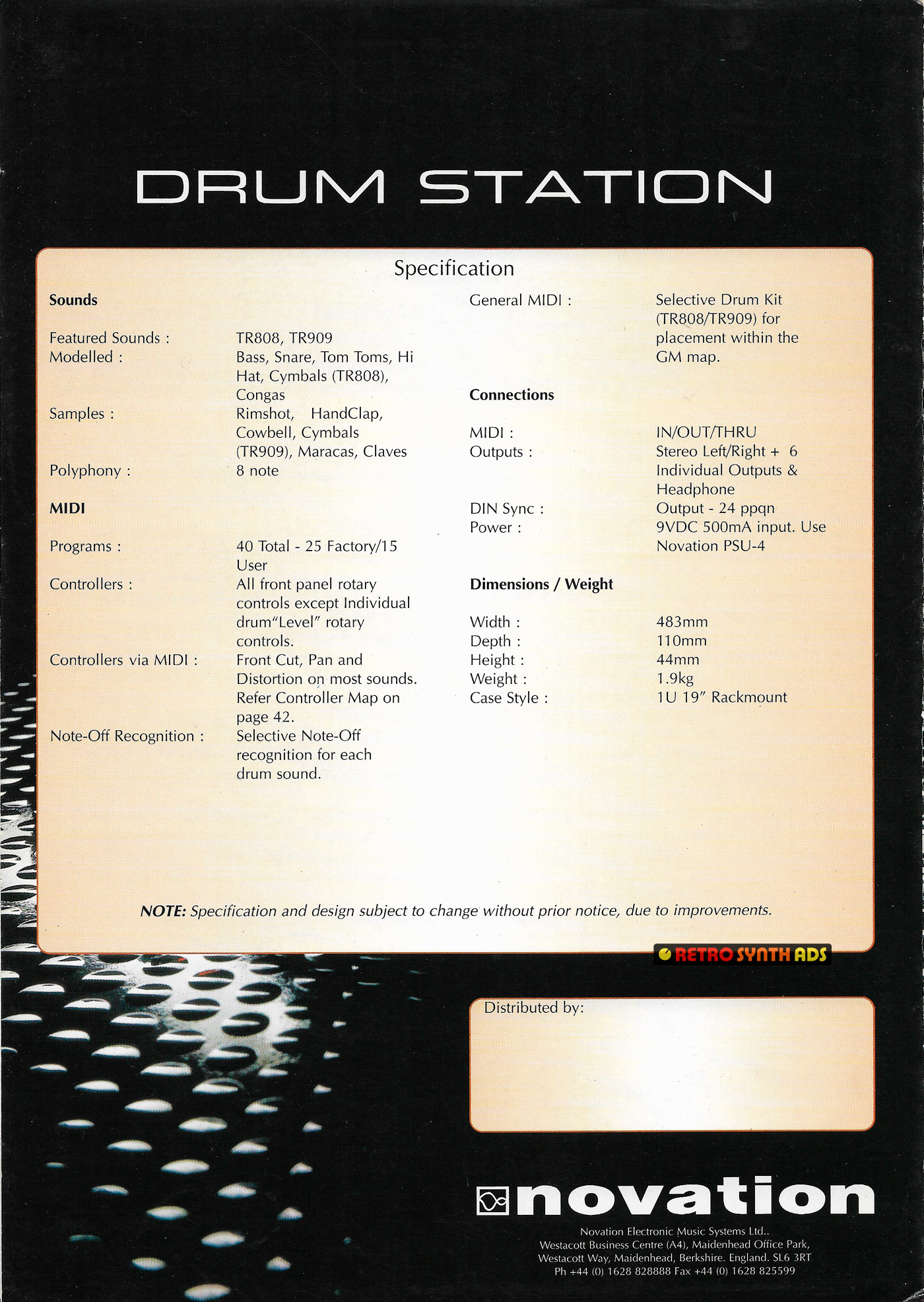
Novation Drum Station brochure, 1998
Novation Drum Station two page colour brochure from 1998.
Gonna keep it short... it's been a while since I've blogged and I've kind of forgotten how to do it. No really. I'm trying to get my mojo back, but this is really hard.
A while back in 2021 I posted a four page 1996 Novation Drum Station brochure. Fast forward a year or two, and Novation has taken a shrink ray and bumped that brochure down to a two page reference sheet. One page, two sides to be exact.
Gone is that lovely front cover image. Instead, Novation has taken the Future Music Platinum Award that used to live on that cover, and plunked it onto the front half of this brochure. But, They have also added a little blurb from the June 1997 issue of Electronic Musician. Go them!
Believe it or not, the rest of the content is almost exactly (if not exactly) the same between the two. The same bullet points. The same sub-titles of the different section. Same order.
Oh wait... one other big different... NO BLOCK DIAGRAM. BOOOOOOO!!!!! I do love me a block diagram.
One other little thing that is bugging me. That marble-y texture Novation chose to have in the background of the front and back of the page. Not a fan. Too distracting.
Okay - like I said. Keeping it short. Probably for the best because I'm grumpy. If you didn't notice. :)
Monday, December 20, 2021
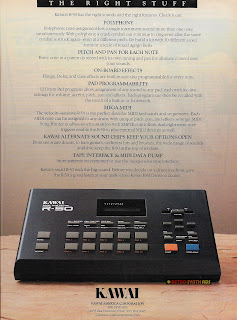
Kawai R-50 "The Right Stuff" advertisement, Keyboard 1987
Although it was in June 1987 that the R-50 started appearing in ads alongside the R-100 (see my last blog post), in November of that same year the R-50 finally got the spotlight to itself. This ad above appeared on and off until early 1988, getting bumped periodically by an ad for Kawai's additive synthesizer the K-5.
This ad was a big departure from the R-100/R-50 80s themed extravaganza that came before it - with a much more standard title/content/photo layout - and the content efficiently spelling out the features of the R-50, including its polyphony, pitch and pan abilities, on-board effects, pad programmability, Midi out the wazoo, and... my favourite... the alternate sound chips. More on that in a second.
Although Keyboard never devoted a full review to the R-50, it did make the Updates & Short Takes section of the Magazine in the January 1988 issue. Yes, you heard that right. Although the R-50 began appearing in ads waaaaaay back in June 1987, it would be seven months before any kind of review showed up.
Wowza is right.
I do give Jim Aikins credit though - its a nice, small compact review - just like the R-50 itself. We end up with about two columns of content devoted to the machine.
Jim starts by pointing out that the $495 R-100 is about $300 cheaper than the R-50. I like this, because it lets me know that the R-100 was still on the market at this time. Also, I dig historical retail prices in general.
Much like my relatives would do when over for Christmas dinner, we first get a lot of chatter about what's missing in the younger sibling compared to its bigger brother (okay, maybe I'm projecting a bit).
- Buttons not velocity sensitive
- Half the memory
- 50 of the 100 patterns are non-programmable factory rhythms
- Song construction simplified (no repeat loops or tempo changes)
- No punch-in recording and song overdub features
- No DIN sync jacks
- In individual outputs
Geeez... sounding even more like me being compared to my older brother. :)
But, the R-50 did have a few improvements like those assignable pads I went on about in the last post, some new effects, and some amazing midi tricks including midi triggers.
And, because I can't, and won't, stop talking about them, Jim also mentions those alternate sound chips. Read what he had to say...
"Two additional plug-in voice chips ($129.00) suggested retail) are compatible between the R-100 and R-50. You have to open up the unit to install the new chips, but we're told that Kawai is planning to market a built-in switcher that will hold all three chips and let you choose whichever one you prefer for the current song.".
This is the first I've heard that Kawai had planned to market their own switcher for all three chips. I'm my head, I'm thinking this would have been a kit that gets installed at the shop.
But correct me if I'm wrong - I don't recall this ever on the marketing. And I'm wondering if maybe Kawai decided that rather than market a switcher, they decided to market a new R-50 entirely - the elusive R-50iii - that contained all three chips.
I just happen to have one of those R-50iii. Time to open 'er up and see how those chips are installed.
Wednesday, December 15, 2021
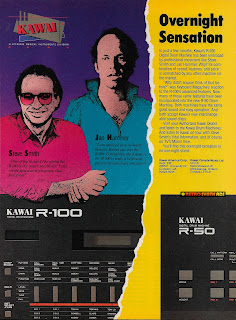
Kawai R-100 and R-50 drum machine "Overnight Sensation" ad, Keyboard 1987
Kawai R-100 and R-50 drum machine "Overnight Sensation" full page colour advertisement featuring Jan Hammer and Steve Smith from page 73 in the June 1987 issue of Keyboard Magazine.
Wowza. There is so much 80s goodness to unpack in this little rare advertisement. It only ran twice in Keyboard - the June and August issues... but should have had a much longer run, dammit.
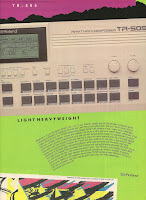
First - lets look at those 80s design elements. Have you ever seen anything more 80s? Those pink, blue, yellow and purple colours? That "torn page" design element traveling through the middle of the ad? Even the logo for Kawai's "Electronic Musical Instruments Division" with its lines, Keyboard keys knock-out, and other various chunkiness. Reminds me of Roland ads running around the same time period (see right).11/10 for design.
Next - 80s endorsements! Steve Smith and Jan Hammer - pure 80s peeps endorsing pure 80s drum machines. Jan Hammer, of course known for Miami Vice (did I mention the 80s!?!?!?) and Steve Smith, known for his work with Vital Information and Journey (80s!!!!!).
The ad copy only solidifies the whole 80s vibe with references to Miami Vice, a keyboard review quote, and the trifecta of 80s brand marketing jargon - the "combination of sound, features and price".
My head is gonna explode!!!!
Here's the thing though - there is just so much going on in this ad, that the whole reason for its existence almost gets lost - and that's the introduction of the R-50 itself. This little guy came out at under $500, and although it lost a few of its bigger brother's great features like velocity-sensitive pads, less memory and, arguably, the fact that half the patterns are uneditable, it did keep all 24 sounds.
But more importantly, in my head, the R-50 represents what in my mind was a huge leap forward for drum machines:
The sounds are mappable to any button.
Look at older drum machines, and you see each button has an instrument label under it. Bass Drum. Snare Drum, Hi Hat, etc. Great when memory cost a lot and there was only a limited number of sounds you could fit in a machine. But memory costs were coming down, and programming was improving.
Some manufactures would get around this button/sound dilemma by stacking sounds on the limited number of buttons. Like the R-100 - only 8 buttons, but three sounds were assigned to each one. But, hard-coded non-the-less.
The R-50 represents that new era of drum machines that were just labeled Pad 1, Pad 2, etc. Like the Roland R-8 or Korg S3. Suddenly, you could have a wack of sounds onboard, and just assign to different pads as needed. Primitive menu diving.
And this brings up to the other really exciting thing announced in this ad almost as an afterthought:
"Both machines have the same great sound and easy operation. And both accept Kawai's new interchangeable sound chips.".
Say what now?!?!?
Yup. And those new sounds rawk even more than the standard ones.
There's a lot more to say about those chips... coming up soonly!
Saturday, December 11, 2021
Kawai R-100 drum machine "What good is playing loud if you can't play soft?" advertisement, Keyboard 1986
Kawai R-100 drum machine "What good is playing loud if you can't play soft?" full page colour advertisement from page 11 in the November 1986 issue of Keyboard Magazine.
"Kawai continued to expand their line of professional products with their R-100 drum machine ($795). The R-100 has 24 32kHz, 12-bit companded sounds on board, including agogos, timbales, and china bell. It also has a selectable clock rate, tap tempo, individual outs, stereo outs, MIDI key assignments, and real-time tuning.
"The R-100 digital drum machine features touch-sensitive pads which trigger 24 12-bit/23kHz sampled sounds. Real-time control is provided for tuning, panning level, and sensitivity of each sound. Memory capacity is 100 patterns, 100 songs, and 10 chains. The unit records velocity, tuning and stereo pan for each note. Song position pointer and MIDI data dump are included in the MIDI implementation. The clock rates are variable and a sync-to-tape function is included. Other features include song overdubbing, programmable tempo and volume changes, and ten separate programmable outputs (two stereo, eight direct). The R-100 drum machine :$795.00."
"In as little as six years, we've seen the digital drum machine evolved from a $5,000, 15c rhythm device to today's fully dynamic, keyboard-controllable, tunable, user-sampling MIDI drum machine. And most of these instruments are priced under $1,000. Ain't life grand!"
Grand indeedy!
After a nice thorough review of the instrument, the reviewer concludes with what would become general consensus pretty much everywhere - Kawai had a winner on their hands with the R-100.
Yes indeedy!
Dave especially liked some of the new features not yet found on other drum machines, like being able to individually assign instrument, tuning and pan placement for each key on a MIDI keyboard, and the "repeat and jump structure" of the pattern sequencer.
I would have to agree. To this day, the R-100 is one of those pieces of gear that will always have a place in my heart. And, on my specimen table, where it sits waiting the next chance to be turned on.
More Kawai to come in the near future.
Tuesday, November 30, 2021
Roland JX-3P and PG-200 "Programmable/Preset/Polyphonic Synthesizer" brochure, 1983
Roland JX-3P synthesizer and PG-200 programmer "Programmable/Preset/Polyphonic Synthesizer" four page colour brochure from August 1983.
Well, well... another "We design the future" brochure. I got a million of them. Okay - maybe a few are duplicates.
Can you blame me? Look at this beauty. All the signs of a Roland brochure from this era - like this JX-8P brochure I published back in 2020 - and the blog post that holds the record by far for hate mail regarding my position on the statement "Too much gear reduces your creativity". But that's another story.
Where was I... oh yeah - the multitude of other We Design the Future brochures (and those that came after the tagline was dropped, but kept the same design format). At least 11 tagged on the blog to date, and as I find others - like that JX-8P brochure I've scanned, I add the tag to those posts too.
The centrefolds in these things never disappoint. Flip the cover page open and you get that big gorgeous photo. I don't care if you love or hate the sound or the programming of this thing... it looks awesome. This is what an 80s synthesizer front panel should look like. Yeah yeah... knobs are great - but I equate those with 70s synths. A real 80's synth has one big data knob. Or at most, one or two sets of up/down button. Think Yamaha DX7. Or Oberheim Matrix 6. :)
But the real history here is Roland's introduction of MIDI to their brochures. The tech was so new, companies were still fiddling about with their buzz words.
"MIDI BUS"
"... can be hooked up with..."
"MIDI BUS connector".
All oddly awkward and satisfying at the same time.
Roland gives up a bit of real estate on the back page (not enough in my opinion) to discuss MIDI even more.
"Today's modern digital technology has made it possible to automatically control and synchronize a remarkable variety of electronic instruments. A personal computer can even be incorporated in such systems which usual require no special knowledge or operational techniques. The only problem is that individual makers have in many cases employed mutually incompatible connections and this greatly reduces the performer's potential. A new universal BUS system called MIDI (Musical Instrument Digital interface) solves this problem. It accepts all connections from instruments and devices of a standard signal. Now any standard musical instrument or computer can be connected using DIN cords for both input and output. Thus, MIDI expands the potential of performers and brings unprecedented convenience to the realm of electronic music. The Roland's JX-3P and Jupiter-6 are equipped with the MIDI Bus terminal. "
Probably a few more months before the words "MIDI" and "cable" are finally strung together in a sentence.
And I love it.
Monday, November 8, 2021
Moog Retail Price List, 1977
Wowza! In fact... two wowzas.
Monday, August 16, 2021
Anatek "Pocket Products Catalog" brochure, 1991
Anatek "Pocket Products Catalog" 10 page fold-out colour brochure from 1991.
Since moving into the new house, I've taken the few opportunities I've had to go through some of the boxes of brochures I've acquired over the years but never put into their protective sleeves. And just yesterday I did just that, and came across *this*.
Now'r days, people will joke that Eurorack modules are the synth-equivalent of Pokemon.
"Gotta catch 'em all."
But, I submit this brochure before the court as evidence that the original synth-equivalent of Pokemon were these little babies.
I can vividly recall going into my local synth haunt and seeing these stacked into their swiveling wire display stand. Okay, "vividly" may be a strong word. Maybe it didn't swivel. And now that I think about it, maybe it wasn't a wire frame. Was there even a stand?!?!? Gah. I'm old.
Point is, they were there. And they left an impression. And the urge to collect.
There was no date on the brochure, so of course I started Googling to try to remember when exactly these popped up on the radar. Didn't take long to find Creation Technologies Wikipage and some great info.
"1989 - Creation Studios, a high end music recording studio is built in North Vancouver by Barry and Jane Anne Henderson. Barry Henderson was also Music Products Division Manager at Anatek Microcircuits, a hybrid manufacturer in North Vancouver, BC with revenues of $1M USD. He and his team developed the Anatek line of MIDI and audio products including the now famous line of small MIDI signal powered MIDI processing accessories called "Pocket Products". "
Boom! Further reading explains how in 1991 a partnership lead to the name "Creation Technologies", which is the name you will find on this brochure, and why I decided to date this brochure to that year.
And look at that - Oh Canada!
Two other great historical facts can be gleaned from that wiki page. The first is this:
"The most famous of the Pocket Products, Pocket Merge, sold close to 10,000 units and generated over $1.6M in revenue in 1989, the product launch year."
Niiiiice! What a great little tidbit of knowledge to blurt out next time you are in someone's studio and they happen to have a Pocket Product sitting around. One thing I'm always interested in when it comes to vintage gear is the number of units manufactured.
The second great historical fact is this:
"Creation had a vision for becoming a high quality global contract manufacturing enterprise and developer of RADAR, the world's first multi-track digital recording system for professional recording studios."
Say what now? I had no idea the peeps behind some of the simplest midi/audio tech devices of the time period were also responsible for one the most complicated and expensive pieces of audio tech at the time as well.
Surprisingly, my squirrel instincts never kicked in even though they still cost less than those Boss half-racks on eBay and there is always at least a few of them for sale.
*looks at eBay again*
Dammit!
Tuesday, July 27, 2021
Roland TR-727 drum machine "The Rhythm Composer that keeps you in the groove..." brochure, 1985
Roland TR-727 drum machine "The Rhythm Composer that keeps you in the groove..." four page colour brochure from October 1985.
Hey! Has it really been 20 days since 707 Day!?!?! Well golly-geeeee!
Happy 727 day, peeps!
No better way of celebrating than by scanning this lovely beast from the archives. (Yes, I also flinched when I used the word "beast" to describe a vintage brochure of a vintage drum machine). But there ya go. What's done is done.
The 1984-1986 period was an awkward one for drum machines. It was like watching your teenager go through puberty. You wanted to look away, but had to keep one eye on 'em to ensure no one got anyone else pregnant, make sure they washed their face, and wait it out until they grew into a fully (semi) functioning adult.
In the case of drum machines, it was watching them make that transition from analog to digital, while keeping one eye on the cost of memory as it slowly came down.
Okay, not the best analogy. Let's just say there was a lot going on and a lot of moving parts.
As 1984 ticked by and 1985 reared its ugly teen-age head out of the bedroom after a three day binge of Fortnite and McD's, it was just a matter of time before the intersection between the cost of memory and the cost of manufacturing hit that sweet spot. Someone got the bright idea that they could just swap out the digital sounds in a drum machine they had already manufactured, give the casing a new paint job, and slap it on the back, out the door, onto music store shelves.
And to that end, we had Boss come out with their Super Drums (DM-110) and Super Percussion (DM-220), Yamaha with their RX21 and RX21L, and of course Roland with their TR-707 and TR-727.
Each pair housed in VERY similarly manufactured boxes, with their sounds switched out for alternative percussion sounds.
It was an interesting and short-lived (experiment) solution to keeping the price-point of your drum machine down until memory came down to the point you could start really backing one single machine with tons of sounds. If I recall, it was Boss/Roland that managed to get their percussion-based boxes out the door before Yamaha, but feel free to correct me if I'm wrong.
Anyways, enough about those other two - I've got brochure scans ready to rock for a later date. Today is the day to let the 727 shine.
Quickly - we've got the classic Roland "We design the future" layout. Cover with large font up top and sexy photo on the bottom. And what a sexy photo this is - pairing the 727 with the Octapad PAD-8, looking longingly at each other in the subdued lighting. I can here the TR-727 softly whispering "come hither". Put some lace on that PAD-8 and this could be a Harlequin Romance book cover. Just saying.
Let's face it, Roland was expecting a large audience of the 727 to be trained percussionists, and as a friend of many percussionists, I can tell you that they love to hit things. The PAD-8 becomes the perfect companion for programming a TR-727. Although with the rigid timing of the 727, it possibly could have ended up to be more frustrating in the end.
With their interest peaked, the reader slowly opens the cover to reveal the inside pages. And it doesn't disappoint. The Roland TR font makes me so happy, as do the large photo and diagrams included! What's interesting is the shear amount of text packed into those pages - especially on the right page.
So much so, that they really had to compromise the negative space of the pages to fit it all in there.
Compare it to the 707 brochure and you can see what I mean. Subtitles are crowded in the 727 brochure, and even the line spacing of the paragraphs seem claustrophobic.
But now I'm just quibbling. It's still lovely. 9.5/10.
Now flip to the back page and we have that PAD-8 again. Coming back for some more of that sweet sweet 727 lovin'. And it looks like it brought it's friend along for a good time.
Bow-chicka-wow-wow.
The perfect upsells.
Have a safe and happy 727 day.
Wednesday, July 7, 2021
Roland TR-707 drum machine "A brand new digital drum machine" brochure, 1985
Roland TR-707 drum machine's "A brand new digital drum machine from Roland "four page colour brochure from March 1985.
Hey there! Happy 707 Day. My fifth happiest day after 303 Day, 808 Day, 909 Day and 606 Day. Oh wait... 202 Day. And 101 Day. Wait. 272 Day. Okay, my eighth happiest day of the year.
But its still a great day! It beat our 358 or so other days. Not too shabby.
All that aside... let's keep this short and sweet. Just like the 16 beat patterns found on this thing.
Based on the classic "We Design The Future" brochure style of the period for Roland, this thing is gorgeous. It hits all the right notes. Large images. lots of breathing room. Cool red laser effect when you flip open the brochure. A marble. Yeah... even the marble.
Like many of the other brochures in this series, the cover has a theme - in this case, some kind of metal thingy behind the 707. It's actually a little freaky on the eyes, ain't it? But that don't matter, because as soon as you open the brochure, you get that large image of the TR-707 and lots of info including the specs.
But even better than the marble and lazer found on those inside pages is the back page. Because here we have the lovely older brothers of the the 707 - the TR-909 and TR-606. I love that even as MIDI started overtaking previous sync standards, Roland kept that fire burning under the TR-606. I can't fault them for that (606 Day beats 707 Day by three other days!!!
Like I said. Short and sweet. because I have a job now. A real one. And its fun too.
Have a safe 707 Day! Enjoy!
Wednesday, June 2, 2021
Novation Super Bass Station brochure, 1997
Novation Super Bass Station four page colour brochure from 1997.
Sure, the BassStation was (is) cool. So what could be cooler? The SUPER Bass Station.
Want to know what is not cool though. For the follow-up, Novation decided to make BassStation two words. Super. Bass. Station.
Grrrr....
Okay - with that out of the way. The first thing I need to point out is that I love Novation's consistency (except for that whole name thing). This looks amazingly similar to the Drum Station brochure I posted previously. Same design inside and out.
Just look... two peas in a pod.
Front page: Same "floating gear on black reflective texture" look to it."Super BassStation (1997) added an arpeggiator, noise source, ring modulator, an additional LFO bringing the complement to two, a sub-oscillator (an octave below Oscillator 1), analogue chorus and distortion effects, keyboard filter tracking, stereo outputs and panning, enhanced memory, analogue trigger signal output and more to the original design."
"over 100 Arpeggiator patterns - TB-303 types with slides through to 9/8 and shuffle."
Thursday, May 13, 2021
Novation Drum Station brochure, 1996
Novation Drum Station four page colour brochure from approximately 1996.
So, it's looking like May could become Novation month. Well, the last half of May any way. I've been drilling down into their brochures and I'm really liking what I'm seeing. But first, a little house-keeping....
I haven't posted anything for almost a month a half. And that last post was my April Fools number - its been about two months since my last real post about the BassStation (one word). I know I've had droughts before but this time I actually have a reason. I got a job. No really... a REAL job. Digital marketing of course. But this time with a dash of business development involved too. Anywhooos, point being that time is becoming a little more limiting. Let's hope I can keep this going. Probably means keeping 'em short and sweet.
Now back to this lovely brochure.
After Novation's mind-blowing launch of the BassStation (one word) around 1993, it was hard to think they could follow it up with something that, personally, I found even more mind-blowing. Mind-melting even. That product - the Drum Station (two words).
Novation called their sound creation system A.S.M. - short for Analogue Sound Modelling, and state in the brochure that the technology "re-created with stunning realism the original character and flexibility of the TR-808 and TR-909 drum sounds". Weirdly, although the acronym A.S.M. is peppered about the first half of the brochure, it isn't until halfway down the second page that we actually learn what it stands for.
Instead of spending time on needless definitions, Novation decided to go straight to the jugular of P.C.M.-based systems on page one, explaining just how crappy and un-variable sampled sounds are.
"Yesterday's analogue drum machines, while not as authentic sounding as today's digitally-sampled equivalents, have the character and warmth which PCM-based systems just can't seem to replace. What's more, a sampled version of an analogue drum sound loses all the variability of the original as the sound is "frozen" in just one of the myriad combinations of the editable parameters which the original machines offered."
Bam! That's how you hit 'em where it hurts.
The intro goes on to explain that this is why there has been a resurgence of analogue drum sounds (true) and that the TR-808 and TR-909 are the much sought after "dream machines" (also true).
And with full control over parameters, these sounds could be as varied as the originals.
So how did it sound...? Unlike the BassStation (one word), which I'm already on record saying it doesn't sound much like a TB-303, this thing was a dream machine. Sure, no sequencer - it had to be controlled through MIDI (and most likely a computer sequencer). But who cares. It cost a lot less than a TR-808 and TR-808 - even at 1995 prices.
So yeah. Love it.
The brochure itself is lovely too. A gorgeous front page that has the Drum Station (two words) floating over top a black reflective texture of some sort. Very reminiscent of Roland textures from their "We design the future" period of the 80s. Inside we have a really large photo spread of the front face, a cool block diagram and lots of juicy info. Back page - the specs in a black font in a large light yellow box with rounded corners.
I mention the colour and shape of that box because I have an older version of this brochure that is slightly different. On the back page that box is square and black, with a white font. Exact same info in the exact same order. Just a different colour theme.
And that's not the only difference. This version of the brochure has that cool "Future Music Platinum Award" logo and blurb on the front page with a July 1996 date. The other version of the brochure doesn't have that award info, suggesting it probably came out earlier - maybe even 1995 when the machine was first released.
If you can find one of these (the machine, not the brochure) for a decent price. Definitely worth picking up. Great sounds. Rack mountable. Lots of tweaking.
Yum!