Showing posts with label 1972. Show all posts

Monday, May 24, 2010

Moog Minimoog Brochure 'The INstrument of the Pros...', 1972


Moog Minimoog brochure entitled 'The INstrument of the Pros...' from 1972.

Do not adjust your television set... (or in this case, computer monitor). Bright red, pink and yellow really were the colours Moog chose for this four-page brochure.

When this brochure was designed and printed in 1972, Moog's Minimoog had only been out for a year or two and the compact synthesizer market was far from saturated. Most synthesizer's keyboards were still considered more of an attachment or accessory. :o)

The Minimoog did have some competition around this time. The ARP Odyssey and the EML ElectroComp 101 were about to launch, if they hadn't already. But the ElectroComp 500 and Roland SH-1000 were still a year or so away.

So, why did Moog go so crazy with the colours of this brochure?

Well, Moog didn't go 'completely' crazy. In fact, those colours were quite 'IN' at the time. Just like the tagline Moog used on the cover of this brochure - 'The INstrument of the PROs...'.

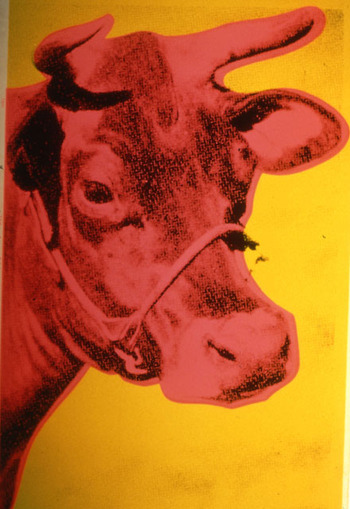
Bright, strong colours were really hot in 1972. You just have to look at Andy Warhol's Red Cow or Mao Tse-tung to see how splashes of colour were being applied over top of black and white images.

The designer used a similar technique to punch up the excitement in what would otherwise be a pretty sedate brochure. On the front cover, the colours are used as a candy-striped backdrop, a popular design element at the time. On the inside pages, the vibrant yellow and pink lines draw your eye through a collection of smaller, random black and white images. The lines are the only reason those photos can be tied together to create a balanced frame for the large central photo of the Minimoog in all it's glory.

If you don't believe me about the trend in colors, you just have to look back at your childhood set crayons. 1972 was the year, according to Wikipedia's Crayola Crayons page, that eight fluorescent colors were introduced into their crayon box, including 'Shocking Pink' and 'Laser Lemon' (renamed Ultra Pink and Chartreuse in 1990).

So, the brochure was really just playing into the design and creative style of the day.

And the exuberant creativity of the pop culture era was translated into the ad-copy as well. Take a look at that first paragraph:
"Brutal, caustic, volcanic - Evocative, flirting, caressing - Crisp, powerful, biting - Entrancing, embracing, exhilarating! Extend the stuff your music is made of with the MINIMOOG, a true Moog synthesizer which opens exciting new dimensions of expression to the creative professional. "
Really? Caustic...? Caressing...? Embracing...? Wow. Crazy stuff.

So, bring all that creativity and brash optimism together, and then on top of that, mix in the pre-clip-art artwork of that little, gentlemanly, 'well-bred' composer dude that pops up four or five times, and how could someone in 1972 not be inspired?

And/Or confused. :o)

BTW, it would be another five years or so before the Sex Pistols would jump on the hot-pink bandwagon with their shocking pink and yellow (or pink and green, depending on where you live) cover for the album 'Never Mind the Bollocks'.

Thursday, April 1, 2010

Arp Odyssey Reference Sheet, 1972

ARP Odyssey reference sheet from 1972.

How quickly ARP learns!

Last post, I blogged about an ARP 2600 reference sheet that... well, shall we say... was an understandably ugly first step in ARP's evolution of reference sheets. But, the company quickly grew appendages and flopped onto the sandy beaches of the synthesizer world with this one.

Gone is the cramped, verbal diarrhea of the not-so-reference-y sales material that in my opinion just doesn't belong on a one-pager reference sheet. In its place, we see an overall improvement in design and white space.

Starting at the top is the big fat ARP logo we all know and love, followed by the word 'Odyssey' in a font similar enough to the logo-type usually found on early Odysseys that I can live with it. Sure, its not as 'square' as the real logo-type, but the y's are especially close enough.

Directly beneath is a nice large photo of the instrument. ARP realized that there just isn't room for a wire-frame outline, and so they provided a photo of the front panel big enough that the reader can see the general layout, and tagged all the juicy bits with reference numbers leading to descriptive text below the image.

Oh, how I do love reference material.

The only thing that really bugged me about this sheet is that ARP still hadn't learned to add in print dates. And I need that date for my titles... :o)

I easily narrowed down the date to pre-1975 - the white-faced model used in the photos was the first of three general models produced by ARP. The first between 1972-1974.

I could narrow the date down further with the tag line "THE ULTIMATE MUSICAL TRIP". This same tag line is used in the description of the Odyssey on the second page of the ARP family dealer ad sheet that I pegged as being printed in either in 1972 or 1973.

Even the smaller image used in this reference sheet is the *exact* same image used in that dealer ad sheet (size too!).

But what is this?

Looking at the larger Odyssey image I couldn't help think that there was something out of wack. Something just seems odd. Did you notice it yet? Take a close look at the logo on the right-hand side of the image, just above the keyboard. That logo-type is made up of all capital letters!

All the older Odysseys that I've seen have a logo that just has a capital 'O', with the rest of the letters in lower case. A quick Google Images search seems to confirm this. Also, vintagesynth.com's Odyssey page has photos of all three models, and the first two models definitely show the lower-case lettering that I'm familiar with.

So, chances are this is a prototype or a *very* early production Odyssey.

And pretty much the reason that I dated this reference sheet early in the Model 1's lifespan - 1972.

End note: Okay, I lied. One other thing bothers me.

The big 'POLYPHONIC!' stamp that appears in the middle of the page. The 'two-voice keyboard' is mentioned in the reference text (#18), so I'm thinking 'polyphonic' was stamped in later since it was a great buzz word at the time.

I have seen a few of these on eBay and elsewhere, and they all contain this stamp. If you know of one without the stamp, please let me know.

Monday, March 29, 2010

ARP 2600 Reference Sheet, 1971


ARP 2600 reference sheet from approximately 1971.

How far synthesizer manufacturers have come when it comes to reference sheets.

And to prove this point, I've scanned this ARP 2600 reference sheet from approximately 1971 so you can compare it to the 1980 Moog sheets I've recently blogged about (Minimoog, Polymoog). Down right primitive.

But it does have a lot to say.

Lets start with the paper choice - a medium-light blue. Maybe they picked this colour because early 2600s were known as 'Blue Marvins', but even ARP must have realized this makes it harder to read and converted over most of their later reference material to the almost-universal standard of black text on a white background for good readability.

And speaking of the text, you can tell ARP was having difficulty trying to decide whether this was a 'specification sheet' as they refer to it, or a marketing piece. To me, most of the tiny crowded text on the page is a sell-job to live performers and educators, sugar-coated as reference information.

I'm not saying marketing material was non-existent in reference sheets, but usually the more flowery text was saved for 2- or 4-pagers like this two-page SRM CAT sheet. Lets face it, ARP just didn't have the room for all that text on one page. Especially with that honkin' big image.

I do dig the two images of the 2600-P and 2600-C. The fact ARP chose to use a larger 2600-P image tells me that ARP was really pushing the 'portable' version of this machine to musicians that were playing live gigs. The text on the sheet also leads off with the live performance aspect, then education, and finally studio composition.

Although there isn't a date on this sheet, the photos of the 2600s also provide clues as to when this reference sheet was printed. If you look really really closely at the larger photo of the -P, it looks like the logo in the left speaker grille is the 'Tonus' logo. I'm not that familiar with 2600s, but my understanding is that early -Ps had the 'Tonus' logo like this one posted on the gearslutz board, and later V.3 and V.4 models had the more common "G-clef' ARP logo.

Also, there is no power-indicator lamp on the front panel of this 2600-P, leading me to believe it is either a *very* early unit or a photo of a pre-production or prototype model. All the other -Ps I've seen have the lamp.

The keyboard in the photo also looks to be the earlier 3604 model with the three controls for portamento, tuning, and scaling - here's a close-up image of the 3604 keyboard controls from a MATRIXSYNTH auction post.

The smaller 2600-C photo in the bottom left hand corner looks like the earlier Blue Marvin model to me due to the lack of 'multiple' jacks next to the left speaker grille. The small photo makes it difficult to see, but I'm pretty sure they are not there.

Putting these facts about the images together leads me to believe it was probably printed in 1971. Of course, you can draw your own conclusions - retrosynth.com has an ARP 2600 page with a lot of great photos of the different models and revisions... definitely check 'em out.