Showing posts with label 1978. Show all posts

Friday, September 1, 2017

Roland Alphabetical Retail Price List, September 1978


Roland Alphabetical Retail Price List for September 1978.

I had recently come across this price list and thought it was interesting enough to share. Don't really have much to say so I'll just start typing and see what comes out.

Well, gotta say it's a great list of historic gear that includes price lists for Roland's early synthesizers, drum machines,effects units and a wack of other things.

One of the highlights for me is seeing the retail prices for the System 100 synthesizer:
  • S-100 Synthesizer System - $2,425
  • S-101 Synthesizer - $795
  • S-102 Expander Module - $650
  • S-103 Mixer - $360
  • S-104 Sequencer - $495
  • S-109 Monitor Speaker Set - 149.50
Also, seeing prices for the System 700 and in particular the Laboratory system is kinda cool.
  • S-700 System Synthesizer - $13,500
  • S-700L Laboratory System (Blocks 2 & 8) - $3,100
  • S-700M Main Console System (Blocks 1 & 2) - $4,995
The pricing for the individual S-700 blocks is also there, but because the list is in alpha order, I almost missed 'em because they are on other side of the page. 

Block 1 Main Console - $4,495
Block 2 Keyboard Controller - $650
Block 3 Sequencer - $1,695
Block 4 VCO Bank - $2,795
Block 5 VCF, VCA Bank - $1,995
Block 6 Interface/Mixer - $1,195
Block 7 Phase Shifter / Audio Delay - $1,150
Block 8 Lab Console - $2,565

Keep looking and you'll find pricing for the early TR drum machines and the SH- family of synthesizers. The RE-101, 201 and 301 Space Echos are also here. And those cute early Boss mixers.

And see those asterisk symbols by the TR-33, TR-55 and TR-700? Those indicate that the units were recently discontinued, giving us a fairly accurate date of when these early drum machines were taken off the market. Roland Canada's drum machine history page tells me these only came on the market in 1972, giving the three machines less than a two-year life span.

This list is pure gold.

Tuesday, August 8, 2017

Roland CR-68/CR-78 "No more waiting for Louie" ad, International Musician and Recording World, 1979


Roland CR-68/CR-78 drum machine "No more waiting for Louie" full page colour advertisement from page 115 in the November 1979 issue of International Musician and Recording World magazine.

How time flies! Happy 8/08 day!

And what has now become kind of a tradition, I've uploaded this lovely 808... er.... wait a tick!   Actually, I've uploaded a scan of an advertisement for the predecessors of the TR-808 - the CR-68 and CR-78 drum machines. I haven't seen this ad online, so if it hasn't been available there, I'm happy to get it onto the record (pun intended).

Where to start? Well, for one, the ad-copy is very well done.

Read it... I'll wait...

I say its well done because Roland strays a little bit away from their usual no-nonsense "We design the future" text to poke a little fun at those drummers reading International Musician. A perhaps risky move since at the time synthesizers and drum machines were viewed by more than a few "real musicians' as just boxes of job-stealing tubes and wires.

But Roland handles this topic well by not suggesting that the rest of the band kick Louie the drummer to the curb for being late all the time, but instead to use this waiting time wisely by plugging in one of their drum machines so they can keep on practicing. To make sure they stay firmly on the fence, they conclude the ad copy with:
"The Compu-Rhythms may not replace the drummers of the world, but they're going to make it a lot easier to live with their little inconsistencies". 
Well played, Roland... well played. Especially since these drum machines ended up on many hit records anyway including ‘Heart of Glass’ by Blondie and ‘In the Air Tonight’ by Phil Collins.

As mentioned above, the CR-series directly preceded the TR-808 drum machine, coming out in 1978 according to Roland's own "Roland Drum Machine History 1964-2016". A great treat for anyone who hasn't scrolled through it yet.

And, also according to the Web site, The CR-78 in particular is a unique milestone for Roland in that it "was the first of its kind to use integrated circuits - an important development in the history of drum machines." In other words, it included memory so that users could program their own patterns and store them for later use. Which you already knew because you made me wait while you read the ad-copy. Right? :)

I'm a little sad that the photo of the drum machines are so small in the ad. I love the look of these machines. The wood-grain sides. The dials. The buttons. And also the colours - some of which went on to appear within the TR-808 colour scheme.

One thing suspiciously missing from the ad is the CR-800 - a third CR- drum machine that also came out in 1978. This was kind of a mash-up between the CR-68 and 78, built within a large floor speaker. Jon Dent's blog goes into some great detail (with large photos!) on the similarities and differences between all three of these drum machines in a Feb 2015. Definitely check it out.

Time to go enjoy the rest of my 8/08 day!

Monday, April 27, 2015

Aries Music Inc. AR-328 Stereo Reverb and Output module "Make some space for your sounds!" ad, Contemporary Keyboard 1978


Aries Music Inc. AR-328 Stereo Reverb and Output module "Make some space for your sounds" 1/4-page black and white advertisement from page 46 in the March 1978 issue of Contemporary Keyboard.

It's been almost three years since I've blogged about Aries and their ads. Too long.... too long...

As I've mentioned in the past, Aries ads fell into two main categories - general ads about Aries instruments and ads dedicated to the promotion of individual modules.

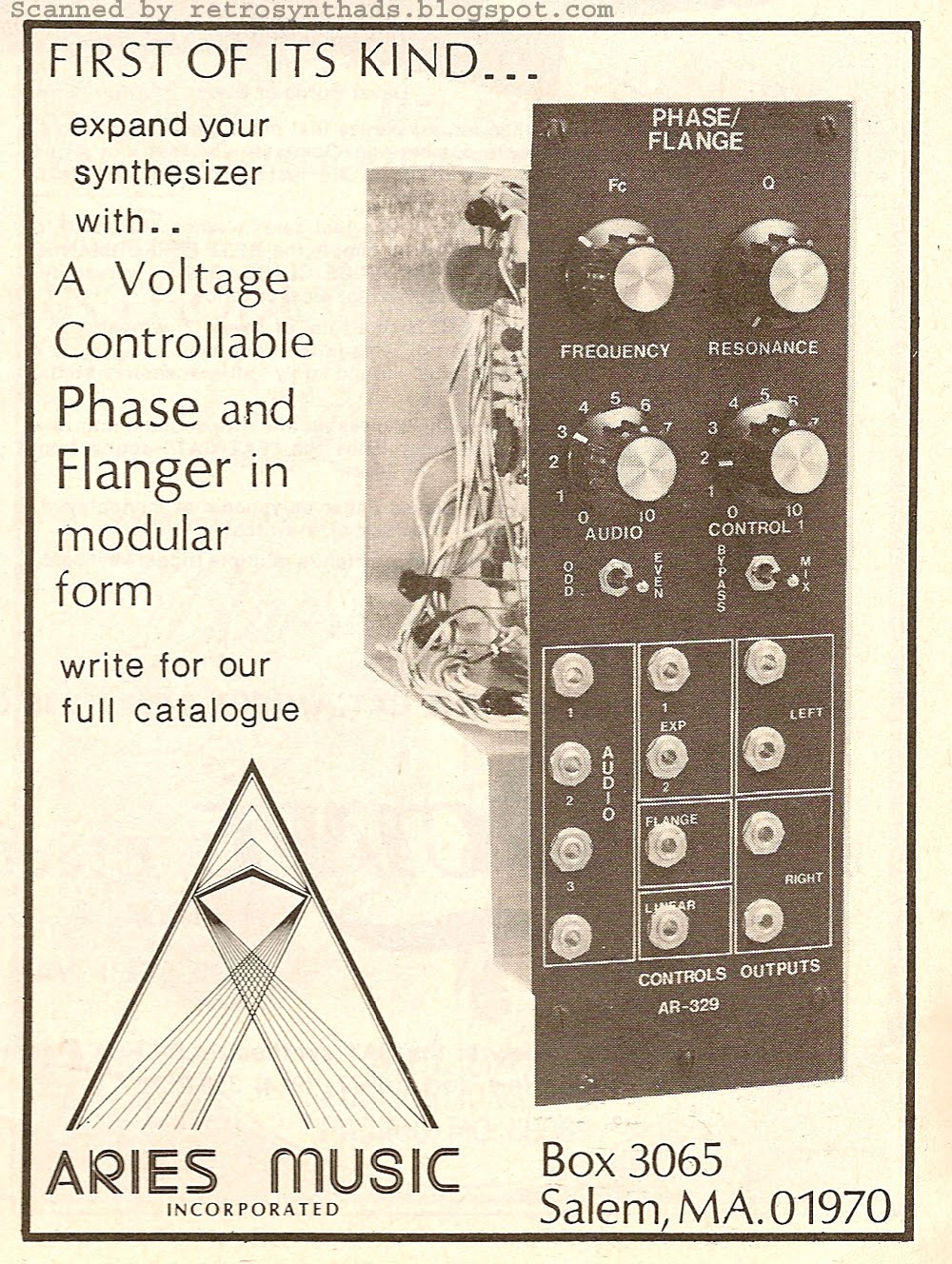
http://retrosynthads.blogspot.ca/2010/07/aries-ar-329-voltage-controlled.htmlThe Aries AR-328 reverb module is the second individual module from Aries to be promoted in Contemporary Keyboard magazine. The first module showed up in the magazine four months earlier in November 1977 and interestingly was also an effects module, labeled "a first of its kind" - a voltage-controllable phase/flange module. (see image right --->)

That first module-specific ad didn't really have too much to say, but this second AR-328 reverb module ad is another story - the ad copy, over time, has become historically interesting for a few reasons.

The first is that it directly mentions the designer of the module - Ron Rivera. According to several sources on the Web including former Aries employee Mark Styles in a "tell me more about Aries modulars" thread on Muff Wigglers, Ron "started doing modifications, and then went on to design some modules" for Aries.

Ken Perrin, commenting on an August 2006 MATRIXSYNTH auction post thread for what can only be described as a mutant ARP/Aries modular monster built by Rivera, said that "Ron Rivera worked at Arp and designed many of the later modules for the Aries Synthesizer. Ron's company was called Rivera Music Services (RMS) and in addition to designing the Aries modules Ron designed a series of modifications and enhancements to the Arp 2600 and the mini-Moog". Indeed, a few RMS ads popped up in Keyboard magazine in the early eighties.

So, that's kinda cool.

Another historical reference in the ad is for a company called O. C. Electronics. "2 Cascade spring delays by O. C. Electronics are included -- giving this the cleanest and most realistic reverb we have found anywhere." A quick Google search brought up some great info on the company.

Accu-Bell Sound Inc's Web site includes a highly information "History of Spring Reverberation" page that includes some great information on the formation of O.C. Electronics from the previously Hammond-owned Gibbs Manufacturing in Jansville, Wisconsin in 1971. When Hammond moved their reverb production to another facility [called Accutronics] "employees at Gibbs decided to start their own reverb manufacturing company called O.C. Electronics, giving Accutronics major competition in the reverb market."

According to the site, O.C. Electronics was known by many service technicians because "of the popular sticker attached to each of their units stating: Made by Beautiful Woman in Janesville, Wisconsin."

Sure enough, another quick Google search brings up this slightly uncomfortable label image from an eevblog.com discussion thread:


Apparently there are "beautiful girls" in Milton, Wisconsin too.

Its hard to make out the actual 238 module in the ad photo. So ModularSynthesis.com comes to the rescue with some great hi-res photos of theAR-328 module itself, including side views with the circuit board. The site's general Aries page is also very informative.

Interestingly, the O. C. Electronics label on the reverb unit itself  does NOT have the "beautiful girls" sticker.

Maybe someone finally figured that one out.

End note: Effects modules make fun modulars.

You'd think I would have figured that out sooner considering I've had my Moog Modular with its lovely spring reverb module for a few decades or more. But honestly, in the early days I hardly ever hooked the reverb up. I was young... naive... I usually just pulled the audio into my mixer dry and sent the signal off to an effects rack. 

What can I say - I was set in my ways.

But now with my Eurorack modular (27U and growing strong!) I've started appreciating the large number of effects modules out there and how they can fit into the signal and control flow of a patch. The Moog Modular reverb module has just two jacks - input and output. But today's units are so much more controllable and I find there is something satisfying about controlling effects using control voltages.

Time to get back to the modular. 

Monday, August 11, 2014

Roland Space Echos "What price clear music" ad, Contemporary Keyboard 1978


Roland Space Echos RE-101/RE-201 and Chorus Echo RE-301 "What  price clear music" full page colour advertisement from page 47 in the May 1978 issue of Contemporary Keyboard Magazine.

Man, is it just me, or does that black/olive green combo with pops of red look great. Wow, I love that. 

Anyways, in my recent blog post on Roland's 1984 advertisement for their SDE-series of digital delay rack effects, one of the major talking points about the design of the ad was that of readability. More specifically, Roland's design decision to consciously or unconciously put form before function and make the ad-copy fit within the design of the ad, even thought this would affect readability. In other words, the ad-copy became one big block of text.  I also pointed out that Roland had done this with other ads as well, such as the one for their 1986 Alpha-Juno ad.

And, to be clear, I liked both of those ads.  :)


"Get to the point, Retro!"

Well, my point is that Roland was doing this waaaay before those two ads were created - and you can see it in this 1978 Roland Space Echo advertisement as well. Even more interesting is the size of the logo in the various ads. In those later ads, the logo is almost as small as the ad text. Still, it's interesting that if I asked you to look for the logo, your eyes would only take a few seconds to find it. Placement is everything.

Although Roland really pushed the 101, 201 and 301 in ads and magazines (they were always the photos), the ad actually mentions that there were six models available. Six? What the....?!?!? Let's see...

According to the RE-201 Wikipedia page, The RE-100 was the earliest in the series appearing around 1973 along with the RE-200, the main difference being that the 200 also included a spring reverb. Both were later replaced by the 101 and 201, and according to Sound on Sound's excellent November 2004 article on the history of Roland, these launched in 1974.

That SOS article also dates the RE-301 as launching in 1977 and Part 2 of the article that ran a month later dates the RE-150 as coming out in 1979.

The Wikipedia page also references a later RE-501/SRE-555 rack, and SOS dates it's launch in 1980.

So, in summary:

RE-100: 1973
RE-200: 1973
RE-101: 1974
RE-201: 1974
RE-301: 1977
RE-150: 1979
RE-501: 1980

But wait... this ad came out in May 1978. And it mentions six models. But by 1978 only five models were released. Hmmm... So, either Roland jumped the gun on promoting the unreleased RE-150, Sound on Sound has some dates wrong, or... maybe I researched/typed something wrong. But, I can't find out where I may have gone wrong.

Another possibility is that Roland is including the DC-50 digital chorus that came out in 1976. It had a similar look to the RE-series - big knobs, black/green colour, etc... Later DC-models like the DC-10 (1977) and DC20/30 (1978) were much smaller units with little design similarities with the RE-series.

Huh.

http://retrosynthads.blogspot.ca/2012/10/roland-echo-chambers-re-101re-201.htmlOne last thing... because I think its neat...

A really great comparison between the RE-101 and RE-201 can be found in a 1975 "Deepen the depth of your music" Roland Space Echo brochure I posted back in late 2012. One of the neat-o things about this early Space Echo brochure is that nowhere in the actual text of the brochure are either unit actually referred to as "Space Echos". Yeah, the name is on the actual pieces of equipment, but it's like Roland hadn't realized what an awesome name "Space Echo" was back in 1975.

As you can see by this ad though, buy 1978 Roland had figured it out. And the "Space Echo" name had become a more general term, even for the "Chorus Echo".

"Space Echo". Good name for a band.  :)

Monday, April 21, 2014

Crumar "The Protagonists" family ad, International Musician and Recording World (US edition), 1978


Crumar "The Protagonists" full page colour advertisement including the Organizer-T2, Organizer-T1, Multiman-s, DS1 DIgital Synthesizer and DS2 Digital Synthesizer from page 29 in the February 1978 issue of International Musician and Recording World (US edition).

pro·tag·o·nist - noun
  • the leading character or one of the major characters in a drama, movie, novel, or other fictional text.
  • the main figure or one of the most prominent figures in a real situation.
  • an advocate or champion of a particular cause or idea.
 Well, there ya go - for all you cerebral types.  Good on Crumar not to dumb it down for a musician's magazine. :)

Over the last five and a half years that I've been blogging, I've spent exactly zero seconds talking about Crumar or their keyboards. Ziltch. Zip. Nada.  One hundred per cent of the reason has been because I've known absolutely NOTHING about them. And that's because Crumar synthesizers are very rare around these parts. Before last weekend, I had seen two in my entire life. Both DS2s. Both for only brief moments. And that was back in the early 2000s. Nothing since.

So it is with happy surprise that a DS2 just happened to come home with me last weekend. And, since they are notoriously flaky (according to Vintage Synth Explorer where they call it "a risky proposition") I'm happy to report that everything works perfectly on it. That's a photo of it right over there---->

Once I had one in my possession, I decided that I needed to do a bit of research on this beast and maybe get a little bit of history.

According to all things Wikipedia, Crumar was an Italian company, which explains why I haven't come across many of their synths in my part of the world. All the keyboards in this advertisement were first introduced in 1977 or 1978 and the DS2 was actually their first synthesizer to market. One of its main selling features was that it was one of the first synths to use digitally controlled oscillators, allowing it to stay in tune quite well - and something I noticed right away when I first turned it on and started noodling.

One of the coolest things about the DS2, in my opinion, is the amount of front panel real estate that is given to LFO control. Together it must make up about 40% of the front panel. Having two LFOs, and being able to choose which LFO controls OSC1, OSC2, VCF, VCA and pulse width - or both at the same time! - really adds another dimension to the machine.

The other crazy thing is that the DS2 also contains a basic string machine. And when I say basic - I mean basic. But it can be played at the same time as the rest of the synth, and runs through the VCF and VCA. Plus it has high and low pass filters/eq of its own. And its own LFO settings. Not too shabby.

As far as I can tell, this was one of the earliest ads for the DS2 - not just in International Musician, but in any magazine that I have in my collection. Keyboard didn't have a DS2 ad out until four months later in June 1978.

One of the first things I noticed in the ad is that the detailing of the DS2, and indeed many of the other keyboards in the ad's photo, is green. But, if you take a close look at the photo of my DS2, the detailing is in red. According to the DS2 page on Sequencer.de (underneath the photo of a green DS2), "Crumar DS-2 as green version, mornal it is red". So, apparently the red is "normal", what ever that means.

But when did the colour change?

According to Studio Dragon's user review for the DS2 on audiofanzine.com, the synth was manufactured between 1978 and 1980, and since the green version is the one in the 1978 advertisement, I'm guessing that green detailing came before red.

A Crumar DS2 auction post on MATRIXSYNTH indicates that only about 500 were made, and the serial number on my DS2 is in the 500s, so I'm guessing mine came out later on in the manufacturing run. But I can't find a date anywhere on the outside of my DS-2 - I may try and open it up later and take a look on the inside. A date may help narrow down exactly when the colour made the switch.

Well, I've only had the synth for a couple of days, but one thing I've noticed is that the beast has a nice filter, although there is a very narrow margin between not-self-oscillating and self-oscillating. But when you find that sweet spot, it has a really nice quality to it. With the help of the noise (white and pink), it makes some nice percussive sounds too.  I've already sampled it quite a few times into my Korg ESX and begun incorporating its sound into a few things I've been working on.

Not too shabby for just one long weekend of creativity.  :)

Monday, July 15, 2013

Technical Research Institute Inc. Orchestron "Your Instrument of the Future" 2nd ad, Synapse 1978

Technical Research Institute Inc. Orchestron "Your Instrument of the Future" half-page black & white advertisement from page 30 in the January/February 1978 issue of  Synapse Magazine.

I've always said there was an art to shrinking down advertisements. Whether you are going from a two-page spread down to one page, or, as happened here, one page down to a half. And in this case doing it twice since they had to shrink down the previous full page Viking Keyboard Systems advertisement as well.

Those two full page advertisements appeared side by side Keyboard Magazine, but that wasn't always the case with the half-pagers. In the November/December 1977 issue, the two ads appeared opposite each other on page 12 and 13, each on the far sides of the page, with CD reviews running down the other halves. But then, in the January/February 1978 and May/June 1978 issues, the two ads appeared on the same page.

The designer did a great job of shrinking down the ads. In fact, there is more white space now than there ever had been before!

In comparison to the previous Orchestron advertisement, only three pieces of content were left out. The first, rather insignificant piece was the last sentence of the ad-copy - "It is our desire to serve you.". Don't need it.

The second, more significant deletion was that of the price - "From under $2,500.00". But, considering that in an even more previous ad from 1976, that price point had been "From under $2,000.00", it may have been better to remove it all together since it seems that price was increasing considerably over time rather than decreasing like technology usually does.

The final piece of information removed was the call-out box from the top-right corner of the ad that explained who Dave Van Koevering was. This is what humanized the TRI/Orchestron brand - especially since Dave worked as a VP for Moog. They took out some good name recognition when they did that. But I agree, it did have to go to fit in the new, smaller space. 

As far as I can tell, this is the first Orchestron advertisement to appear in Synapse Magazine, although the previous company - Vako Synthesizer Inc. - had begun appearing much earlier in the "Listings" section of the mag under "Synthesizer Manufacturing". In fact, it continued to appear as Vako in this listing for quite a while, even though Dave Van Koevering had changed the name of the company to TRI quite a while earlier. Someone wasn't keeping up with the times at Synapse.

And speaking of confusing name changes, the first time these two ads appeared in the Nov/Dec77 issue, the companion ad for keyboard cases was stilled named Viking Keyboard Systems. There was even an Orchestron give-a-way contest in that issue under the Viking name. It was in the Jan/Feb78 issue that Dave Van Koevering changed the name of that company to Voyager Keyboard Systems and dumped the viking ship logo. 

And...and...  speaking of contests, by fluke I came across an earlier Contemporary Keyboard giveaway contest (#15) for an Orchestron from page 22 in the July 1977 issue. What is really cool about this giveaway is that CK does a great job at explaining more of the technology behind the Orchestron. More than I've seen elsewhere:
"The Orchestron operates on the principle of modulated light measured by photoelectric cells. A variable-area sound track is cut by a high-energy laser on a thin translucent disc. As the disc is rotated, a beam of light is modulated by the laser-cut soundtrack. This modulated light is converted into electrical impulses by photocells. These laser-cut recordings can be made of virtually any instrument and are played on the Orchestron's 37-note keyboard. This unit is supplied with five memory discs: violin, pipe organ, 'cello, flute and vocal choir. The pitch of the instrument is voltage-controlled and separate bass and treble boost circuitry is provided. High-impedance and balanced-line outputs are included. The duration of the laser-recorded sound is infinite, and the optical memory discs can be interchanged in seconds."
That info is GOLD! Someone needs to get that info in the Wikipedia page.   :)

Thursday, April 18, 2013

Roland "The Creative Answer" Original Stickers, 1977 or 1978


Roland "The Creative Answer" Original Stickers from approximately 1977 or 1978.

If you haven't guessed by now, I don't just love old synth ads. I've posted brochures, catalogs, newsletters, sell sheets and even belt buckles. But I'm pretty sure this is the first sticker set. 

So.... like, awesome.  Where to begin?

Well, that small middle sticker is a good place to start. Yup - that's a circular System 100 sticker with an actual little System 100 photo. Looks almost like a poker chip. When I was first getting into synths, a good friend had a System 100 in his basement and I loved going over there to noodle on it. I think it was the modularity of it that interested me most. Especially the sequencer. It was in great condition too.

The dude with the headphones and the guitar are also fantastic because the imagery is a great reflection of the time period.  The bandana/scarf around the neck, the hair cut, the v-neck shirt. All of it.  Even the boots with the stars on them.

But, with no date included on the sticker sheet, I had to estimate the year it was printed.

The colouring is still so bright that a part of me is still not convinced this is from the 70s. I did a few Google searches to see if I could find anything similar and nothing came up. A few Roland Orzabal (Tears for Fears) stickers came up though. I almost got sidetracked looking for other 80s new wave band stickers.

I also decided a few MATRIXSYNTH searches were in order. LOTS of great stickers there from a lot of synth companies. I recommend doing a few searches yourself if you are interested. But again, nothing resembling this Roland sheet came up.

With my suspicion *almost* subsided, my first idea to estimate a print date was to look at the tag line found in some of the stickers - "The Creative Answer" - to narrow down the time period. But I'm writing this part of the blog post in a hotel room and don't have access to my library of documents. I tried a couple of quick Google searches with the tag line but it didn't bring up anything.

Reviewing other Roland ads already posted on the blog found that by 1979 Roland was already using the "We Design The Future" tagline in brochures and ads. Earlier ads like this 1977 MicroComposer ad, this 1977 System 100 ad, or this 1978 "You simply don't outgrow the best" family ad don't seem to mention "The Creative Answer" anywhere in the ad-title or ad-copy. But my blog posts still make up a small sample size of world-wide Roland ads, so that tag line could still very well have been used somewhere else in print. Very likely, I'd say.

In the end, I had only the few pieces of gear that were included on the sticker sheet to help me. And based on the System 100 - introduced around 1976, and the SB-100 - introduced around 1977,  I decided that most likely the sheet was printed in 1977 or 1978.

Even now I'm still a little suspicious that these stickers may not be from the 70s at all. But they look nice, especially that System 100 sticker.

And I'm keeping 'em.  :)

Monday, February 18, 2013

Steiner Microcon vertical ad #2, Synapse 1978


Steiner Synthesizers Microcon vertical black and white half-page advertisement from the left side of page 52 in the January/February 1978 issue of Synapse Magazine.

Someone was obviously paying attention.

What an improvement over the last version of this vertical advertisement that appeared in the previous issue of Synapse.

In that previous ad, you will recall that the dark text was appearing over the top of the dark photo of the Microcon being held by the hairy Wookie. Even the name of the instrument couldn't be read.

Look over there and click ----->

But all that changed and this might be Steiner-Parker's best ad yet. Correction - Steiner's best ad yet. That's right, Parker has packed up.

Finally, with this advertisement and it's tall, vertical format, readers could get up close and personal with the Microcon. Most, if not all of the labels on all those switches and knobs are readable.

The ad-copy is also nicely laid out, with the ad-title "Steiner Synthesizers" big and bold. So is the name of the instrument, nestled gently next to the wrist in the photo. And what used to be just big blocks of ad text has been separated into three paragraphs. Much more legible.

A branding expert may have wanted them to retake the photo (assuming that newer versions of the Microcon would only have the "Steiner" name on them - and not the Steiner-Parker logo like in the photo. But I'm not gonna get picky.

Although Steiner-Parker had chose not to advertise the Microcon or any other SP instrument in Contemporary Keyboard since the end of 1976, just the other day I did notice that it did pop up in the Spec Sheet section of the July 1977 issue.
"Steiner-Parker Synthesizer. The Microcon features a VCO, and LFO, a VCF, and an AD envelope generator. It is designed to complement other synthesizer by adding an extra voice to them. The unit is about the size of a small pocket calculator in width and height, but is about four times deeper. A power supply is built in. Price is $300.00. Steiner-Parker, 2258 S. 2700 W., Salt Lake City, UT 84119."
 Two interesting things about this Spec Sheet.

First - the same summer, a similar promo appeared in the What's Happening section of Synapse, and, as I posted in my last blog post, Synapse also included the promo for the Minicon, another one of their synthesizers. But it didn't get mentioned at all in this Spec Sheet promo.

Second - when was the last time you saw something compared to a pocket calculator? And apparently a "small" pocket calculator. How awesome is that!?!? I guess in today's world, the equivalent would be a comparison to the Apple iPad Mini or Google Nexus 7 (I love my Nexus 7   :)

But unless you were an avid reader of Synapse magazine, I doubt many people interested in Steiner's Microcon ever actually saw one. Luckily today, we have Google, and in particular MATRIXSYNTH  :)

There are some good photos to be found in this July 2008 auction post, this August 2011 auction post, and this follow-up auction from October 2012. Most of the details are taken from the Microcon ads of the day.

One other really cool resource I found online was through the electro-music.com forums, where one smarty-pants engineer, David M. Ingebretsen, has created new PCBs for the Microcon. The project seems to have started back in 2011 with the PCBs shipping at the end of 2012. A cool  read for anyone interested in that sort of thing. 

And that thread led me to his own Web site, where he has resurrected a Steiner Synthasystem modular - and it looks fantastic.  He has tons of other projects too - you can read his blog here.  

I've only started to explore these pages... there goes the rest of my Sunday afternoon! 

:)
 

Monday, February 4, 2013

Strider Systems Inc. MicroSequencer "Designed for live performance" brochure, 1978


Strider Systems Inc. MicroSequencer "Designed for live performance" two-page folded brochure from 1978.

I think this is a first. In over four years of posting scans, I don't think I've ever posted a scan that wasn't mine - either through my personal collection, or given to me by some generous interviewee or reader. But I just couldn't resist with this one.

If you've been keeping up with my blog posts lately, you know I've been on a bit of a Strider Systems kick and while doing my research I managed to track down then co-owner and president Jim Christensen. During a follow-up email on the Microsequencer, he was generous enough to provide this scan of the original brochure and give me permission to post. Up until I saw this brochure, I've never stumbled across any other reference to the Microsequencer except the single ad I posted last week

The brochure provides a lot of new information about the functionality of the sequencer, but to me the most important reason for getting this brochure online is that photo. It really helps provide good reference to its size and functionality.

As the brochure states, the Microsequencer came bundled in a "compact case" that could "be placed beside or on top of your keyboards", with a slanted top "for easy operation of the controls". The digital display and the 1/8" mini-jacks further help to put its minute size in perspective.Small indeed.

I also love that front cover of the brochure. For two reasons.

The first is the alternate name for the Microsequencer - " µSEQ ". Using the "micro" symbol just adds to the hipness of this little device. And makes the name as compact as the sequencer itself.

The second reason I love that front cover is that HUGE logo. Ever since I first came across the Strider Systems logo, in the back of my mind I've always wondered something. And, quite frankly, I'm a little surprised no one else has commented or emailed me about it.

I'm talking about Lord of the Rings.

This logo is screaming "Seven stars and seven stones and one white tree". If you do a Google Image Search the resemblance is amazing. And then when you put that together with another LOTR reference - the name of the company: Strider Systems - I start going into full-on geek mode.

[Aside: It reminds me of another great literary reference from a keyboard ad. Yup - the Arthur C. Clarke quote from an E-mu advertisement that appeared in Keyboard Magazine back in 1982.  One of my favorite quotes of all time.]

I couldn't resist asking Jim if the company name was LOTR-influenced.
"Yes, it was intentional. Strider (Aragorn of Arathorn) was a big hero of Roy's [Jim's business partner]."
So then who designed the logo? 
"My younger sister (she was 24 at the time). 'Seven stars, seven stones and one white tree.'"
Jackpot!

And it makes total sense.  Lord of the Rings was huge in the 70s. From Wikipedia:
"The Lord of the Rings has had a profound and wide-ranging impact on popular culture, beginning with its publication in the 1950s, but especially throughout the 1960s and 1970s, during which time young people embraced it as a countercultural saga. "Frodo Lives!" and "Gandalf for President" were two phrases popular among American Tolkien fans during this time."
Even the game Dungeons & Dragons threw in many of the races found in the books "as a marketing move to draw on the popularity the work enjoyed at the time" Gary Gygax was developing the game. And this led many games that were influenced by D&D to carry on these LOTR references into the games of today. How awesome is that.

But most importantly, music of the 70s was also influenced by LOTR. Led Zeppelin, Rush, Styx and Black Sabbath. And I'm sure there were more.

So, put it all together, and there is little chance that at some point in time a high-tech (*ahem* "geek") start-up synthesizer company wouldn't be influenced by LOTR.

Genius.

I've said it before, and I'll say it again:

Talent borrows. Genius steals.

Thursday, January 31, 2013

Strider Systems Inc. Microsequencer "The Live One" ad, Contemporary Keyboard 1978


 Strider Systems Inc. Microsequencer "The Live One" 1/6-page black and white advertisement from the bottom right-hand side of page 57 in the June 1978 issue of Contemporary Keyboard Magazine.

The DCS-1 and DCS II were definitely the focus of Strider Systems Inc. in magazines like Contemporary Keyboard and Synapse - both in terms of advertisements and product promos. But those were not the only products coming out of this five-man shop in Oklahoma. A few other products managed to make it out of the factory at one time or another.

For example, what sounds like a really cool little digitally controlled device could be spotted in the March/April 1978 issue of Synapse called the Digital Envelope Generator (DEG).
"Strider Systems Inc. has release a Digital Envelope Generator (DEG) designed for the original equipment manufacturer market. The DEG is a micro-computer controlled, 37 input, single output audio mixer and keyboard scanner combined on an 8"x10" printed circuit board. The microcomputer scans a multiplexed 37-note keyboard for keypress and release information to generate independent loudness transients for each of the 37 audio input channels. The factory presets 64 ADSR and LFO envelopes, and custom programming is available on a 10-day turn-around. In quantities of 100 units and up, the DEG sells for $350.00, with small quantities for $750.00 per board. For more information, write: Strider Systems P.O. Box 2934, Norman, OK 73070."
I contacted co-owner and President of Strider Systems Inc. Jim Christensen about the DEG to see what he could remember about it.
"If I remember correctly, the DEG was a sort of probe to see if there was any market for this kind of product targeted at Original Equipment Manufacturers (OEMs), as we were beginning to realize that we were too small and underfunded do the whole thing ourselves. We had a prototype running but did not do any layout for the full board, as we had no response. Thinking back, it's clear that other manufacturers would want to keep the digital portion of the system as a core technology rather than farming it out."
Although I couldn't find any DEG advertisements in CK or Synapse (makes sense since a product like this would more likely get advertised in manufacturer/trade mags), another product that came out of Strider in 1978 did deserve a few advertising dollars - the Microsequencer.

This piece of kit popped up on my radar early on in my Strider Research and I suspected the technology around it was pulled directly from the 256-note sequencer that was available on the DCS II synthesizer.

But when I asked Jim about the Microsequencer and my theory on its development, he replied that it was a totally different design that "used a single D/A circuit both for CV output and input (using a comparator and programmed A/D algorithm)".  I'll take his word on those specs. Engineers...   :)

This $450.00 sequencer was only 63-note. And when I say "only", that's "only" when compared to the 256-note sequencer integrated into the DCS II. For 1978, a stand-alone under-$500 63-note sequencer wasn't too shabby. For comparison, the Korg SQ-10 analog sequencer was advertised with 24 notes in 1980, the Wasatch Music Systems Sequencer 1020a handled 20 notes in 1976, and the ARP Sequencer ad with the really really really creepy hand looks to have provided 16 notes for $795.00 in 1976.

But with such a small ad budget and with funding rapidly running out, Jim told me that they probably only sold a dozen or so.

Too bad - it looks like a cool little machine.  Wait... what? "Looks like"? There's no photo...

No, not in the ad. But there is a photo in the brochure scans that Jim sent me.

I'm saving that one for next time.  :)


Monday, January 28, 2013

Korg MS-20, MS-10 and SQ-10 "The Second Generation of Korg Synthesizers" brochure, 1978


Korg MS-20 and MS-10 synthesizers and SQ-10 sequencer "The Second Generation of Korg Synthesizers" brochure from approximately 1978.

 Gorgeous, eh? I know.

I've been going strong on my Strider System posts but then last week Korg came out swinging at NAMM and I just had to interrupt my thought process to post this baby. We'll get back to Strider on Thursday, but today here's my way of toasting Korg's balls for not only doing what they did, but apparently doing it RIGHT.

If you are not aware, Korg has introduced (eeerr... reintroduced?) the Korg MS20 Mini. From the Korg Web site:
"Korg’s MS-20 monophonic synthesizer, first introduced in 1978, is still a coveted instrument to this day, thanks to its thick, robust sound, its powerful, iconic analog filter, and its versatile patching options. Over 300,000 people have enjoyed the distinct MS-20 sounds from the original, from Korg’s MS-20 plug-in synth, or the iMS-20 iPad app.

Today, the sounds of the MS-20 have been reborn in hardware, as the MS-20 Mini. The same engineers who developed the original MS-20 have perfectly reproduced its circuitry and fit into a body that’s been shrunk to 86% of the original size, yet retains the distinctive look of the original"
Perfectly replicated, PLUS MIDI in and a USB connector. Hello!

Even before it was officially announced, the rumors spread fast. Vintage Synth Explorer's forum, MATRIXSYNTH and pretty much everywhere else. I'm surprised it was kept quiet for as long as it was.

Now, I love my original MS-20, but I will be first in line at my local store to pick one of these up. Heck, I may even sell my MS-20.

Well, actually... probably not. But you get my drift.

This brochure is awesome in so many ways. The font choice - spectacular. And also the front cover family photo and all the individual portrait photos of the MS-10, MS-20 and SQ-10. And also all those delicious features and specifications that accompanies each piece of gear sitting on each of their opposite pages.

Those are some nice spreads - each one would have made made it onto my bedroom wall beside my Annie Lennox poster.

And speaking of the spreads, there was a good reason that I ended up loading the inside pages separately instead of as individual spreads. Blogger has a size-limit for images, and will shrink down larger images if you upload above the limit. When I did full spreads, they horizontal width triggered resizing and shrunk 'em down to a point that the specifications weren't even legible.

Even if you shift-clicked on the images and zoomed in, the detail just wasn't good enough. I've included them below. For comparison, the above individual images were uploaded with a width of 1600 pixels. The below spreads had a width of 3200 (double). You can definitely see the difference in resolution with you shift-click on the images. Boo.

But even at this smaller size they are still mighty impressive.


The back page of the brochure is probably my favorite - both the colours and the photo are excellent. With the Stage Echo sitting there beside the synths.

One disappointing thing about this brochure is that there is no date to be found. I gave it a date of 1978 considering this is when the gear ads originally started showing up in CK - but that was back in November, so this brochure could very well have been printed in 1979 or even later. But I'm an optimist. :)

Looking back at my other posts for the MS-20 and MS-10, I realized I never posted the Spec Sheet promo that appeared in the January 1979 issue of Contemporary Keyboard, shortly after the ads for these instruments started running.
"Korg Synthesizers. The Korg MS-20 synthesizer features two 10-octave VCOs, two VCFs, a 3-octave keyboard, two envelope generators, and a programmable control wheel (modulation routing can be set up however you like). Also included are a second VCA and a white and pink noise generator. A patch panel allows interfacing with another instrument, or the MS-20 can be patched internally into routings other than those provided in the hard wiring. The Korg MS-10 is a single VCO version of the MS-20 with a 2 1/2 octave keyboard. Prices are: MS-20, $750.00; MS-10, $450.00. Unicord, 75 Frost St., Westbury, NY 11590."
With the release and no doubt crazy popularity of the new MS-20 Mini imminent, I'm hoping we can expect Korg to release mini versions of the MS-10 and SQ-10 as well. And maybe it will also be the kick in the pants Roland needs to FINALLY try and bring out new versions of their XOX- line.

Drool.


Thursday, January 10, 2013

Dennis Electronics "Expand your synthesizer!" ads, Synapse 1978


Dennis Electronics "Expand your synthesizer!" 1/9th-page black and white advertisements from page 39 in the March/April 1978 and page 38 in the May/June 1978 issues of Synapse Magazine.

If you've been reading the last few posts, you know Dennis Electronics about as well as I do. Sure, I'm interested in the gear the company manufactured, but it's also been about piecing together as much of the history as I can. I wanted to find out as much as I could about Dennis, and get the info online and into search engines with the hope that someone with more information, even Dennis himself (if he is an actual person), would come across it and fill in a few blanks.

So far I've posted the initial VCO module 1/4-pager that appeared in the July/August 1977 issue of Synapse and the rather dull follow-up Control Voltage Processor 1/12th-page ads that appeared in the two following issues. And in all that time I've learned very little about the company and the modules.

But finally, these slightly larger 1/9th-page ads provide the space required to give us a lot more information about the Dennis 201 Control Voltage Processor. And, just like in the those earlier two 1/12th-pagers, the copy-writer had twiddled the ad a little between the first and second version to make in more effective.

In the first March/April 1978 advertisement ("13 modules in 1") readers finally got to know exactly what a Dennis CVP module contains. And, they get to see what it looks like too. That photo may be small, but you can still pick out some of the jacks, dials and switches. And there were more than a few of them.

Other tidbits of knowledge:
  • a call to action - ORDER NOW
  • a price -$299.00  (jackpot!)
  • and the accessories that come with the unit - power supply and mahogany cabinet
Not too shabby, and it gets better.

In the follow-up ad, the description turns from what is available on the module to what the module can process. And, as noted above, we gain a few more tidbits of knowledge from the tweaked ad-copy in this later version.
  • comes with detailed instructions
  • a catalog was available for 25 cents
All that juicy information, packaged up and nicely organized into that small little space. With room for white space to boot.

And it could be said that Dennis had good timing too. With that first ad in the March/April 1978 issue, we also find out in the Notes from the Editors section that Synapse had grown from its humble beginnings to over 7000 subscribers. And that doesn't include all the non-subscribers out there picking up the issue from their ever-expanding list of distributors. A sizable module-synth-loving audience.

Unfortunately, this looks like the beginning of the end for Dennis - in Synapse anyways. These were the last two ads that I could find. The company kept appearing in Listings section up to and including the January/February 1979 issue. But by the Summer 1979 issue, Synapse had done away with their "Listings" section, I'm guessing because in a way it was giving away free advertising.

I did do a bit more of an exhaustive search online once I could include "control voltage processor" in my searches and came across a few online references. Interestingly, the more common reference was in relation to the creation of the Sequential Circuits Prophet VS!

Side note: For those not familiar with the awesome Prophet VS, it was awesome and rather unique mid-80s synthesizer that allowed the programmer to use a joystick to blend four different waveforms over time. The results are some seriously awesome sounds.

 Lord Frito (I'm not kidding) posted an article by Chris Meyer, ex-employee of Sequential from the VS WaveWrangler User Guide from 1991 (and updated July 1999 and June 2001 by the author) called "The Birth of the Prophet". Simply put, the author was looking at the way the PPG handled waveform cross-fades and he started thinking about how to cross-fade in two dimensions rather than one. He ended leaving the office to "patch it up at home on my rag-tag modular synthesizer".

That "rag-tag" modular he is referring to is an amazing assortment of synth components. The full article is an interested read, but if you are too lazy or don't have time time to click on the link, I've included those paragraphs below:
"For some reason, I was originally convinced that all four waveforms had to be at exactly the same frequency, with their only differences being their waveshape (and therefore, timbre). I plunged into my already heavily-modified Oberheim TVS 1-A (Two Voice Synthesizer - a pair of old SEM modulars, a sequencer, and a three octave keyboard in a road case) and found a way to sync all four oscillators. I then dialed up four different waveforms by playing with the waveshapes, sync tuning, and filters. Since the TVS has only two filters, to create more variations I used my hand-built linear-based PAiA modular for the other two, employing a Korg MS-02 exponential-to-linear control voltage converter to make sure they all tracked the Oberheim's keyboard together.

I then patched the four resulting VCAs from a custom cabinet built by Gentle Electric, using the various control voltage mixers built into it and the inverters and bias offsets in a Dennis Electronics Control Voltage Processor to perform the crossfades. The timbre mix was animated by envelopes from a Sequential Model 700 programmer and an LFO patched in from the Oberheim. This was all mixed together and fed into a final VCA, also controlled from the Oberheim. In the end, one voice took up almost my entire collection of analog synths, spread across modules from six different manufacturers."
D. R. O. O. L.

How awesome is that!  I haven't seen name-dropping like that since a late 1970's ARP post.  :)

The second reference could be argued to be almost as historically significant as Dennis Electronics role in the development of the VS. 

An Electronotes index listing from Tim Stinchcombe's Web site includes the name of an employee - D. Genovese - in an article title in Volume 10, issue 88 (1978)
"A. Envelope Follower With Improved Ripple And Response Time (D. Genovese, Dennis Elect.)"
 Further searches didn't bring up anything noteworthy. But I didn't spend a lot of time (work, work, work!) - so there could be more to dig up for those with time to spare.

But that brings my Dennis Electronics fact-finding missipon to an end for now. Dug up some good info, but  unfortunately didn't end up finding out where Dennis Electronics ended up. Did they get out of the business completely? Did the owner or employees end up working at larger, more successful companies?

Like many creatures of the lost ages, they popped up onto the timeline for a brief period and played their role in the evolution of synthesizers.

And then just disappeared.

Monday, January 7, 2013

Dennis Electronics "Expand/Increase your synthesizer's capabilities..." ads, Synapse 1977/78


Dennis Electronics "Increase your synthesizer's capabilities..." and "Expand your synthesizer's capabilities..." 1/12-page black and white advertisements from page 36 in the November/December 1977 and page 50 of the January/February  1978 issues of Synapse Magazine.

If you recall, my last blog post focused on a small Honolulu-based synth manufacturer called Dennis Electronics. I had been following a trail through old issues of Synapse Magazine to see if I could find out more info about them.

By the end of the post (and up to the time their first ad appeared in the July/August 1977 issue) I had figured out that they had recently redesigned their "system" and were blowing out their old stock. Their new module was a VCO that used an envelope input to continuously modify the timbre from a sine wave to a "big fat" pulse using a technique the company described as "Dynamic Depth FM technique (through 0)".  I also learned that, unlike some of the other smaller manufacturers of the time period,  Dennis Electronics was not offering their modules as kits.

But oddly, even with the publication of that advertisement, we still didn't have a module name or model number. Just "VCO".  This time, all we get is "Control Voltage Processor". More on Dennis in a second, but  first a small history lesson about the magazine Synapse itself.

Let me back up a bit...

When I first got by grubby little paws on the 1977 and 1978 issues of Synapse as a full lot, I was told it was a complete set. But, the September/October 1977 issue was missing. For a magazine squirrel like myself, missing an issue is a rather troubling matter. It gets under my skin like a creature from Alien whenever I'm flipping through old issues, trying to track down some information. What info was I missing? What nugget of gold was in that issue that I don't know about.

It was until a while later that I learned the truth. There simply was no September/October issue. And the answer had been there in the volume numbers at the top of the mags, and on page 2 of the November/December 1977 issue in the notes from the publishers - Doug Lynner and Chris August.
"Don't get nervous. You haven't missed the September/October Synapse. With our move to increased newstand distribution cover dates have become a bit more critical, so this issue became November/December - no one missed an issue. Volume numbers are still the same. Why don't you relax, buy a six-pack with the cash you'll save by subscribing or renewing  before the end of the year..."
Anyways, the point being that Dennis Electronics continued to be included in the ever-expanding "Listings" section under "Synthesizer Manufacturers" in the November/December 1977 and January/February 1978 issues of Synapse. And so telling that little cover-date story will make sure I don't get accused of glossing over a missing September/October issue by some eagle-eyed reader.

And, more importantly, the fact that its an awesome little piece of Synapse history! Much like when Keyboard misprinted the date on their October 1982 issue or dropped the word "Contemporary" from their title.

So, where was I... oh yeah... Dennis continued to appear in the "Listings" section at the back of the magazine. Unfortunately, unlike that Listings section, Dennis ads were NOT expanding. The exact opposite. The next two ads to appear in the magazine were these two 1/12th-page advertisements.

Although they are simple little ads, they are also simple little examples of how a good copy-writer can make all the difference.  In that first advertisement, the copy is a little awkward with a touch of verbal diarrhea. In comparison, that second shorter version just flows like melted butter in a reader's mind.
"Increase your synthesizer's capabilities many fold"
compared to
"Expand your synthesizer's capabilities"
So it will expand my synth's capabilities. Okay.

But how? Even a 1/12-page ad can contain too little information.

And now what? There is no call to action.

Even a simple "Write for more information" or "Write for a free catalog" would have helped this ad out. I'm all for white space, even in smaller ads, but a little bit more information and a call might seduce just a few more readers to slap a stamp on an envelope.

I'm not saying you have to go full-on-used-car-tv-commercial-like on reader's @sses like this CFR Associates/Tau Systems 1230 VCO module advertisement from the same issue as the first Dennis ad I've posted today. It may contain more fonts that a 1991 rave flyer and verge on unreadability, but it is more visually interesting and contains other bits of info like price, call to action and so on.


Luckily, it wouldn't be long before Dennis finally figured it out. But would it be too late?

Thursday, November 1, 2012

ARP Omni-2 "We're a rock and roll orchestra... / Kerry Livgren" ad, Contemporary Keyboard 1978


ARP Omni-2 "We're a rock and roll orchestra... / Kerry Livgren" black and white and orange full page advertisement from page five in the November 1978 issue of Contemporary Keyboard.

It's Halloween night! And I've already had a recycling container and a spider monkey come to my door! They both got extra candy. Every year I get the 90 or 120 packs of mini bars and twizzlers - and every year only about forty kids show up.

But this year, even with all this candy hanging around, I've still been able to hold out and not eat a single treat. And I'm not just talking about tonight. I have yet to eat even one mini chocolate bar this year. Bam!

[kids coming to my door - ballerina in a parka, Woody (toy, not pecker), ninja, and ????]

And to celebrate, here is the second and last Omni-2 "Halloween"-themed ad, and the third in the full ARP series as far as I can tell.. Unfortunately, ARP decided to move on after this ad last appeared in January 1979. I think the theme could have easily lasted another three months, changing up the performers every two or three months. But hey, always leave 'em wanting more. Right?

[more kids - two cowboys, a princess, and Thing 1 and Thing 2!]

So, here they are all in a nice little row.


In that first one we had spooky Tom Coster, in the second happy frankenstein-like Allan Zavod, and now ghostly Kevin Livgren. A trifecta!

[kids - ghost, smurf, guy in just a hat (booo!) and a three year old batman]

There is something to be said for continuity from top to bottom - large image of musician, main quote in larger font, small more recognizable photo of musician face, three columns of ad-copy, logo, large ad-title, slogan, other musicians.

[more kids - Mick Jagger (apparently), a boat, and three girls in pajamas]

They moved around a few small bits, but overall pretty much stayed constant throughout.

[Hulk, bumble bee (insect, not robot), and a pirate]

Okay...

[small child with the label Spiderman pinned to his red outfit, cheesehead, another batman]

Kids starting to come a bit faster...

[robot, cat and mouse, pikachu!]

So much yelling...

[another ninja, thing from the movie Scream (mask is off because it is "sweating her face"), another kid in parka]

I think this might be a record. I'm not gonna get anything else written.

Blogging done for tonight.

Monday, October 29, 2012

ARP Omni-2 "Big polyphonic synthesizer sounds.../Allan Zavod" ad, Contemporary Keyboard 1978


ARP Omni-2 "Big polyphonic synthesizer sounds.../Allan Zavod" black and white and orange full page advertisement from page 41 in the September 1978 issue of Contemporary Keyboard Magazine.

Halloween is getting closer and closer, and I think I'm finally getting into the spirit. Pumpkin is ready to be carved and boxes of candy have been bought. Even more surprisingly, I still haven't opened any of that candy stash. Usually I'd be on box #2 by now.

That *is* a first. But there is still three nights to go. Let's not get too optimistic. My insulin levels are already rising in anticipation of a will-power breakdown.

Anyways, Just like I'm prep'd for Halloween, ARP was locked and loaded with the new look of their synth front panels - what I have been referring to as their Halloween colours or theme. Usually this term has been used when referring to one of the three colour palettes of the Rhodes Chroma's panel that used orange, red and yellow colouring. But, since it was Philip Dodds, VP of Engineering at ARP and product manager for the Chroma at CBS/Fender, that came up with the term, I'm going to say its okay to use with other ARPs as well.    :D

The first ARP ad that used the new colours was an Odyssey advertisement that featured Tom Coster of Santana fame.


The following month, ARP decided to give the same kind of make-over to their Omni-2 ads. And readers of Keyboard would have had the opportunity to come across both of these ads in the September and October 1978 issues of Keyboard. Nice. The more I look at these ads, the more I like 'em (could be all the talk of sugar too).

Now, if like me you found Coster had a spooky jack-o-lantern kinda look to him in that Odyssey ad, you may also have found that Allan Zavod superficially resembled a very happy Frankenstein in this Omni-2 ad.

I'd be a very happy looking person too if I was surrounded not just by Omnis, but those other ARP synths as well. Look to be 2600s to me.

I don't have 2600s surrounding me at the moment (I haven't checked my lotto ticket yet), but thanks to Allan Zavod and this ad, I am still quite happy because of all this ad-copy. Well, actually, just that last paragraph.
"Thanks to Allan Zavod, and more than five thousand other great musicians around the world, the ARP Omni has become the most popular synthesizer in music history..."
 Unless you are Apple Computers or Nintendo and your quarterly earnings are through the roof, its often quite hard to get a company to cough up real production numbers. Usually companies will try and keep those numbers confidential for as long as possible.

So, after almost a year of ARP bragging that more Omni's have been sold than any other synthesizer, we finally have a number from ARP (over 5000) to back up that claim. 5000 doesn't seem like a lot now, but back in 1978 synths were still falling slowly towards affordability. But it wouldn't be long after that new technologies would make both the power of synths skyrocket while bringing prices to the lowest they have ever been.

The result? Well, after the DX7 was released approximately four years after this ad appeared in CK, it apparently sold over 160,000 units according to Wikipedia. The M1 came out in 1988 and sold 250,000 units. Interestingly, each of these machines sold for $2,000 - more or less.

Of course, you have to take into account inflation. One online inflation calculator tells me that $2000 in 1978 had the same buying power as $3,143.32 in 1983 and $3,717 in 1988. So, costs down, but technology in those machines definitely skyrocketing.

If only I could same for the Halloween mini Mars and Snickers bars where although prices for a box of 90 seem to go down every year, so is the size of the little bars in each little package. I have to eat something like ten now just to get a full chocolate bar fix.

Or at least it seems like it.

Thursday, October 25, 2012

ARP Odyssey "You cannot duplicate the sound of the ARP Odyssey..." ad, Contemporary Keyboard 1978


ARP Odyssey "You cannot duplicate the sound of the ARP Odyssey..." black and white and orange full page advertisement from page 41 in the August 1978 issue of Contemporary Keyboard.

Oooooh - Halloween is approaching and I think I'm finally getting into the spirit of the season. My gothy/industrial-influenced teen-age years give me a natural affinity for skulls. Even earlier, as a child, a glowing skull is one of the few things I brought back from Disney. No mouse ears for this young pirate.

If you haven't seen the trend yet in these blog posts as of late, ARP has also been approaching full-on Halloween-ess in their ads. 

And so here we have ARP going full-on jack-o-lantern in this new Odyssey advertisement. It makes sense that this ad first appeared in the August 1978 issue of CK and then continued to run monthly through September and into spooky October as well.

I really like that the designer of the ad took the next logical next step and incorporated the new synthesizer panel colour scheme ARP first introduced on their gear last March into the actual ad itself.


And speaking of spooky, doesn't Tom Coster look just a little bit spooky in that black and white ad photo. I'm not saying I don't like that image. Its actually quite awesome because if you look closely, I'm pretty sure that's a maple leaf on Tom Coster's shirt. Go Canada!

In fact, it kinda looks like an NHL Maple Leafs jersey, no? But, if Google images is any indication, it doesn't really look like a 1978-style jersey. Not really a hockey fan anyways. But still get a kick out of the idea.

I checked his Wikipedia page and did a few quick Google searches to see if I could confirm he is/was a hockey fan, but nothing came up. But Wikipedia does tell me he was born in the hockey-town of Detroit (although raised in San Francisco).

Like the ad in Monday's ARP post, this ad has a lot of text running across the page. But this time at least a large portion of it is quotes from Tom - makes the ad more personal. And, this time the ad copy isn't running all over the imagery. Let's face it, that last ARP Omni-2 ad was a bit of a dog's breakfast.


For comparison, I've put them side by side above.

We still have a lot happening in this new Odyssey ad, but just that little bit of extra white space (er.... black space) makes it a much more visually balanced ad. The eye has places to focus on. Even the ad-title at the bottom of the page that is in such close proximity to the ad-copy looks good. And those oange accents on the name of the synth and the ARP logo also give this ad a nice kick.

So, yeah... ad itself, less spooky on the readability front. More spooky on the Halloween front.

Just the way I like it.