Showing posts with label aries. Show all posts

Monday, April 27, 2015

Aries Music Inc. AR-328 Stereo Reverb and Output module "Make some space for your sounds!" ad, Contemporary Keyboard 1978


Aries Music Inc. AR-328 Stereo Reverb and Output module "Make some space for your sounds" 1/4-page black and white advertisement from page 46 in the March 1978 issue of Contemporary Keyboard.

It's been almost three years since I've blogged about Aries and their ads. Too long.... too long...

As I've mentioned in the past, Aries ads fell into two main categories - general ads about Aries instruments and ads dedicated to the promotion of individual modules.
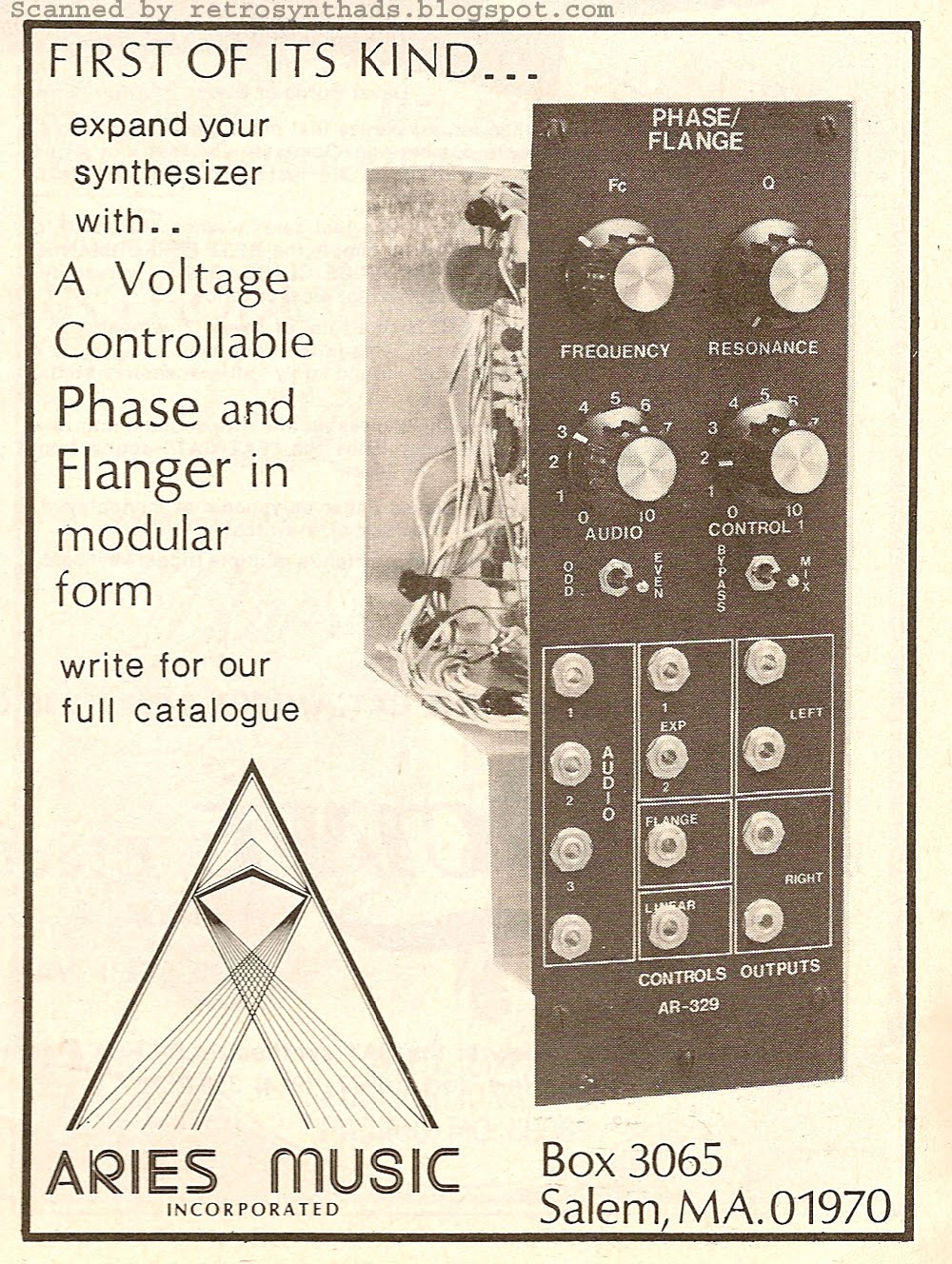
http://retrosynthads.blogspot.ca/2010/07/aries-ar-329-voltage-controlled.htmlThe Aries AR-328 reverb module is the second individual module from Aries to be promoted in Contemporary Keyboard magazine. The first module showed up in the magazine four months earlier in November 1977 and interestingly was also an effects module, labeled "a first of its kind" - a voltage-controllable phase/flange module. (see image right --->)

That first module-specific ad didn't really have too much to say, but this second AR-328 reverb module ad is another story - the ad copy, over time, has become historically interesting for a few reasons.

The first is that it directly mentions the designer of the module - Ron Rivera. According to several sources on the Web including former Aries employee Mark Styles in a "tell me more about Aries modulars" thread on Muff Wigglers, Ron "started doing modifications, and then went on to design some modules" for Aries.

Ken Perrin, commenting on an August 2006 MATRIXSYNTH auction post thread for what can only be described as a mutant ARP/Aries modular monster built by Rivera, said that "Ron Rivera worked at Arp and designed many of the later modules for the Aries Synthesizer. Ron's company was called Rivera Music Services (RMS) and in addition to designing the Aries modules Ron designed a series of modifications and enhancements to the Arp 2600 and the mini-Moog". Indeed, a few RMS ads popped up in Keyboard magazine in the early eighties.

So, that's kinda cool.

Another historical reference in the ad is for a company called O. C. Electronics. "2 Cascade spring delays by O. C. Electronics are included -- giving this the cleanest and most realistic reverb we have found anywhere." A quick Google search brought up some great info on the company.

Accu-Bell Sound Inc's Web site includes a highly information "History of Spring Reverberation" page that includes some great information on the formation of O.C. Electronics from the previously Hammond-owned Gibbs Manufacturing in Jansville, Wisconsin in 1971. When Hammond moved their reverb production to another facility [called Accutronics] "employees at Gibbs decided to start their own reverb manufacturing company called O.C. Electronics, giving Accutronics major competition in the reverb market."

According to the site, O.C. Electronics was known by many service technicians because "of the popular sticker attached to each of their units stating: Made by Beautiful Woman in Janesville, Wisconsin."

Sure enough, another quick Google search brings up this slightly uncomfortable label image from an eevblog.com discussion thread:


Apparently there are "beautiful girls" in Milton, Wisconsin too.

Its hard to make out the actual 238 module in the ad photo. So ModularSynthesis.com comes to the rescue with some great hi-res photos of theAR-328 module itself, including side views with the circuit board. The site's general Aries page is also very informative.

Interestingly, the O. C. Electronics label on the reverb unit itself  does NOT have the "beautiful girls" sticker.

Maybe someone finally figured that one out.

End note: Effects modules make fun modulars.

You'd think I would have figured that out sooner considering I've had my Moog Modular with its lovely spring reverb module for a few decades or more. But honestly, in the early days I hardly ever hooked the reverb up. I was young... naive... I usually just pulled the audio into my mixer dry and sent the signal off to an effects rack. 

What can I say - I was set in my ways.

But now with my Eurorack modular (27U and growing strong!) I've started appreciating the large number of effects modules out there and how they can fit into the signal and control flow of a patch. The Moog Modular reverb module has just two jacks - input and output. But today's units are so much more controllable and I find there is something satisfying about controlling effects using control voltages.

Time to get back to the modular. 

Thursday, July 12, 2012

Aries Music Inc. Modular Synthesizer ad, Contemporary Keyboard 1978


Aries Music Inc. 1/4-page black and white modular synthesizer advertisement from page 38 in the February 1978 issue of Contemporary Keyboard.

I gotta say this Aries ad really starts to freak me out after a vodka cooler or two. Yes, vodka cooler. Don't judge.

The last Aries ad I posted didn't have any type of imagery included, and the ones before that, like this voltage controllable phase and flanger usually included a photo. I've included a few examples below.


But this latest one puts Aries ads on a whole new psychedelic level. My ex is a scientist, and those images look like phytoplankton or algae or whatever drawings she would create after peering into her microscope. No kidding.

I'm not saying I hate it - in fact I'm drawn to it. Like a moth to a flame.

Any ways, I think one of their best messages gets a little lost in this advertisement:
"We think musicians want performance over packaging".
 It's surrounded by all that talk of kits and choice and stuff. Those are good messages for sure - but not as snappy as "performance over packaging". Neat and tidy.

It makes me think back to those Pepsi Challenge taste tests, where Pepsi removed the packaging from both the Coke and Pepsi bottles and asked consumers to compare the taste. True performance over packaging. And no, I'm not getting paid by Pepsi. I think I actually prefer Coke most days. Been a long time since I've had either in a non-diet form.  :D

That second paragraph kind of gets back on message in terms of performance with the promotion of that Aries manual that the Boston School of Electronic Music created.  I wrote a bit about the manual in my last Aries blog post, but quickly got sidetracked by surfing around looking for more info on that electronic school in Boston as well hanging around Robert Leiner's most awesome Aries Web site's home page. That site just happens to have tons of information, scans of catalogs and stuff - and also a mention or two about the manual.


For example, Robert's site has transcribed certain parts of different catalogs and manuals, and the "introduction" link on the left navigation bar will take you to an Aries Music / Series AR-300 Systems Introduction page written by Aries President Bob Snowdale. Near the end of the intro is a good little piece of reference material about the evolution of the manual and what was to come.
"We offer software support for our instruments. We have expanded our Owner's Manual to 143 pages of information, patches, experiments and instruction in the use of the AR-300 Series modules. As we add more modules we add supplements to the manual including information on the new modules. Written by Ken Perrin, our manual is designed to offer basic understanding of and instruction in the use of our instruments.

We have additional manuals planned. One is a series of laboratory experiments in Fourier synthesis for college-level physics instruction. This manual was written by Jerry Lemay and is based on the use of the AR-332 phase-modulated sync VCO's included as part of the Aries Music "Physics" system. Mr. Lemay uses both the manual and the system in classes at Southeastern Massachusetts University. The manual will be available to our customers in the summer of 1979."
Nice! The manual has grown from the original 93 or so pages up to 143 pages - and was to continue to expand!  That introduction also provides some other great information about Aries' business model and customer service. A definite read.

But one of the coolest pieces of the Web I came across while doing a little bit of Googlin' on Aries and manuals was on preservationsound.com. There I found a modular synthesizer article PDF scan from the May 17, 1979 issue of Down Beat, with the rather witty title SynthesizeIt Yourself - Erector Sets for Grownups by John Balleras. Back in 1979, John had this to say about the manual:
"Aires, incidentally, distributes one of the best operating  manuals I've come across. Written by Kenneth L. Perrin and the staff of the Boston School of Electronic Music for use on the Aires 300 system, this text is both theoretically and practically adaptable to any modular synthesizer and to many prepatched ones as well."
The article also mentions other modular manufacturers including EML, Paia, Heathkit, Blacet as well as drops other familiar names and companies such as Craig Anderson, Moog and others.

Go read it.

NOW!  :)

Monday, July 9, 2012

Aries Music Inc. synthesizer manual ad, Contemporary Keyboard 1977


Aries Music Inc. 1/4-page black and white synthesizer manual advertisement from page 50 in the December 1977 issue of Contemporary Keyboard.

I can't believe it's been over two years since I posted my last Aries ad - on July 1, 2010 - Canada Day! It's odd to think that much time as gone by, but then again I knew it was just a matter of time before I was pulled back to that awesome 70's string-art-inspired logo. Yum.

The laws of Aries advertisements (in Contemporary Keyboard Magazine anyways) go something like this:

1. Must include cool logo.
2. Don't run any advertisement more than two or three times, tops.
3. Keep that blogger guy thirty-five years into the future guessing as to what we can advertise next.

This ad follows these rules to a T.  Cool logo? Check. Cool as a cucumber.  Keep ad-run to a minimum? Check. This one seems to have only ran once. And keep me guessing? F@&$ yeah! Will it be their modular? A new module? Kits? A manual... wait... what?

Yup! A manual. For $9.50. But this was apparently not your ordinary manual.

When you are a small company with a limited ad budget, you have to be creative and look for alternative sources of revenue. And if you've spent the time (or asked someone else to spend the time) creating a really good resource - why not pull in some extra cash. But from everything I've heard about Aries the company, I've no doubt that they were sincere in releasing this manual as a "real teaching tool, not a sales tool". Especially if it is coming from the Boston School of Electronic Music.

I did a quick search and although I couldn't find this owner's manual anywhere online, I did find reference to it on Google Books. Or, I'm assuming this is it. The author is listed as Kenneth L. Perrin - who's association with Aries is well known. He can be found in an Aries group photo on Robert Leiner's most awesome Aries Web site's home page.

Top row, far left.

Cool lookin' dude.

The publisher on the Google Books page is listed as The Boston School of Electronic Music - also referenced in association with Ken's name next to the photo on that Aries Web site.

So, what about this Boston School of Electronic Music? BSEM comes up often when I'm doing research on vintage synthesizers and turns out it was a electronic music school in the 70s founded by Jim Michmerhuizen. And speaking of manuals, Jim Michmerhuizen is best known to me as the guy who wrote the ARP 2600 manual. Still sells that on his site. Also on his site is his introduction to BSEM from their 1977 catalog. It's a good introduction of what exactly went on within the walls of the school.

A quick Google search provides more evidence of just how wide the connections between BSEM and vintage synths went. For example, Cynthia Webster, founder of Synapse magazine and creator of Cynthia modular synth modules went there. That same Google search will also bring up Flickr photos of the studio - nice. And although they have not existed for quite some time, they even have a Facebook page with three "likes"! :D

But, back to Kenneth Perrin for a second, because - surprise, surprise - it just so happens that not only was he a writer of manuals, he also wrote a nice little "inside perspective" article on the Boston School of Electronic Music for the March/April 1978 issue of Synapse magazine. Hello!

The article describes BSEM's role - starting out as "an outpost on the edge of a wilderness" to one where students "can learn factual information about electronic music instruments and in which they are exposed to professional standards".

At the time the article was written, the school offered 10 different courses in two semesters dealing with a number of topics including synthesis, music theory, composition and analysis, electronics and math - and was soon to grow to 19 courses over four semesters, including courses on computers (in 1978?!?!?).

There's a lot of other interesting historical pieces of info included in that article - which you can fortunately read online thanks to BSEM grad Cynthia Webster.  :)   And to keep all these connections going... the Aries ad below is printed on the opposite page of that article.


Small world!


Thursday, July 1, 2010

Aries AR-329 Voltage Controlled Phase/Flange Module, Contemporary Keyboard 1977


Aries AR-329 Voltage Controlled Phase/Flange Module from page 46 of Contemporary Keyboard Magazine November 1977.

Up until November 1977, Aries ads in both Contemporary Keyboard and Synapse magazine were... well.... they were nothing really outstanding - except for that awesome logo! Take a look at these blogged ads for examples - July 77 CK, August 77 CK, March/April 77 Synapse.

Then, something happened. They found their marketing mojo and came out with this highly-targeted ad in Synapse. Around the same time, the 1/4-page module advertisement you see above came out in CK.

Normally I'm not a fan of smaller ads in magazines, but in this case I'm tempted to make an exception. I think Aries found the perfect format for a relatively low-cost way of advertising single modules - especially if this module was as unique as the ad makes it out to be (and apparently it was). Aries used the space well by including a close up of the module itself, with the text laid out beside, and not on top of, the photo. Clean and simple. The font is almost too simple.

Really, the only real problems with this ad are:

1. As far as I can tell, Aries only ran this advertisement twice - Nov'77 and Jan'78. It would have been much better if this ad had run as many times as possible in succession to get maximum impact.

2. It only ran in Contemporary Keyboard - a magazine that I would think has a more generalized keyboard playing audience. I would be inclined to argue that this ad would have been able to better reach more of its target audience if it had appeared in Synapse. But as was pointed out to me in an email after my last blog post, the average Synapse reader may have been more inclined to take action on an Aries advertisement, but that audience may have been a whole lot smaller than CK. In other words, that small slice of modular owners/builders that read CK may have been larger than Synapse's audience as a whole.

[Reminder to self: find some circulation numbers for these mags.]

So, how unique was this module? Unique enough that Aries though that it deserved its own advertising campaign. And that campaign actually started before the ad came out. You can see the first signs of the promotion in the Spec Sheet section of the previous issue of CK (Oct'77).
"The AR-329 stereo phase/flange module is a voltage-controlled phase shifter with variable resonance. The manufacturer informs us that its signal-to-noise ratio is better than 7-db. the device is compatible with standard 1 volt/octave synthesizers, and both linear and exponential control-voltage inputs are provided. The unit provides 1800 degrees of phase shift at the fundamental frequency. Price is $159.00 in kit form, and $245.00 assembled and tested. Aries Music, Box 3065, Salem, MA 01970"
Synapse included some similar info in their What's New section of the Nov/Dec'77 issue.
"The AR-329 is a voltage controlled phase shifter with variable resonance or "Q" and features 1800 degrees of phase shift at the fundamental."
But, those specs don't tell the whole story.

Robert Leiner, owner of one of the best Aries sites on the Web, has a great technical description of the AR-329 module and specifically mentions how unique it is.
"The AR-329 is a voltage controlled phaser. Usually people think of phasing as a special effect - swooshing, jet-sound, etc. Very few people have had a chance to use a phaser that isn't controlled by an internal oscillator, so fail to discover that a phaser can be uniquely effective timbral modifier."
You can read the rest of Robert's technical description of the module on his Web site.

For more of a musician's description on the AR-329, I naturally turned to Kevin Kissinger, the Aries synthesist from my last blog post. He had some great comments on its unique sound:
"To patch a sine wave to the VC input gives a typical phaser effect -- that is, the comb sweeps up and down as the sine wave's voltage rises and falls. The phased effect is the result of mixing the delayed signal with the primary signal. The Odd/Even switch inverts the phased signal and is very effective.

The "Q" control functions like most "Q" controls -- that is, it controls feedback. The AR-329 is designed to suppress uncontrolled feedback however at the highest Q setting at some input frequencies the AR-329 produces a "glitchy" kind of feedback -- it sounds more like static than clear feedback.

However, if one backs off the input signal (there is a front panel input pot for this) one can run at the highest Q setting and avoid the static. The sound is very throaty -- very colorful -- a lot like a Clavinet.

The AR-329, as are most analog phasers, is a little noisy. When the phaser is at the end of my signal chain, I always noise-gate it with a VCA. If the phaser is fed a steady amplitude signal (i.e., from a VCO or the noise source) then noise is not a problem."
Overall Kevin is very happy with his AR-329 and finds that it can perform outside of its traditional role of a phase/flange.
"Often, I run the module at minimum Q with no CV input and just set it as a form of fixed EQ. This is handy particularly when one wants to vary the amount of "boominess" in the bass.
If anyone else has anything to add about this module, please don't hesitate to leave a comment below or email me.

Oh, and happy Canada Day everyone! :o)

Monday, June 28, 2010

Aries Music Inc. Modular ad #2, Synapse 1977


Aries Music Inc. Modular advertisement from page 42 of Synapse Magazine November/December 1977.

This second Aries 1/2-page advertisement ran in a couple of Synapse issues starting in November/December, directly following the first 1/2-pager. It was an improvement over that first ad in some ways, and not in others.

First, the negative. And it is obvious. White text on a black and white image hardly every works - you really have to darken the image to make it readable. When my eyes glance quickly at this ad, they are immediately drawn to the knobs - not the logo or tag line. Both get lost in a sea of light grays. Aries tries to darken the photo behind the text, but for the most part it fails to make the text readable.

And it is a shame that the readability of the ad is compromised because that Aries logo (suspiciously absent in the first Synapse Aries ad) would look gorgeous against a darker background.

Also, the ad-copy is a significant improvement over the first ad. In fact, its almost perfect for the audience. Usually I don't copy out the full ad-copy, but I really want you to read it...
"Almost every synthesizer has a keyboard, but not every keyboard player is a synthesist.

Aries makes modular systems for the musician who considers the synthesizer to be his primary instrument. Modular design allows complete control over pitching and normalled connections - thus each player can achieve a personalized repertoire of sounds.

Every Aries system is a custom design because every customer gets involved: choosing from our kits, modules and cabinets the kind of system he wants to use.

So if you play the synthesizer, and not just the keyboard, we think you've already made the connection."
As you can see, this ad-copy is totally customized for a Synapse audience. Put this advertisement in Contemporary Keyboard magazine and you would only reach a fraction of that magazine's reading audience. But in Synapse, Aries can target with pin-point accuracy someone that is willing to take the time to plan and build their own personal modular synthesizer. That special breed of musician known as a 'synthesist'.

Someone like Kevin Kissinger - a musician, composer, and recording artist from Kansas City, Mo. who chose to build his modular from Aries kits. He originally built his Aries modular back in the 70s and has a Web page on his site devoted to his Aries modular.

I contacted Kevin to ask him a few questions about his decision to build rather than buy a modular, choosing to go with Aries, and other stuff. Luckily for me, he was quick to reply a nd *very* generous with his answers.

As with most musicians, his decision to build a modular back in the 70s started off with a good dose of inspiration.
"Since I always admired the work of Wendy Carlos one of my goals was to do 'Switched-on' music on the synthesizer. While the Arp Odyssey, 2600 and Mini-Moogs were great for live performers, I wanted something flexible, expandable, and fully patchable."
But inspiration can only get someone so far - eventually you have to sit down and do your homework and financial calculations. Some call it 'research', I call it 'the fun stuff' :o)

According to Kevin, cost-savings played a big role in his choice to go with an Aries kit, but that didn't mean that quality and performance features were pushed aside.
"The Moog and Arp modulars were too expensive for me and I spread the word among my friends that I wanted to build a synthesizer though I had never tackled such a project before.

A friend-of-a-friend gave me a brochure about Paia Electronics. I went as far as to select modules and draw up a mock-up control panel for the instrument. However, I felt the short keyboard would compromise my work, I was uncomfortable with linear tracking VCOs and had heard that the keyboards were hard to calibrate.

So, I held back and then the same friend-of-a-friend sent me an Aries brochure. The brochure touted the pure waveforms, the 61-note keyboard, and the use of precision 1% resistors in the keyboard and the VCO's. At the time, Aries did not have a demo recording however I felt confident about building it. As I recall, the Aries kits were about half the cost of a comparable Moog Modular."
Once built, Kevin was definitely impressed with the quality and the sound of Aries, and was able to compare it to other big-name modulars.
"After I had built the Aries I had the opportunity to work with a large Moog Modular at the university -- at the time it had probably lost some of its original specs -- it was noisy, the VCO's drifted, and audio and control signals weren't compatible. As wonderful as the big Moog was (and is), it seemed outdated compared to the Aries. What the Moog had that the Aries didn't was a trigger-delay and a fixed-filter bank."
Kevin definitely provides a unique historical perspective on Aries - more than any technical reference information you can pull off a piece of paper or Web page. A big thanks to Kevin for taking the time to answer my questions!

Check out Kevin's Web site for more information, including recent and upcoming performances.

Thursday, June 24, 2010

Aries Music Inc. Modular, Synapse 1977


Aries Music Inc. Modular ad from page5 of Synapse Magazine March/April 1977.

This 1/2-page advertisement ran in Synapse for three consecutive issues starting in the March/April issue and I have to say right off the bat that I'm a little disappointed (and surprised) that the ad didn't include the awesome Aries logo that appeared in the two Aries ads in Contemporary Keyboard magazine around the same time period (you can catch those advertisements in my two blog posts from November 2009 and March 2010 ).

But the one thing that definitely excites me about this ad is the photo. Look familiar? If you have ever come across the classic 'Explore Sound - The Aries System 300 Electronic Music Synthesizer' brochure, you will notice that this ad uses the same photo (with the second dude cropped out).

In fact, I just came across the cover image of that brochure in an auction post on MATRIXSYNTH. That post was actually what triggered my memory about this ad and I knew it was time to dig it up.

I'm not 100% certain, but based on this photo from Robert Leiner's awesomely cool Aries Web site, I'm pretty sure the guy in the ad photo sitting in the chair is Jimmy Bastable. He was the partner of Bob Snowdale, who purchased Aries from Frank Fink in 1976. Someone correct me if I'm totally wrong on that.

The 'second dude' that is not in the ad, but is in the photo on the brochure (see MATRIXSYNTH link above), has gotta be Dennis Colin. I'm basing that comment on the crazy beard alone. Dennis was the designer of the Aries 300 - and according to Rob's site, before the Aries, Dennis designed the Arp 2600!

As mentioned in the ad, Aries was one of many modular companies that also sold their modules in kit form. I've never been seriously interested in building my own modular synthesizer, though I'll admit I've day-dreamed about being proficient enough in electronics to build any kind of sound device. But seriously... you don't want to be around me with a hot soldering iron.

I can definitely understand the cost-savings incentive when deciding to buy modules from kits - especially when you consider we are talking about 1970's $$'s. But without the Internet around, and only a few music mags, how did someone get enough information to make an informed choice about which modular company to order from? Why choose an Aries kit over, say, Paia or Serge?

Well, I think I found someone with an answer to these questions... more on that in the next blog post.

Monday, March 22, 2010

Aries Music Inc. Modular, July 1977


Aries Music Inc. modular synthesizer advertisement from page 48 of Contemporary Keyboard Magazine July 1977.

Between spending time doing a stint at a tradeshow booth, attending an art auction (that included eating lots of cupcakes) and some marathon Fallout 3 sessions, it has been a busy week. But I remembered coming across this quarter-page advertisement from Aries while flipping through CK the same time I had come across that Oberheim SEM Evolution full pager earlier this month. This ad only appeared once in the July '77 issue.

I had overlooked this advertisement when I blogged about this early Aries ad, so I was quite excited to come across it. I haven't seen it online either - maybe because, surprisingly, the ad doesn't include an actual photo or image of an Aries modular.

But it does include my very favorite thing about Aries advertisements...

THE LOGO!

To me, the prismatic-inspired 'A' symbol really did a great job positioning Aries both artistically and technically. Robert Leiner, owner of the most comprehensive Aries Web site I've ever come across, calls the logo 'spiffy'. I have to agree.

There is one problem with this ad that really gets under my skin. You see, the logo pulls my eyes upward, directly to the only ad-copy in the advertisement.

From a design perspective this is great - Zenbecca commented on this aspect of the logo in my previous Aries blog post. But from a grade-10-grammar-teacher perspective, the sporadic use of capital letters would get your hand slapped with a ruler pretty quickly.

Send One Buck for our New catalog

It may be the smallest text in the ad, but now, whenever I look at this ad, all I see is this sentence.

My irritation with capitalization disasters is a pet-peeve that I picked up over twelve years ago when I first started working in a communications and public relations department. My boss used to get mad at me all the time for not capitalizing properly. I don't claim to know all the rules... but I know the text above is breaking a few of them.

I'll even admit that I have trouble with my own blog posts. I changed the capital letters in this sentence back and forth a number of times before deciding which words should be capitalized:
Aries Music Inc. modular synthesizer advertisement from page 48 of Contemporary Keyboard Magazine July 1977.
And don't you dare go back to old blog posts to see if I have been consistent. Because I probably haven't. But then again, my boss doesn't see these posts.

Monday, November 30, 2009

Aries Music Inc. Modular, August 1977


Aries Music Inc. Modular ad from page 30 of Contemporary Keyboard magazine August 1977.

This 1/4 page ad was one of the earlier ads by Aries to run in CK, mostly during the summer and fall of 1977 before being replaced with a Phase/Flange module ad.

I have to admit I'm not that familiar with Aries, but I'm always surprised at how memorable the ads are. I don't have to tell my regular readers that one of the reasons is that awesome Aries logo - most likely designed by then-resident designer Jennifer Morris. This wasn't their first logo, but it is a classic.

But other than the logo, I don't know why I'm drawn into these ads. In fact, Aries ads confuse me a little.

In some ads, like the one posted today, Aries is positioned as a maker of modular systems, competing directly with Moog, ARP and others. While in other ads, they only push one or two modules and stress the fact they are fully compatible with other major instrument manufacturers. To top it off, Aries was also trying to sell the modules in kit form like Paia did.

Maybe Aries was trying to be a lot of different things to a lot of different people. Or maybe they didn't know what made themselves great yet and were still trying to find the niche that best fit. Who knows... . But either way, since they only had a quarter of a page to get their game on, they could really only choose one message to fit into that little space, hindering their ability to effectively stake their claim in all the different markets they were trying to compete in.
I came across two great online resources for anyone interested in Aries. Definitely check 'em out.