Showing posts with label r-100. Show all posts

Wednesday, December 15, 2021

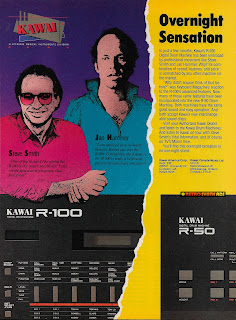
Kawai R-100 and R-50 drum machine "Overnight Sensation" ad, Keyboard 1987

Kawai R-100 and R-50 drum machine "Overnight Sensation" full page colour advertisement featuring Jan Hammer and Steve Smith from page 73 in the June 1987 issue of Keyboard Magazine.

Wowza. There is so much 80s goodness to unpack in this little rare advertisement. It only ran twice in Keyboard - the June and August issues... but should have had a much longer run, dammit.
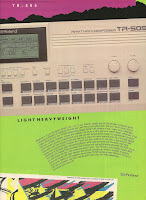
First - lets look at those 80s design elements. Have you ever seen anything more 80s? Those pink, blue, yellow and purple colours? That "torn page" design element traveling through the middle of the ad? Even the logo for Kawai's "Electronic Musical Instruments Division" with its lines, Keyboard keys knock-out, and other various chunkiness.  Reminds me of Roland ads running around the same time period (see right). 

11/10 for design. 

Next - 80s endorsements! Steve Smith and Jan Hammer - pure 80s peeps endorsing pure 80s drum machines. Jan Hammer, of course known for Miami Vice (did I mention the 80s!?!?!?) and Steve Smith, known for his work with Vital Information and Journey (80s!!!!!).

The ad copy only solidifies the whole 80s vibe with references to Miami Vice, a keyboard review quote, and the trifecta of 80s brand marketing jargon - the "combination of sound, features and price". 

My head is gonna explode!!!!

Here's the thing though - there is just so much going on in this ad, that the whole reason for its existence almost gets lost - and that's the introduction of the R-50 itself. This little guy came out at under $500, and although it lost a few of its bigger brother's great features like velocity-sensitive pads, less memory and, arguably, the fact that half the patterns are uneditable, it did keep all 24 sounds. 

But more importantly, in my head, the R-50 represents what in my mind was a huge leap forward for drum machines:

The sounds are mappable to any button. 

Look at older drum machines, and you see each button has an instrument label under it. Bass Drum. Snare Drum, Hi Hat, etc. Great when memory cost a lot and there was only a limited number of sounds you could fit in a machine. But memory costs were coming down, and programming was improving. 

Some manufactures would get around this button/sound dilemma by stacking sounds on the limited number of buttons. Like the R-100 - only 8 buttons, but three sounds were assigned to each one. But, hard-coded non-the-less.

The R-50 represents that new era of drum machines that were just labeled Pad 1, Pad 2, etc. Like the Roland R-8 or Korg S3. Suddenly, you could have a wack of sounds onboard, and just assign to different pads as needed. Primitive menu diving.

And this brings up to the other really exciting thing announced in this ad almost as an afterthought:

"Both machines have the same great sound and easy operation. And both accept Kawai's new interchangeable sound chips.". 

Say what now?!?!? 

Yup. And those new sounds rawk even more than the standard ones.

There's a lot more to say about those chips... coming up soonly!

Saturday, December 11, 2021

Kawai R-100 drum machine "What good is playing loud if you can't play soft?" advertisement, Keyboard 1986


Kawai R-100 drum machine "What good is playing loud if you can't play soft?" full page colour advertisement from page 11 in the November 1986 issue of Keyboard Magazine.

This gorgeous advertisement appeared in Keyboard Magazine from around November 1986 to February 1987. Somehow Kawai found a little hole in time between promo'ing their K3 ad they had been running, and a K3/K3m/computer ad that kicked the K100 to the curb in March 1987. 

It deserved more. More real estate. More promo. More time. 

This thing is still a beast. A living, breathing animal. Seriously.

You see, I'm not just a fan of the R-100, but also a trained biologist. Botanist/zoologist to be exact. Sure, my last 25+ years in Marketing may have dulled some of this here scientific noggin (*points at head*), but if there is one thing I can still do, it's identify the life cycle of living, breathing organism. And included in that category is gear that would follow the classic Keyboard Magazine life-cycle. NAMM article. Spec sheet. Ad. Review.

Take the R-100 for example. 

I first tagged a wild R-100 specimen while hunting in the forests of the September 1986 issue of Keyboard Magazine. Even though I had just entered university as a science undergrad, I'd like to think my catch-and-release game was already in top form way back then as I flipped through a Summer NAMM article and found this write-up under the "Drum Machines" subheading.
"Kawai continued to expand their line of professional products with their R-100 drum machine ($795). The R-100 has 24 32kHz, 12-bit companded sounds on board, including agogos, timbales, and china bell. It also has a selectable clock rate, tap tempo, individual outs, stereo outs, MIDI key assignments, and real-time tuning.
To put the time period in perspective, also roaming the forests of theis September 1986 issue was Korg's new DDD-1 drum machine ($999.95).

Needless to say, I tagged both for future observation and data collection before pushing forward in my quest to find more info on this new Kawai drum machine.

It would be a few months after that initial interaction that I would see the elusive R-100 again while staked out in my little observation hut. I remember I was sipping some hot chocolate I'd made by the fire pit when I saw fleeting images darting across a deer path. 

Two shadows leaping through the underbrush toward a stream. 

I squinted... remained motionless... and there, in the Spec Sheet section of the December 1986 issue of Keyboard (a month after it's first sighting in an advertisement - okay, no life cycle is perfect), crouched down along-side a K3m, quietly drinking from the stream, was another sighting of the R-100...
"The R-100 digital drum machine features touch-sensitive pads which trigger 24 12-bit/23kHz sampled sounds. Real-time control is provided for tuning, panning level, and sensitivity of each sound. Memory capacity is 100 patterns, 100 songs, and 10 chains. The unit records velocity, tuning and stereo pan for each note. Song position pointer and MIDI data dump are included in the MIDI implementation. The clock rates are variable and a sync-to-tape function is included. Other features include song overdubbing, programmable tempo and volume changes, and ten separate programmable outputs (two stereo, eight direct). The R-100 drum machine :$795.00."
But as I moved in for a closer look, the R-100 caught my scent and they both took off into the night brush. I returned home, telling the tale of this second sighting of the R-100 to all that would listen. 

Then, FINALLY, while walking through the dense woodlands of the February 1987 issue of Keyboard, I found what I was looking for. A review of this magnificent beast by Dave Fredrick!

The article starts, as most reviews do, with a brief intro that includes this rather scientific, fact-based observation on the rather short history of the digital drum machine:
"In as little as six years, we've seen the digital drum machine evolved from a $5,000, 15c rhythm device to today's fully dynamic, keyboard-controllable, tunable, user-sampling MIDI drum machine. And most of these instruments are priced under $1,000. Ain't life grand!"

Grand indeedy!

After a nice thorough review of the instrument, the reviewer concludes with what would become general consensus pretty much everywhere - Kawai had a winner on their hands with the R-100. 

Yes indeedy!

Dave especially liked some of the new features not yet found on other drum machines, like being able to individually assign instrument, tuning and pan placement for each key on a MIDI keyboard, and the "repeat and jump structure" of the pattern sequencer. 

I would have to agree. To this day, the R-100 is one of those pieces of gear that will always have a place in my heart. And, on my specimen table, where it sits waiting the next chance to be turned on.

More Kawai to come in the near future.

Thursday, April 16, 2009