Showing posts with label keyboard magazine. Show all posts

Tuesday, July 29, 2025

MPC Electronics "The Kit", including Synkit, The Tymp and The Clap, October 1983


The Kit, including the Synkit, The Tymp and the Clap, from page 29 in the October 1983 issue of Keyboard Magazine. 

Its been hard for me to blog these last couple of years due to medical issues that I won't get into at the moment. But lately, as I flip through magazines aimlessly, certain ads have jumped out at me. Hence the resurgence in blogging as of late. 

And this ad is a great example of one that jumped out of the pages and right into my eyeballs. Funny enough, I'd never heard of these little units, and didn't think I'd find much on the Interwebz about them. 

Boy, was I wrong. 

One quick Google search and up pops a goldmine of info. Three links in particular, stood out. 

But first - we got to address the design of the ad itself.  Obvious... it's cleverly designed to target keyboardists, using a clean black-and-white aesthetic and bold, engaging typography. The headline—"A compact electronic drum kit for keyboardists who may already have their hands full"—immediately addresses the ad’s intended audience with a witty, relatable hook. 

The image features a keyboard above a well-arranged display of The Kit’s touch-sensitive pads and companion devices, highlighting the compact size and modularity. The layout draws attention downward from the eye-catching headline to the product, and finally to the detailed body text, which explains the functionality, flexibility, and benefits of the system. Emphasis on user-friendliness, performance versatility, and integration into existing setups makes the ad both informative and persuasive, reinforcing The Kit as a practical and innovative tool for modern musicians.

Now back to the Googles... because a quick search brings up a few interesting links. 

First, we've got an article on the Kit written by Rick Palmer for Music UK, December 1982, thankfully kept online by Muzines! Wonderful! It also includes links to ads related to the review. 

What we learn is that “The Kit” is a compact, battery-powered electronic drum kit designed for finger drumming, featuring pads for snare, toms, bass drum, and hi-hats, with customizable sensitivity and decay. The top panel houses volume controls for each sound, tone control for the cymbal, and tempo/rhythm selectors for six pre-programmed hi-hat patterns. Additional controls include rocker switches for beat patterns, time signature, and start/stop, as well as LED beat indication. It offers individual ¼" outputs for each sound, a pre-mixed output, two 3.5mm trigger outs, and inputs for external footswitches and a power supply. 

In addition, we learn that while the unit feels awkward at first, users can quickly adapt and discover its versatility, especially with high-quality snare and tom sounds. It offers outstanding value, appealing to drummers and non-drummers alike. 

Add-on units expand the system’s capabilities: 

“The Clap” delivers a decent handclap sound with controls for noise mix and decay, though it lacks trigger integration with the main Kit. 

“Synkit” produces versatile synth-drum sounds with pitch sweep capabilities, ideal when triggered from the main Kit’s toms, although its decay control is finicky. 

“Tymp” offers low-pitched, noise-heavy sounds more suited to effects than traditional percussion, but suffers from inconsistent sensitivity and lacks adjustment options. 

The best news... that's not the only article on the kit you can find online - there is also another link to an article from Muzines from the January 1984 issue of Electronics & Music Maker. It includes similar info, but also introduces us to the Bass Drum Pedal/Hi-Hat on/off accessory that can be connected. Also included is pricing info - always a treat to see! 

One weird Amazon link that popped up was to "The Kit Operating Instructions", providing us not just with a colour image of the main unit, but a summary of the history of the company. Summarized from the page: 

MPC Electronics Ltd was founded in 1982 in Cambridge by Mike Coxhead to produce and market "The Kit," a compact electronic drum trigger device invented by Clive Button, designed to be played with fingers instead of sticks. 

After refining the design, the improved Mark 2 version gained acclaim at trade shows and sold widely in the UK, Europe, and North America. The company released complementary accessories such as bass drum pedals and sound modules like The Clap and Synkit. 

In 1983, Button introduced a more advanced version—the Music Percussion Computer—with eight pads, onboard memory, and compatibility with home computers, influencing future products by Roland and others. MPC later developed full-size drum pads and synth modules, but despite several innovations, the company folded in 1986 after Button moved on to work for other firms. Many units of The Kit remain functional today, and a comprehensive manual and history booklet documents MPC’s contributions during its brief but impactful existence.

Here's a picture of the unit in colour... gotta say, I wasn't expecting the red or the gold. 

Want to learn more about it's designer Clive Button? Check out his website. It provides even more history!

Wednesday, July 16, 2025

Yamaha SY-22 "Vector Synthesis" advertisement, Keyboard 1990

Yamaha SY-22 "Vector Synthesis" advertisement from page 39 in the September 1990 issue of Keyboard Magazine. 

In a crowded world of 90s synths, the SY-22 vector synthesizer dared to be different. With FM, sample playback and joy-stick driven sound design, its still loved by a small group of fanatics. I've never owned one... and I still consider myself one of those fanatics. 

According to the InterWebz, after Sequential Circuits, responsible for the Prophet VS (Vector Synthesis) was bought by Yamaha, Dave Smith "served as the President of the DSD group at Yamaha, producing a mini VS in the Yamaha SY22, but when ownership of Sequential was passed to their newly-acquired Korg, Dave oversaw that as the Korg R&D group in California, who designed the very successful Wavestation." 

Interesting. Explains why the Wavestation and SY-22 both came out so soon after each other. 

Looking at the SY-22 itself...  first, lets get this out of the way. No low-pass filter. Ugh. Okay, we can move on, because what it does have is AWM synthesis, 2-operator FM synthesis, and vector synthesis via a joystick. And now lets throw in stereo onboard effects, as well as velocity keys with aftertouch. SAAAAAAY-WHAAAAAAT? 

All for under $1100. 

So its not an SY-77. Too bad...  The SY-22 has vector synthesis. 

So its not an SY-55. Too bad...  The SY-22 has vector synthesis. 

I think you can see where I'm going with this. Its got vector synthesis. Like I said above - I've never owned one. I don't think I've even heard one on purpose. But in my head, its just got to be cool sounding. 

And Jim Aikin, managing editor and Keyboard reviewer back in 1990 agrees. Kinda. 

See... he was going on vacation the day the Korg Wavestation arrived for review. So he didn't get to review it. And instead, he came back from vacation with the Yamaha SY-22 waiting for review. so he switched it on and was 'pleasantly surprised'. 

Why do I know this?!?! Because the same issue of Keyboard that includes this advertisement, also includes Jim's full-length review of the SY-22. 

According to the review, each patch on the SY-22 "can be programmed with its own vector. Once you've found a set of waveforms that you like, you can go to the "record level vector" page and use the joystick to do a real-time recording of a sequence of up to 50 vector positions." FIFTY positions. Then you can edit each position, loop the entire thing, etc. Smashing!

One thing he does note that is a real downer is that the joystick doesn't send or receive midi data. Yup. You heard that right... there's no way to record the movements into your favourite sequencer. Jim acknowledges that Yamaha needed to keep the cost down somehow. 

Jim goes on to review the sounds ("usual mixed bag"), patch programming ("fairly predictable"), effects ("short, but no big around"), and multitimbral operation ("fairly standard"). Still, in the end, Jim explains that vector synthesis "gives the SY22 a sound that's unique in its price range", and even calls the real time recording of vector movements "the most significant innovation in synthesizer design that we've seen in the last couple of years". 

Nice. Jim done good.

The Yamaha SY-22 may not have achieved mass-market fame, but its combo of vector synthesis, FM synthesis, and sample-based warmth makes it a hidden treasure for all you creative musicians.

Wednesday, July 9, 2025

Alesis HR-16:B "Killer B" advertisement, Keyboard 1990

Alesis HR-16:B "Killer B" advertisement from page 102 in the September 1990 issue of Keyboard Magazine. 

Before software ruled the studio, drum machines like the Alesis HR-16B offered an affordable and surprisingly powerful way to get your industrial tracks bangin'. Released in the early 1990s as an update to the original HR-16, the HR-16B isn't as well-known as the TR-808 or have the power of modern groove boxes, but it carved out its own corner of electronic music history—and for one.... very... good... reason.

From the ad: "47 samples, pre-produced with reverb and processing for a killer rhythm assault right out of the box." 

That's it. Right there. Those sounds. Right when industrial music was seeping into the mainstream. Nine Inch Nails, Ministry, Front 242.... goth clubs were also banging. 

The ad tries to promote its high sample rate16-bit samples, but compared to today's standards, that limited gritty aesthetic, along with a fairly intuitive interface, is what makes this drum machine sought after today. Its no surprise that I'm blogging about it so close to the Kawai R-100/R50 drum machines... another industrial fav. 

And don't get me started on the glitching... I'll just leave this video right here. 


The ad itself stands out when you are flipping through the magazine. Arriving on page 102 would usually be a checkmark against it, but it comes just pages after the wonderfully HUGE Public Enemy article... so I won't hold it's placement against it. 

A giant title "Killer B" quickly grabs your attention. And then we get sparse content that is easy to read. And then, of course, is that gothy-black machine sitting atop a giant foam B. 

As good and attention-grabbing as the ad is - and very ON-BRAND for Alesis - I can't help thinking the design doesn't cater to its audience. Those black-clothed, industrial leather jacket wearing Nitzer Ebb loving fans that would want to put down their hard-earned cash. AKA Me! 

I don't know what the answer is... but the designer could surely have put a little bit more time and effort into solving the problem and getting a bit more grit into the design of the ad. 

Monday, December 20, 2021

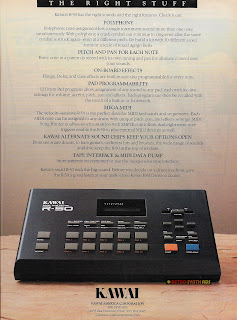
Kawai R-50 "The Right Stuff" advertisement, Keyboard 1987


Kawai R-50 drum machine "The Right Stuff" full page colour advertisement from page 81 in the December 1987 issue of Keyboard Magazine. 

Although it was in June 1987 that the R-50 started appearing in ads alongside the R-100 (see my last blog post), in November of that same year the R-50 finally got the spotlight to itself. This ad above appeared on and off until early 1988, getting bumped periodically by an ad for Kawai's additive synthesizer the K-5. 

This ad was a big departure from the R-100/R-50 80s themed extravaganza that came before it - with a much more standard title/content/photo layout - and the content efficiently spelling out the features of the R-50, including its polyphony, pitch and pan abilities, on-board effects, pad programmability, Midi out the wazoo, and... my favourite... the alternate sound chips. More on that in a second. 

Although Keyboard never devoted a full review to the R-50, it did make the Updates & Short Takes section of the Magazine in the January 1988 issue. Yes, you heard that right. Although the R-50 began appearing in ads waaaaaay back in June 1987, it would be seven months before any kind of review showed up. 

Wowza is right. 

I do give Jim Aikins credit though - its a nice, small compact review - just like the R-50 itself. We end up with about two columns of content devoted to the machine. 

Jim starts by pointing out that the $495 R-100 is about $300 cheaper than the R-50. I like this, because it lets me know that the R-100 was still on the market at this time. Also, I dig historical retail prices in general.  

Much like my relatives would do when over for Christmas dinner, we first get a lot of chatter about what's missing in the younger sibling compared to its bigger brother (okay, maybe I'm projecting a bit). 

  • Buttons not velocity sensitive
  • Half the memory
  • 50 of the 100 patterns are non-programmable factory rhythms
  • Song construction simplified (no repeat loops or tempo changes)
  • No punch-in recording and song overdub features
  • No DIN sync jacks
  • In individual outputs

Geeez... sounding even more like me being compared to my older brother. :) 

But, the R-50 did have a few improvements like those assignable pads I went on about in the last post, some new effects, and some amazing midi tricks including midi triggers. 

And, because I can't, and won't, stop talking about them, Jim also mentions those alternate sound chips. Read what he had to say...

"Two additional plug-in voice chips ($129.00) suggested retail) are compatible between the R-100 and R-50. You have to open up the unit to install the new chips, but we're told that Kawai is planning to market a built-in switcher that will hold all three chips and let you choose whichever one you prefer for the current song.". 

This is the first I've heard that Kawai had planned to market their own switcher for all three chips. I'm my head, I'm thinking this would have been a kit that gets installed at the shop.   

But correct me if I'm wrong - I don't recall this ever on the marketing. And I'm wondering if maybe Kawai decided that rather than market a switcher, they decided to market a new R-50 entirely - the elusive R-50iii - that contained all three chips. 

I just happen to have one of those R-50iii. Time to open 'er up and see how those chips are installed.

Wednesday, December 15, 2021

Kawai R-100 and R-50 drum machine "Overnight Sensation" ad, Keyboard 1987

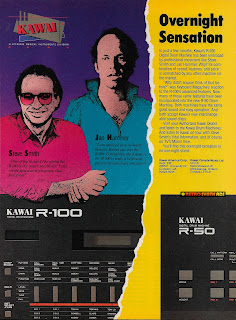
Kawai R-100 and R-50 drum machine "Overnight Sensation" full page colour advertisement featuring Jan Hammer and Steve Smith from page 73 in the June 1987 issue of Keyboard Magazine.

Wowza. There is so much 80s goodness to unpack in this little rare advertisement. It only ran twice in Keyboard - the June and August issues... but should have had a much longer run, dammit.

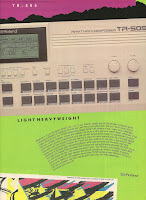
First - lets look at those 80s design elements. Have you ever seen anything more 80s? Those pink, blue, yellow and purple colours? That "torn page" design element traveling through the middle of the ad? Even the logo for Kawai's "Electronic Musical Instruments Division" with its lines, Keyboard keys knock-out, and other various chunkiness.  Reminds me of Roland ads running around the same time period (see right). 

11/10 for design. 

Next - 80s endorsements! Steve Smith and Jan Hammer - pure 80s peeps endorsing pure 80s drum machines. Jan Hammer, of course known for Miami Vice (did I mention the 80s!?!?!?) and Steve Smith, known for his work with Vital Information and Journey (80s!!!!!).

The ad copy only solidifies the whole 80s vibe with references to Miami Vice, a keyboard review quote, and the trifecta of 80s brand marketing jargon - the "combination of sound, features and price". 

My head is gonna explode!!!!

Here's the thing though - there is just so much going on in this ad, that the whole reason for its existence almost gets lost - and that's the introduction of the R-50 itself. This little guy came out at under $500, and although it lost a few of its bigger brother's great features like velocity-sensitive pads, less memory and, arguably, the fact that half the patterns are uneditable, it did keep all 24 sounds. 

But more importantly, in my head, the R-50 represents what in my mind was a huge leap forward for drum machines:

The sounds are mappable to any button. 

Look at older drum machines, and you see each button has an instrument label under it. Bass Drum. Snare Drum, Hi Hat, etc. Great when memory cost a lot and there was only a limited number of sounds you could fit in a machine. But memory costs were coming down, and programming was improving. 

Some manufactures would get around this button/sound dilemma by stacking sounds on the limited number of buttons. Like the R-100 - only 8 buttons, but three sounds were assigned to each one. But, hard-coded non-the-less.

The R-50 represents that new era of drum machines that were just labeled Pad 1, Pad 2, etc. Like the Roland R-8 or Korg S3. Suddenly, you could have a wack of sounds onboard, and just assign to different pads as needed. Primitive menu diving.

And this brings up to the other really exciting thing announced in this ad almost as an afterthought:

"Both machines have the same great sound and easy operation. And both accept Kawai's new interchangeable sound chips.". 

Say what now?!?!? 

Yup. And those new sounds rawk even more than the standard ones.

There's a lot more to say about those chips... coming up soonly!

Saturday, December 11, 2021

Kawai R-100 drum machine "What good is playing loud if you can't play soft?" advertisement, Keyboard 1986


Kawai R-100 drum machine "What good is playing loud if you can't play soft?" full page colour advertisement from page 11 in the November 1986 issue of Keyboard Magazine.

This gorgeous advertisement appeared in Keyboard Magazine from around November 1986 to February 1987. Somehow Kawai found a little hole in time between promo'ing their K3 ad they had been running, and a K3/K3m/computer ad that kicked the K100 to the curb in March 1987. 

It deserved more. More real estate. More promo. More time. 

This thing is still a beast. A living, breathing animal. Seriously.

You see, I'm not just a fan of the R-100, but also a trained biologist. Botanist/zoologist to be exact. Sure, my last 25+ years in Marketing may have dulled some of this here scientific noggin (*points at head*), but if there is one thing I can still do, it's identify the life cycle of living, breathing organism. And included in that category is gear that would follow the classic Keyboard Magazine life-cycle. NAMM article. Spec sheet. Ad. Review.

Take the R-100 for example. 

I first tagged a wild R-100 specimen while hunting in the forests of the September 1986 issue of Keyboard Magazine. Even though I had just entered university as a science undergrad, I'd like to think my catch-and-release game was already in top form way back then as I flipped through a Summer NAMM article and found this write-up under the "Drum Machines" subheading.
"Kawai continued to expand their line of professional products with their R-100 drum machine ($795). The R-100 has 24 32kHz, 12-bit companded sounds on board, including agogos, timbales, and china bell. It also has a selectable clock rate, tap tempo, individual outs, stereo outs, MIDI key assignments, and real-time tuning.
To put the time period in perspective, also roaming the forests of theis September 1986 issue was Korg's new DDD-1 drum machine ($999.95).

Needless to say, I tagged both for future observation and data collection before pushing forward in my quest to find more info on this new Kawai drum machine.

It would be a few months after that initial interaction that I would see the elusive R-100 again while staked out in my little observation hut. I remember I was sipping some hot chocolate I'd made by the fire pit when I saw fleeting images darting across a deer path. 

Two shadows leaping through the underbrush toward a stream. 

I squinted... remained motionless... and there, in the Spec Sheet section of the December 1986 issue of Keyboard (a month after it's first sighting in an advertisement - okay, no life cycle is perfect), crouched down along-side a K3m, quietly drinking from the stream, was another sighting of the R-100...
"The R-100 digital drum machine features touch-sensitive pads which trigger 24 12-bit/23kHz sampled sounds. Real-time control is provided for tuning, panning level, and sensitivity of each sound. Memory capacity is 100 patterns, 100 songs, and 10 chains. The unit records velocity, tuning and stereo pan for each note. Song position pointer and MIDI data dump are included in the MIDI implementation. The clock rates are variable and a sync-to-tape function is included. Other features include song overdubbing, programmable tempo and volume changes, and ten separate programmable outputs (two stereo, eight direct). The R-100 drum machine :$795.00."
But as I moved in for a closer look, the R-100 caught my scent and they both took off into the night brush. I returned home, telling the tale of this second sighting of the R-100 to all that would listen. 

Then, FINALLY, while walking through the dense woodlands of the February 1987 issue of Keyboard, I found what I was looking for. A review of this magnificent beast by Dave Fredrick!

The article starts, as most reviews do, with a brief intro that includes this rather scientific, fact-based observation on the rather short history of the digital drum machine:
"In as little as six years, we've seen the digital drum machine evolved from a $5,000, 15c rhythm device to today's fully dynamic, keyboard-controllable, tunable, user-sampling MIDI drum machine. And most of these instruments are priced under $1,000. Ain't life grand!"

Grand indeedy!

After a nice thorough review of the instrument, the reviewer concludes with what would become general consensus pretty much everywhere - Kawai had a winner on their hands with the R-100. 

Yes indeedy!

Dave especially liked some of the new features not yet found on other drum machines, like being able to individually assign instrument, tuning and pan placement for each key on a MIDI keyboard, and the "repeat and jump structure" of the pattern sequencer. 

I would have to agree. To this day, the R-100 is one of those pieces of gear that will always have a place in my heart. And, on my specimen table, where it sits waiting the next chance to be turned on.

More Kawai to come in the near future.

Tuesday, May 7, 2019

Steinberg Cubit "Visual Song Processing" advertisement, Keyboard 1989 / Cubase "Buy it! Boot it! Love it! " advertisement, Electronic Musician 1990


Steinberg Cubit "Visual Song Processing"full page colour ad from page 65 in the May 1989 issue of Keyboard Magazine and Steinberg Cubase "Buy it! Boot it! Love it! Or your money back!" half page black and white ad from page 112 in the March 1990 issue of Electronic Musician Magazine.

I don't do it often, but today I have two scans. And for good reason!

I had actually scanned each one separately a while back and written little bits to form into future blog posts, but then this morning I noticed a tweet from Steinberg announcing it was Cubase's 30th anniversary. And I thought... heck - that's a bandwagon worth jumping on! So I went back, checked, and sure enough... this Cubit advertisement first showed up in the May 1989 issue of Keyboard Magazine

(Aside: That May 1989 issue of Keyboard Magazine isn't just exciting because of this initial Cubit ad. Its also the now-legendary CYBERPUNK issue.)

It wasn't just on this side of the pond that Stenberg was rolling out its successor to Twenty Four  III (aka PRO24) sequencing software - Cubit was being rolled out in Europe in magazines such as Music Technology  and Micro Music with large three page advertisements as well. Check out Mu:zines for those ads!

But the Cubit advertisements lasted for only a few months before Steinberg shut them down. The reason? According to Cubase's Wikipedia page, a trademark issue was forcing Steinberg to change the name.

And better for it too!

Well, it didn't take long for that name change to happen. How do I know? Well, for one, the Cubase ad includes quotes from three different 1989 magazine reviews - and those aren't the only reviews that came out soon after the Cubase name change. 

Music Technology magazine out of the UK was one of the first with their review. It was actually a two-part review that ran in the August and September 1989 issues running in at over 8000 words. And the reviewer Nigel Lord still didn't manage to cover all of Cubase's features.

In his verdict, he writes: 
"Quite honestly, this is the most impressive piece of music software I have yet encountered for the ST. And I certainly cannot conceive of it being possible to develop a more sophisticated sequencing package for that machine. As with most genuinely worthwhile designs, the transition from well-crafted tool to creative instrument is quite seamless - the features which give it a claim to both these titles being universally well thought-out and meticulously presented. Not only that, but it's a delight to use and one of that increasingly rare breed of technologically advanced designs which positively encourage the user to experiment and get to grips with it."
Not bad. Not bad at all. 

Sound on Sound's review also came out in their August 1989 issue. And I gotta say after reading David Hughes' verdict, we are starting to see a pattern...
"I like this program a lot. Cubase is a natural successor to Pro24 and I would strongly recommend Cubase to any existing Pro24 owners, who should remember that they can save quite a substantial amount of money if they take part in the part-exchange scheme that Steinberg are offering. I would also recommend this program to those musicians looking for a fully professional system with the potential for expansion. Cubase has this in abundance. I've used the review package for over a month now and Steinberg will find it difficult to prise it out of my hands. I feel that I've written some of my best music with Cubase, and consequently don't want to lose a single note of it. I enjoyed the sheer depth of this product. You simply won't exhaust the possibilities in a single night. It will take a great deal longer than that, I promise you."

Keyboard Magazine's October 1989 review by Jim Aikin was a little more low-key, but still very positive. In addition to the quote used in the Cubase ad I scanned, we get a little bit of software sequencer history along with Jim's conclusion:
"The impact made last year by C-Lab's Notator has forced other Atari sequencer developers to put some muscle in their hustle. With Cubase, Steinberg proves that they're up to the challenge; it's fully competitive with anything that Notator has to offer, except in the area of notation printout - and let's face it, that's not Notator's strong point either (me: Ouch!). Dr. T's KCS Level II still leads the pack in terms of sheer editing power, but its user interface is starting to look a bit long in the tooth, though there have been some strong enhancements in version 2.1..."

Interestingly, the ads for Cubase took a while to get into magazines. I'm not sure if this is because Steinberg had spent their 1989 marketing budgets on the earlier advertisements, or maybe they were just waiting for the Mac version slated to come out in early 1990 to be closer to production? 

No matter, because according to Steinberg's earlier Twenty Four software advertisement, there was already a base of 30,000 users. And many of those 30,000 users would have read those early positive reviews or started to see the software pop up in music shops.  

And the proof is in the pudding - or whatever that saying is.  30 years later Cubase is still going strong. 

Monday, April 1, 2019

Casio LZ-1000 synthesizer "Why would you let your friends choose any other synthesizer" ad, Keyboard Magazine 1998


Casio LZ-1000 phase distortion and sample playback synthesizer "Why would you let your friends..." full page colour advertisement from the inside front cover of the April 1998 issue of Keyboard Magazine.

Let's face it... Casio knew a good thing when they saw it.

And *everyone* was as happily surprised as Casio when David Schwimmer finally got the chance to show off his virtuoistic chops on a Casio CT-460 in his hit TV docu-drama "Friends" in 1997.

Blessed with a peerless technique, David's repertoire on the show was wide-ranging, taking in everything from Merzbow and Beethoven, to Coltrane, Parker and Monk, not to mention his own masterful transcriptions and other compositions. It was, perhaps, his sense of spontaneity and impeccable timing that only comes from years of training that made his live performances on "Friends" so fresh and exciting for the studio audience, America and the world.

Knowing a good thing when they saw it, Casio quickly made an endorsement deal with David and upgraded his gear. Within a few short months you could find David's trademark smile and I-don't-care-if-my-music-is-too-loud shrug on every magazine rack in Liechtenstein, Tuvalu and Saskatchewan for months to come. And, of course, it could also be found in this Casio LZ-1000 advertisement which Casio paid good money to place strategically on the inside front cover of Keyboard Magazine for over two years.

Casio and Schwimmer were a perfect fit - an awesome sounding keyboard with some of the latest "Moo", "Bark", "Ding Dong" and "Pew Pew!" sound samples recorded to date, paired with a light-up keyboard that let new users play along with some of David Schwimmer's latest and greatest hits that came pre-programmed with the internal sequencer.

Utilizing some of the latest Internet technology, owners of the LZ-1000 could dial-up to AOL and connect directly with Casio to download Schwimmer's latest hits twice a year. Casio's state of the art sample compression algorithms allowed users to download the package of songs, including the Schwimmer's personally recorded 16 bit/44.1kHz samples, in under six hours and averaging less than $200 in telephone and AOL fees.

I managed to catch his set in Chicago at the 2005 Lolapalooza festival. His set began quietly, with David lingering over just a few short samples, avoiding the urge to head straight for the shredding post-punk that dominated his playing style during that time period. By the fifth hour, the intensity started to build, unleashing explosions of raw energy on the audience of campers next to the festival.

I bought his t-shirt. Who wouldn't?

Casio kept the AOL service running for over 20 years until the endorsement deal unfortunately and suddenly collapsed at the 2017 Amsterdam Dance Event in Belgium where David unexpectedly took his music in a new, totally acoustic direction.

Keyboard Magazine's Jim Aikin concluded his review of the LZ-1000 in the July 1998 issue, stating "...It works, but what's with all the animal sounds?", before giving it a solid 8 out of 10. Coincidentally, Jim also reviewed Schwimmer's newly released electro album "Coffee with Friends" in the same issue asking a similar question.

Here's a great look back at David's authentic and expressive playing style that captivated viewers around the world.


What an inspiration.

Monday, February 11, 2019

Akai MPC60, S1000 and S1000PB "Hitmakers: Don Henley and Akai" ad, Keyboard 1989


MPC60, S1000, S1000PB "Hitmakers: Don Henley and Akai" colour advertisement from page 23 in the December 1989 issue of Keyboard Magazine.

Artist endorsement ads are as old as the wheel and both are still around because they are good at what they do. Just ask ARP. Or Korg. Or Roland. Or....   :)

And in 1989, Akai did good when they nabbed Don Henley for this long running advertisement. His album "The End of the Innocence" was Grammy nominated for Song of the Year, Record of the Year and Album of the Year... and WON for Rock Male Vocalist. Not too shabby.

Although this second Keyboard Magazine ad for the MPC60 didn't appear in the mag for well over a year after Akai's first introductory ad in the February and March 1988 issues, the MPC still managed to pop up every now and then.

For example, right after that first ad ran, the MPC60 appeared the following month in an April 1988 NAMM article.
"The Akai booth was really dancing, with Roger Linn demonstrating the MPC60 ($4,995.95), featuring MIDI sequencing and drum machine sampling. Detailed in-depth in our Summer 1987 NAMM coverage (Keyboard, Nov. '87), the MPC60 (formerly known as the ADR15 Drum Machine/Sequencer) is now available."
And if you read the blog post about that first ad, you'll recall that the MPC60 was also highlighted in Keyboard's November '87 NAMM show article as well. That's right - it received some great double exposure for showing at two different NAMMs.

In November 1988, the MPC60 finally made it into the Review section of Keyboard Magazine. The extensive write-up weighs in at over five pages and covers a lot of ground that included an introduction that wears Keyboard reviewer Freff's uneasiness on his sleeve. Remember - this was really the beginning of what could possibly a whole new market.
"We should admit our own conflicting reactions up front. Our very first thought, upon examining the MPC60, was why? Why even design, let alone try and sell, a three-in-one unit like the MPC60 when the marketplace is awash in inexpensive drum machines, samplers and sequencers (both software- and hardware-based)"
Doesn't sound like its going to go well, eh? That's what I thought, until later into the intro we read...
"Our second reaction, upon using the MPC60 for several days, was Oh, of course - that's why. It is an unquestionably professional piece of gear in its attention to conception, design, and execution. It looks good and feels even better: It is, in fact, a tactile pleasure to play and to program. These are qualities that have been given short shift by manufacturers in recent years, and we're happy to see that the trend might be reversing."
There ya go... I know I feel much better. You?

I'm sure many people at the time popped into the local music store and had similar first impressions upon seeing it, and that same second reaction after playing.  :)

And finally, the MPC60 popped up again in the March 1989 issue of Keyboard. Twice.

The first appearance was that Akai Michael Jackson advertisement that I blogged about just a bit ago.

And the second time was when the magazine tried its darnedest to come up with a way to comparatively test over a dozen different samplers. Although it didn't make the cut for the dozen or so samplers that they did test, there is a great section called "Features Chart" that does include the MPC among 30+ other samplers.

Better than nothing.

Especially since its descendants have outlasted most of pack.

Friday, December 21, 2018

Alesis HR16 and MMT-8 "Yes there is a Santa Claus" ad, Keyboard 1987


Alesis HR16 drum machine and MMT-8 sequencer "Yes there is a Santa Clause" full page colour advertisement from page 19 in the November 1987 issue of  Keyboard Magazine.

Surprisingly, very few companies take advantage of the season to customize their marketing message during the holidays. It makes sense since it requires extra time and money to produce an ad that will only get used for one or two months max. But I've come across a few holiday ads that took the chance and made it happen.

Sequential Circuits kept it simple in their black and white quarter-page holiday advertisement that ran in the December 1985 issue. Sequential made the decision to split their marketing dollars into two quarter page ads on two different pages so that they could keep their holiday message totally separate. Nice work.


Oberheim took it a big step further in their full page colour ad in the same December 1985 issue when they took out a full page colour product-oriented ad on the back-inside cover. It's definitely Santa/Christmas themed, but its not a message to readers. It's a full on product-oriented ad.


But Alesis...  they took it one step further.

It's not just a "Merry Christmas and Happy Holiday" message like Sequential's ad.

And it's not a holiday product ad like Oberheim's.

This advertisement is actually THE LAUNCH of the HR16 drum machine and MMT-8 sequencer. Alesis took advantage of the timing of these two pieces of gear to create a holiday season product launch.

Surprisingly, they kept the ad pretty bland. Ad title. Announcement copy. Two photos with some specs. And a holiday message. With some red and green font colours to make it a bit more festive.

But bland or not, those machines were definitely a Christmas miracle. And even more of a Christmas miracle... this is MY FIRST Alesis ad. Don't worry - more to come.   :)

Merry Christmas and Happy Holidays everyone!

Sunday, April 1, 2018

Roland TR-606 Drumatix drum machine and TS-404 Multitrax sequencer ad, Keyboard 1983


Roland TR-606 Drumatix drum machine and TS-404 Multitrax sequencer full colour advertisement from page 49 in the August 1983 issue of Keyboard Magazine.

I've already posted a scan and blogged about Roland's popular first ProForm advertisement that launched the TB-303 and TR-606, so I thought I'd focus more on the TS-404 in this 606/404 ad.

Within a year after launching the first two pieces of music gear that made up their "ProForm Series" - the TB-303 and TR-606 - Roland realized the hits they had on their hands. In particular, positive response in regards to the simplicity of the TB-303 sequencer led Roland to deliver on their promise to bring more ProForm gear to market by announcing a multi-track TB-style sequencer to go along with the bass synthesizer and drum machine.

Roland is known for re-purposing their cases to help keep costs down, and they've definitely kept that philosophy with all three ProForm products. As can be seen in the ad photo, the TS-404 kept the simple and clean TB-style sequencer on the lower half of the case, but replaced the main synth controls at the top of the case with multi-track sequencer functionality in the form of "Track" buttons and corresponding LED lights. CV and Gate labels indicate that each Track has its own set of CV/Gate outputs situated on the back. Slick!

The result - an awesome four track sequencer that looks absolutely smashing next to its older TR-606 sibling.

And it doesn't just look gorgeous. Its just about as dreamy to program. A Roland representative at the time remarked "If programming and editing one TB-303 sequence was easy, then programming four TS-404 sequences is four times as easy."

I found the TS-404 programming instructions in an article that appeared in the September 1983 issue of CV/Gate-Love Magazine called "The TS-404: Release yourself from your cumbersome Fairlight sequencer software". The guide matter-of-factly states that when using their simple 37-step programming and editing guide, "even someone with only a Doctorate in Astrophysics will be up to speed making Yazoo-style tracks in no time".

An amazing machine, but unfortunately, MIDI had just launched and was gaining steam quickly,  eventually stopping the sales of the TB-303, TR-606 and TS-404 in their tracks (pun intended). Many ended up sold in store blow-out sales and later dumped in pawn shops around the world. And while the TB-303 and TR-606 ended up becoming famous soon afterwards in the hands of acid house producers around the world, the TS-404 became generally recognized within a lesser well-known genre of techno called Banjo-Tech.

This fad of integrating banjos with TS-404s began in Belgium around 1992 and quickly spread to a small city in Canada called Regina. Owners would send their four-string banjo and TS-404 to a guy in Keflavik, Iceland. Known as the GodFerret mod, the integration with the banjo effectively destroyed the TS-404 in the process but resulted in an instrument that had one very unique sound when the four strings were played directly through the four tracks of the sequencer.

But unlike acid house which spawned many sub-genres and is still going strong today, the unique sound and genre of BanjoTech faded soon after, and the few rare TS-404s that never were GodFerreted are coveted by the few lucky owners that have them.

Shame I'll probably never be able to get my banjo GodFerreted.  :(

Tuesday, March 13, 2018

Oxford Synthesiser Company OSCar "Why would anyone buy this ugly, monophonic synthesizer" ad, Keyboard 1985


Oxford Synthesiser Company OSCar "Why would anyone buy this ugly, monophonic synthesizer" half-page black and white advertisement from page 35 in December 1985 issue of Keyboard Magazine.

I love the December issues of Keyboard. They are always a slightly different beast from the rest of the months. They are usually packed with more pages and within those pages are a lot more ads. As a result, I've seen many advertisers try something a little different or take a bit more risk and step out of their comfort zone in order to break through the noise.

Sometimes those ads are just a change from their normal campaign to wish readers a happy holiday or merry Xmas. Good examples are this SCI's "Happy Holiday Season" ad. Another is this Oberheim "Sounds of the Season" ad.

But sometimes, just... sometimes... readers get a real treat. And this OSCar advertisement is exactly that!

I'm sure you'll agree that the opening line immediately grabs your attention:
"Why would anyone want to buy this ugly, monophonic synthesizer"
Remember, this isn't 1981. Readers are on 1986's doorstep. Polyphonics had not only been on the market for a while, but prices were starting to tumble. There were lots to choose from - Korg's DW series, Sequential's MultiTrak, Yamaha's DX100/21 and Roland JX3p come to mind.

But being upfront and honest about your product is a great way to help cut through all that advertising clutter. A good comparison is Buckley's Cough Syrup's long running "It tastes awful and it works" campaign. You throw the reader the bad news first to get their attention, and then hit them with the good news. And that's exactly the strategy this OSCar advertisement went for.

The ad copy below the title expands on this idea:
"When you've got a synthesizer with endbells that look like deflated Uniroyals and a front panel design that could double for a rat maze in some scientific research program...". 
That's synth comedy gold. And it works.

Its only then that the ad gets to the point of the question - why would anyone want to buy it? And here's where the real pitch begins. The good news.

And what is the good news? That it sounds great! As Wikipedia puts it, this is mostly due to "its many unusual features and design quirks". I'm not going to get into all the features and quirks here in this post, except to say that it had such good sounding digital oscillators that the book Vintage Synthesizers by Mark Vail noted "its sales took off very quickly despite the fact that it was monophonic and cost almost as much as a Roland Juno-60".

And it still sounds so good that even today the OSCar sells for the same, if not for more, than a Minimoog.

That's saying something.

Another highlight of the ad, especially if you caught that little asterisk after the word "anyone" in the headline, is that list of bands that used the OSCar - Go West, Ultravox, Asia, Dead or Alive, and the System. That's a fine list of "anyones"!

But, I have to say, the most interesting thing about this ad is that the OSCar synthesizer wasn't being promoted by the company that manufactured it, the Oxford Synthesiser Company, but by their North American distributor Europa Technology Inc.

Europa was responsible for bringing some of the best European synths to North America in the 80's, including the PPG as well as the OSCar. And one of the owners of Europa, Geoff Farr, who was previously an Oberheim Electronics sales rep in the 70s, went on to distribute the Waldorf Wave and Access Virus as part of the GSF Agency, where he continues to represent Tom Oberheim, Knifonium and Acoustica Audio.

That guy has a keen eye for good gear!  :)

Monday, December 4, 2017

Moog Song Producer, Keyboard 1985


Moog Song Producer 1/6-page black and white advertisement from page 108 in the November 1985 issue of Keyboard Magazine.

"Pivot" - you hear that word a lot now'er days.

For example, Your FarmVille-app wanna-be isn't panning out? Pivot to become an online Organic Farm location service.

In the case of Moog Music, it looks like one such pivot started around 1983 when the company was sold to management. But in order to see it more clearly, we need to back up a bit.

What looks to be prior to the sale, Moog had shown up at 1983's Summer NAMM with Keith Emerson's Modular System, a few MIDI-equipped Memorymoogs and, according to the September 1983 issue of Keyboard Magazine...
SL-8 photo from Keyboard Magazine
September 1983
"Hidden away up in a hotel suite was a prototype of the SL-8, an eight-voice synthesizer that generates its colors digitally. The keyboard can be split and layered. Projected list price was somewhere in the neighbourhood of $2,495.00. No final plans have been made as to when it will come out."
Without getting too far off my original point, I kinda went down a rabbit hole looking for info on the SL-8 and came upon a great little story.

A September 2015 Reddit post of a photo of the SL-8 submitted by "theofferings" (who looks to be David Harrison, the Technical Director of the Audities Foundation most likely) included some info about the synth's appearance at that NAMM 1983 show mentioned in Keyboard Magazine:
"The story goes, Moog brought this to NAMM 83 as an 8 voice polyphonic synth, a follow up to the Memory Moog (which btw has the fattest Osc's I might have ever heard). They brought the cards for the SL8 to NAMM in a "cardboard box" and this was placed below the SL8 for performance during NAMM. After NAMM the cardboard box containing the cards was lost or misplaced and all the remains is the body."
Another reader followed up with some information from "a friend" about this SL-8 prototype appearing later on at a London trade show in 1984, including how the synth got it's name and why it may not have made it into production.
"I'm very familiar with the SL-8, I was the person who got it working in London at the Music trade show in 1984. The boards were in a card cage underneath the prototype behind a curtain with big ribbon cables running up inside to the control panels. When it arrived in London from Buffalo it was DOA. I took the ferry over from our service center in Rotterdam to the UK and fixed it on the opening morning of the show. We took over 700 orders for it that weekend ($1995 Retail). When I got back to the plant, Marge Beltz (Our accounting genius) killed it. Ray Dennison and I are old friends and he ended up leaving Moog over that decision after spending a year of his life designing it. It was the first polyphonic Moog with a 16 bit Micro. The name comes from Split/Layered 8 Voice synth (SL-8). It had really gritty digitally controlled analog oscillators with a harmonic multiplier knob. " 
Great stuff!

But anyways, back to the point... what was the point again...?

Oh yeah! The "pivot".

It looks to be around the time of the buyout - and a name change from Moog Music to Moog Electronics - that the company began its pivot. For example, according to the Moog Archives web site, Moog had begun to put a new emphasis on contract manufacturing, such as in the production of the SSK Concertmate synthesizer for Tandy Corp (Radio Shack). And the company also began producing non-music related products, like the Telesys 3, later know as the Operator (view the advertisement on the Moog Archives site), and the Phone Controller (photos from the awesome MATRIXSYNTH). Hence why they couldn't keep on using the word "Music" in their company name, I'd guess.

But that doesn't mean they weren't gonna keep a few eggs in their own Moog products basket. The company continued to sell the Memorymoog  for a while, with advertisements running until the summer of 1984, and as we just read on Reddit, they were still showing off the SL-8 prototype into 1984.

And there was one other musical product that seemed to survive the pivot - The Moog Song Producer hardware and software set-up for the Commodore 64.

Now, I'm a big fan of the C-64 and hang out in the Facebook groups devoted to the computer. So, I can tell you that when someone posts *this* photo (see right) of the Moog Song Producer, a lot of discussion ensues. 5 (thank you again, MATRIXSYNTH).

Most MIDI cartridges for the C-64 look and act very similar. They all have MIDI in and and out or two, and a few will get a little bit more exciting with a clock and/or tape sync in/out. A few like the Sequential Circuits Model 64 and C-Lab Supertrack-ROM will even have the sequencing software on the cartridge to save you from having to load a program on from a floppy drive.

BUT, the Moog Song Producer was a different beast altogether. It was a large rectangular box almost as wide as a C-64 itself. And, as this ad will tell you, it included *a lot* more than just a MIDI in and one or two MIDI outs.
Hardware:
- 4 MIDI OUTS channelize OMNI synths and speed throughput.
- 8 gate outputs drive non-MIDI drums.
- Footswitch inputs free your hands.
- Clock IN/OUT and clock Disable IN/OUT provided for non-MIDI clock(s) control.
Wowza. 

The software wasn't just a simple sequencer either:
Software:
- MIDI COMMAND splits/layers/transposes and controls MIDI PROGREAM Numbers for 4 instruments independently.
- SONGSTEPPER composition program displays realtime  entry and stepmode. Keyboard skills not required. Compose drums and music using one system.
- SYNC COMMAND has 9 synchronous clocks with Master Tempo to get your gear together.
- Dr. T's Music software now available for the Song Producer interface.
Best of all, we also get some retail prices!

$395 U.S. for the software and hardware. And $15 for the 250 page manual owners manual that includes 12 color photos of the software screens. Now, I'm not a big fan of paying for an owners manual, but this one was 250 pages, and it was written by Tom Rhea. So, I'll let that go. 

The ad itself isn't much to look at - but after doing some digging I found there's a lot more to say about Moog's Song Producer.

But I've rambled on enough.

So I'm gonna save that for the next Song Producer advert blog post. 

Saturday, September 9, 2017

Roland D-50 "A new technology is creating a powerful storm...", Keyboard 1987


Roland D-50 "A new technology is creating a powerful storm in the world of sound synthesis" four page colour introductory advertisement from pages 89 to 92 in the June 1987 issue of Keyboard Magazine.

Happy 9/09 day!

I had a lovely 909-related post ready to rock and then... BOOM! Roland announces their new D-05 Boutique module based off their 1980's best selling D-50 synthesizer. Luckily I had been saving this draft of the D-50 four-page introductory advertisement for a special occasion. And I can't think of a better one right now.

(And bonus! I have a 909-related post ready to go for the next 9/09 day!).

Roland introduced Keyboard readers to the their new D-50 synthesizer in the June 1987 issue with this four-page ad. Its not often you get to see a four-page advertisement in Keyboard magazine. And its definitely not often you see it run for four months in row. That's a lot of advertising dollars. And then Roland just pared it down to a two-page ad and continued to run it.

Although Roland began advertising it in June 1987, its possible the first time that readers of Keyboard were introduced to its existence was two months earlier in Ted Greenwald's winter NAMM article that appeared in the April issue. The D-50 received top billing!
"For a couple of years it took small American companies such as Sequential and Ensoniq to prove to synthesizer players that there is, indeed, life after the DX-7. So it was a surprise to see the big boys grab the spotlight this time around with some exciting new instruments."
Ted goes on to write about Roland,
"The indefatigable Roland led the way with the D-50 Digital Synthesizer, the obvious highlight of their prolific new offerings, and possibly of the entire show". 
Side note: I'm not sure if "indefatigable" is a word, but it definitely described Roland's push of new gear both during that time period, and now with the announcement of so many Boutiques.  :)

The D-50 really did take the synth world by storm in 1987. Ted Greenwald drew the lucky straw and also got to write the Keyboard Report that appeared in the September 1987 issue.

Ted opening paragraph really packages history up nicely and is one of the reasons I love reading through old synth mags. He points out that MIDI was invented to do patch layering and talks about the "sonic richness that could be obtained by combining two" separate synthesizers. He goes on to write:
"While Sequential and Oberhaim addressed the problem by designing polytimbral instruments (the Six-trak and the Xpander), and Roland and Yamaha started packaging two synthesizers in one case (DX-5 and the JX-10), New England Digital gave the Synclavier the ability to layer four sounds, either synthesized or sampled, under one key."
What he was saying is that Roland's D-50 allowed synthesists to add a little sparkle of "Synclavier" into their productions at a fraction of the cost.

The three-and-a-half page Keyboard report gets into all the aspects of the synth including the basics of linear arithmetic synthesis, how the samples are incorporated into the synth, the effects (reverb and delay in a synth?!?!), and the front panel interface. On that last topic, its noted that programming can get complicated with all the menu diving, but luckily Roland decided to keep the tradition of pairing programmers with their synthesizers and offered up the PG-1000 programmer right out of the gate.

Ted concludes his review with some pretty good predictions...
"LA synthesis is a success, and we expect that the D-50 will be as well, even if some corners were cut to get it into such a competitive price range. ... An instrument this capable for under $2,000 would be a strong contender for Keyboard Of The Year even if it didn't include reverb, delay, chorus and EQ effects. In the coming months, we're expecting some of the factory patches to become as ubiquitous as that blasted DX-7 Rhodes sound. Keep your ears open".  
He definitely got that right.

And with the D-05 Boutique I'm expecting and looking forward to a resurgence in those patches! I was a resurgence in Enya cover bands using that Pizzagogo patch. And yes, I'm evening looking forward to hearing how the Digital Native Dance patch is going to be incorporated into synthwave.

Now time to enjoy my 9/09 day!

Friday, July 7, 2017

Roland TR-707 "Digital Dynamite" ad, Keyboard 1985


Roland TR-707 drum machine "Digital Dynamite" full page colour advertisement from page 50 in the May 1985 issue of Keyboard Magazine.

Well, it seems like its only been a week or two since I celebrated 6/26 day by posting a TR-626 ad. That may be because it has only been a week or two.  :)

Coincidentally, it is 7/07 day and to date, this blog has been conspicuously absent of any mention of the TR-707. So, time for that to change.

I'm a big fan of the TR-707. The large LCD screen and the fact it has MIDI, DIN sync, trigger out AND tape sync are big pluses for me (well, not so much tape sync any more). The individual outputs and the great little mixer section make it very useful in live situations.

As you can see from the image of the advertisement, this lovely drum machine got swept up in Roland's "Roland Makes It Happen" marketing campaign. The distinctive neon light design style and tag line started to appear in Keyboard and other magazines back in the summer of 1984 beginning with their gorgeous dark blue Juno 106 "Synful" advertisement, and carried on well into the spring of 1986 until ads with a new "computer art" design replaced it - like that used in their TR-505 "Light Heavyweight" ad.

Other Roland ads to get the neon "We make it happen" treatment included the JX8p (green) and MPU-401 (baby blue). And of course, this yellow TR-707 ad. But the most memorable piece from this marketing campaign bunch has to be Roland's three-page-plus  MIDI-love-fest fold-out that appeared in the July 1984 issue (see right).

The ad itself got little play in Keyboard Magazine, making only two appearances - May and December 1985.  During this time period, Roland instead chose to give their JX8p and new MPS software (Music Processing System) ads its monthly page real estate. Kinda makes sense since the Magazine is called "Keyboard".

The ad copy, although a tad hard to read, includes a lot of useful information, including my favourite historical reference- the price! $595 ain't too shabby. The text also highlights the increasingly rare M-64C memory cartridge, and  Roland fortifies its importance by including a not insignificant sized photo.

But one of the most interesting and notable features of this ad and others in the series is the size of the Roland logo. Its quite small compared to the other design elements. Normally I'd be freaking out about something like that, but Roland had such a large presence in Keyboard and its products' evolution was so highly recognizable, that they could get away with it. Work in their favour even.

A nice position to be in!


Friday, May 5, 2017

Roland TR-505 "Light Heavyweight" ad, Keyboard 1986


Roland TR-505 drum machine "Light Heavyweight" colour advertisement from page 17 in the December 1986 issue of Keyboard magazine. Also appeared on page 9 in the March 1987 issue of Electronic Musician.

Well, it's Cinco De Mayo today, and I don't want to take anything away from that. But May 5 also has another name - 505 day!

Sure, its not as celebrated as 303, 808 or 909 day, but to me it's part of the XOX family and deserved a little recognition.

Hmmmm... not buying it, eh? Okay - I'll come clean. I have a personal soft spot for the 505. It wasn't the first drum machine I played on, but it was the first one I bought for myself. I spent hours programming the rhythm patterns to songs like Dreaming of Me and New Life by Depeche Mode into it, along with the bass and melody lines into the sequencer of my Casio CZ-5000.

Yup. That was me.

And I'm  not the only one who digs this machine. Although review sites will often give the 505 a relatively low rating when compared to its brothers and sisters, it only drives users like me to become even more fanatical about it.  For example, Vintage Synth Explorer only gives this adorable battery operated puppy two stars, but the user rating is a much higher 3.72 stars. Just look at some of the comments below the review. Yoiks!

The ad itself looks to only have appeared once in Keyboard Magazine and Electronic Musician. I suspect its rarity can be attributed to the fact that it was released after the Super JX and right before the D-50. Roland only had so much ad space to allot to a budget drum machine when sandwiched between those two heavyweights. Technically, the 505 also appeared in another set of Roland Family ads - I'll get to those later.

In fact, it was so far off the radar I don't think it even ever got a review in Keyboard. But, luckily, it did make it into Keyboard's Spec Sheet section back in June 1986.
"Roland Drum Machine. The TR-505 Rhythm Composer features 16 PCM drum sounds, including five Latin percussion sounds. The unit is MIDI-compatible and has a memory capacity of 48 programmable patterns, 48 preset patterns, and six tracks, storing a total of 423 bars. MIDI velocity controls dynamic response. A cassette interface in included. The TR-505 can be powered with batteries or AC. RolandCorp, US, 7200 Dominion Circle, Los Angeles, CA 90040-3647" 
I'm almost as fond of the advertisement as I am about the drum machine itself. Roland had been using this colour pallet for a number of earlier synths including the Super JX and Alpha Juno series ads. In particular, I love the low-res computer graphics that were becoming all the rage in the 80s, as MIDI and personal computers started becoming more common. Alas, this was to be the last ad to use the design style before the introductory advertisement for the D-50 took on a totally new 4-page look and feel.

The text of the ad makes me happy as well. Phrases like "Spunky new TR-505". "Thoroughly modern MIDI instrument". "Our new champ still has a few moves you haven't seen". "Scores an easy technical knockout". And its

Read the whole thing and tell me it doesn't make you happy.

As happy as I am right now on Cinco De Mayo!

Wednesday, April 5, 2017

Dave Smith Instruments Evolver "Will You Evolve?" ad, Keyboard 2002


Dave Smith Instruments Evolver "Will You Evolve?" colour advertisement on page 128 from the September 2002 issue of Keyboard magazine.

So recently, I happened to be doing some historical research for a totally different synthesizer company and came across some of Dave Smith Instruments early synth ads. I decided to file them away in the back of my mind (and my excel spreadsheet) to blog about later. Probably when the ads had aged another five years or so.

Then, just today (I'm writing this on April 4), Dave Smith Instruments announced on their Facebook page that this year marks it's 15th anniversary. As part of the celebrations, they are asking users to send in a photo of their first DSI instrument along with a short story. Now, I have a great DSI Evolver story, but I'm saving that ditty to send in to them to hopefully win some sweet DSI swag.

Anyways, now throw those two coincidences in with my recent and totally unrelated Sequential Circuits Prophet-15 April Fools Day post and it's looking like Fate is punching me in the face.

Why fight it?

And so here we have it. Dave Smith's FIRST advertisement in Keyboard Magazine under the DSI banner.

Hello!

What a humble new beginning for such a synth giant. It's a small advertisement - that's for sure - measuring in at only 2.5" x 2.25". Understandably it doesn't have the room to say a lot about the Evolver.
  • Real analog synthesis
  • Stereo processing
  • 16 x 4 sequencer
The Evolver does a lot more, but the bullet points provide a good insight into what DSI probably thought would differentiate itself from other gear at the time and/or what users in 2002 would probably gravitate to.

And that tagline - "Synthesis with attitude" is perfect.  The Evolver has *tons* of attitude.

But to me, the most interesting thing about this ad was its location in Keyboard.

Unlike many of the Sequential Circuits advertisements that came before it, the Evolver wasn't being introduced to readers through a large two-page centrefold spread. This little guy was tucked into the classifieds section of Keyboard (see right). It's clear that precious marketing dollars weren't being spent on advertising in these early early days. And, it was probably the right move since from a PR perspective, his name alone would have opened a lot of doors and created some good exposure through earned media. Better to spend those dollars elsewhere like trade shows.

In fact, if I recall correctly, it wasn't these early ads that led me purchase an Evolver so early on. It was word of mouth as news of Dave Smith's return slowly spread across the Web.

Yup - his name sold me on that synth. Sure, it was also the features of the Evolver, but back in 2002 it felt like a big risk for me to buy a synth off a Web site from another country.

His name sealed that deal.  Grass roots all the way!

(and nope - I'm not being paid in any way to promote DSI's contest or anything else)

Sunday, October 23, 2016

Passport Designs Soundchaser "Bring your computer to your senses..." ad, Keyboard 1981


Passport Designs Soundchaser "Bring your computer to your senses..." 1/4 page black and white advertisement from the bottom left side of page 13 in the August 1981 issue of Keyboard Magazine.

This ad may be small, but its deadly. It represents a key turning point in technology that spelled out the slow beginning of the end of the Fairlight era.This is one of the earliest, if not *the* earliest, Soundchaser ad to appear in Keyboard magazine.  Every new company has to start somewhere and this one started with a 1/4 page black and white ad with some of the smallest text around. I had to take out my reading glasses to get a good look.

If you follow me on Twitter,  you may know that I'm a bit infatuated with older computers and software sequencers. Atari 520/1040 ST and Commodore 64 in particular, and Amiga hardware and software have also been floating my boat a little bit.

When curiosity took over and I decided to take a look back in the magazines and get a better idea of what was happening at the beginning of the home computer-studio revolution, I suddenly found myself deep in pre-MIDI-land. What became interesting to me was the time period when systems that used relatively cheaper home computers started to steal turf from larger systems that used proprietary hardware.

Sure, keyboards that piggybacked on home computers still cost a lot back in 1981 - you did need to buy the home computer as well - but, they were still way under those larger systems that relied on what I presume was custom hardware.

According to Roger Powell's July 1982 Keyboard article "Practical Synthesis - A Quick Tour of Digital Synthesizers, prices for larger custom systems were in the $15,000-50,000 price range. That includes systems like the Fairlight ($27,750), Prism ($49,000), Con Brio ADS 200 ($28,500) and Synclavier II ($13,750).

Now, compare that to home computer -ased systems and you begin to see my point.

This included set ups such as the Casheab Music System based around an S-100 computer ($6,000). That thing came with dual 5" drives, 5-octave keyboard and sequencing software. Already got the computer? No problem - you could get the two-board hardware for $1,095.

Side note: Yeah, I'd never heard of the S-100 computer either. According to the s100computers.com Web site "these computers were the first home computers people used before IBM-PC, Apple etc. computers existed." And about 20 manufacturers made these things by the thousands, including kits. Interesting stuff. 

Probably more familiar that the Casheab system is the Alpha Syntauri that was based around an Apple II home computer. The computer, with disk drives and CRT monitor cost $3,020. And then the keyboard, including interface card and eight-track software would run between $750 - $1495. The system used Mountain Computer's Apple II sound card (I think they ran about $350-400) to give the system a whopping 16-note polyphony.

And then of course, there was the Soundchaser system by Passport Designs - the subject of this ad. If you've been around long enough you might be familiar with Passport Designs. My first Apple IIe MIDI sequencer was Passport Design's Master Tracks Pro.  But one of their earliest products promoted in Keyboard Magazine was Soundchaser.

Like the Alpha Syntauri system, the Soundchaser system used an Apple II computer and according to this ad,included a 4 track sequencer. There was also Note-writing and education software packages available. The ad also gives us pricing - a single 3-voice card went for $1000, and their 6-voice (two cards?) for $1350.  The ad also states they created a Soundchaser package for the mountain computer sound card that I already mentioned above. Nice!

More on these systems in future posts!