Showing posts with label satellite. Show all posts

Monday, November 8, 2021

Moog Retail Price List, 1977


Moog Retail Price List from January 1, 1977.

Good lord. I haven't posted since August. Time is just flying since I took a new work gig in the spring. Told myself I was "retired" back in 2016, but after some consulting work during the height of COVID, I found an opportunity I just couldn't pass up. 

Anyways, I found this write-up sitting half-finished in my drafts, and thought it was a gooder since it includes some comparisons to other Moog pricing brochures I've already published. In particular, a 1974 brochure I posted in 2012 and a 1980 brochure I posted back in 2018. 

This 1977 brochure sits right in between, so I'd expect prices to fall somewhere in between as well. Let's take a look at a few....

Minimoog:
1974 - $1,595.00
1977 - $1,795.00
1980 - $1,995.00

 Satellite: 
1974: $595.00
1977: $695.00
1980: not on the list

Sonic Six: 
1974:$ 1395.00
1977:  $1495.00
1980 - not on the list

Micromoog
1974: not in the list
1977:  $795.00
1980: $895

Taurus:
1974: not on the list
1977: $795
1980: $1,195

Wowza! In fact... two wowzas. 

First wowza - we can see how the Minimoog seemed to transcend all those other Moog products. The Satellite, Sonic Six, and Taurus came and went, never appearing in more than two of the brochures, but the Minimoog just kept on truckin'! 

The second wowza was that price jump for the Taurus Pedals. All other price jumps were exactly one hundred bucks on the nose. But that Taurus Pedals jumped an astonishing $400 within three years. I wonder what caused that kind of drastic change in pricing?!?!

From a purely design perspective, there's a few interesting elements I'd like to touch on. First, is that signed photo of Keith Emerson. Not surprising since he had been a long-time spokesperson for Moog. And awesome that he shows up in a pricing brochure of all things. It's a big step up from the 1974 brochure that featured that little conductor dude that was their kind-of mascot back in those mid-70s days. 

Don't get me wrong, I still think Moog could make a killing slapping that little dude on a t-shirt. Just look at him over there ---->

 He even looks better on that Minimoog brochure that came out around two years previously. Look at him with the Moog logo behind him. 

Now put THAT image on a hoodie!!!!


Moog Dude. On a t-shirt. NOW!

Thursday, January 12, 2012

Moog Retail Price List, 1974


Moog retail price list including Satellite, Sonic Six, Minimoog, Model 1130 Percussion Controller, Model 1150 Ribbon Controller, Model 1125 Sample & Hold, Satellite Carrying Case (Model "Satcase"), Minimoog Carrying Case (Model 1110), Model 1120 Foot Pedal Controller and Model 1121 Glide/Decay Foot Switch, from July 1974.

----

Update: Just updated the Moog and Korg interactive timelines with the latest advertisements. Great way to browse through the ads.

-------

This is one of those Moog retail price list docs I wrote about in my first blog post of 2012 - the Moog 1984 product catalog. If you recall in that post, I explained that Moog historically had only a few main pricing documents for public consumption, including retail price lists and product catalogs. And that I was harping on the fact Moog had made the decision not to include actual prices in that 1984 product catalog. Its even more of a crime since as little as two years earlier they were including prices.

But, a decade earlier, Moog was in fine form. And I say that both from a design perspective as well as a Moog historical document collector.

First, we have a great little 8" x 9" brochure-style folding format printed on a nice thick paper stock. The light yellow colour of the paper is an interesting, and I'll admit readible, choice. The layout is fantastically simple with lots of space. All in all, a great doc that includes many of the features that make historical documents highly... er... historical.

For one, readers of this price list always knew what company they were dealing with because that snazzy iconic Moog logo appears on all three pages - front, inside and back. But the best part is that at no point is the logo ever overbearing. It always fits the space provided perfectly.

Second, on the front cover, we have a date - July 1, 1974! I love dates for their historical value. That *and* printed prices. :)

Also on the front cover is that gentlemanly composer dude that almost becomes as imprinted in my mind as the Moog logo itself. That little pre-clip-art guy made multiple appearances in a few pieces of Moog literature, including the hypnotic/epileptic-inducing 1972 Minimoog "The INstruments of the Pros..." brochure.

Open the price list and you immediately discover Moog's big push of the day. Accessories! Or as Moog calls them - the Sound Ensemble - including the ribbon controller (model 1150), percussion controller (model 1130), sample/hold (model 1125) and foot pedal controller (model 1120). That little promo and picture takes up the whole top half of the brochure beneath the title "Only Moog puts it all together".

And below that... magic! AKA retail prices. For not only the above accessories, but also for the glide/decay foot switch (model 1121). And heck, Moog wasn't just about the accessories. They were still building some fine synthesizers - the Satellite, Sonic Six and Minimoog. They give us historical price junkies 1974 retail prices for those too. And they print the date a second time in that price list box just for me! Nice touch.

If you want to see other docs for these particular synths, I've posted and blogged the classic 1974 Sonic Six brochure and similarly-dated Satellite reference sheet. And my Minimoog label will give you a little helping of Mini-goodness in the form of that hypnotic brochure I linked to above, a reference sheet, and advertisements.

Finally, Moog obviously reserved the back of the brochure for the lawyers. But, even with all that space available, Moog had the good sense to keep that fine-print rather fine. And if you historical buffs put on your reading glasses, what do you see in that fine-print? Another date! I've think I've died and gone to heaven.

Suddenly, I have a new-found respect for lawyers.  :D

Thursday, March 4, 2010

Moog Satellite Reference Sheet, 1970s


Moog Satellite reference sheet from the 1970s.

Seen this reference sheet on eBay a couple of times recently - but I haven't run across a higher-res scan of it on the InterWebz. It is a great piece - from the stylized photo and rounded font used on the front side, to the creative use of text (crazy adjectives and name dropping!) and reference information on the back!

There is unfortunately no date on this reference sheet, but the opening text introduces this keyboard as their 'newest dimension in sound' suggesting it may have come out early on in the Satellite's production run. Comparing it to other Moog sheets, the design doesn't match Moog's family of reference sheets from 1975 or 1980.

The Satellite is a single VCO preset synthesizer that was apparently built by Moog to compete with the ARP Pro-Soloist (read my blog posts on the Soloist, Pro-Soloist, and Soloist Mk II if you are not familiar with that run of keyboards). Surprisingly, the Satellite's production run went from approximately 1974-1979, while its more powerful dual VCO sibling, the Minitmoog, was introduced in 1975 and only lasted for a year or so.

The Minitmoog didn't just offer up twice as many VCOs either, it also offered up more than twice as many presets. The Satellite's presets included Brass, Reed, String, Bell, and Lunar, while the Minitmoog up'd the ante by including Trumpet, Oboe, Clarinet, Sax, Taurus, Violin, Piano, Guitar I, Guitar II, Aries, Lunar and Flute.

So why the quick demise of the Minitmoog? Just a few minutes on Google will tell ya - it just wasn't built very well and there were major issues with its aftertouch.

But, enough about the Minitmoog - and back to the Satellite.

The book 'Vintage Synthesizers' by Mark Vail (the chapter 'The Rise & Fall of Moog Music' written by Connor Frerr Cochran & Bob Moog) offers up a great anecdote about the Satellite and how it fit into the sale of Moog to Norlin.

As the story goes, when Moog Music showed the Satellite at NAMM in 1973, it was definitely a hot product but wasn't in the production queue yet. So Moog Music decided to sell the rights to build Satellites instead of building them in-house. The Thomas Organ Company bought the rights to build 5,000 Satellites for a royalty of $75 a piece, and also built Satellites into its organs for $15 a piece. This apparently came out to a wholesale royalty of around 40% - astonishingly higher than the usual 5% seen in the industry at the time. $375,000 of income from the royalties showed up on Moog's income and expense statement that year creating an operating profit of 25% for Moog Music. Again, astonishingly high. Norlin, not realizing this was a one-time event, apparently ended up buying the company based on these numbers.

I love a good anecdote.

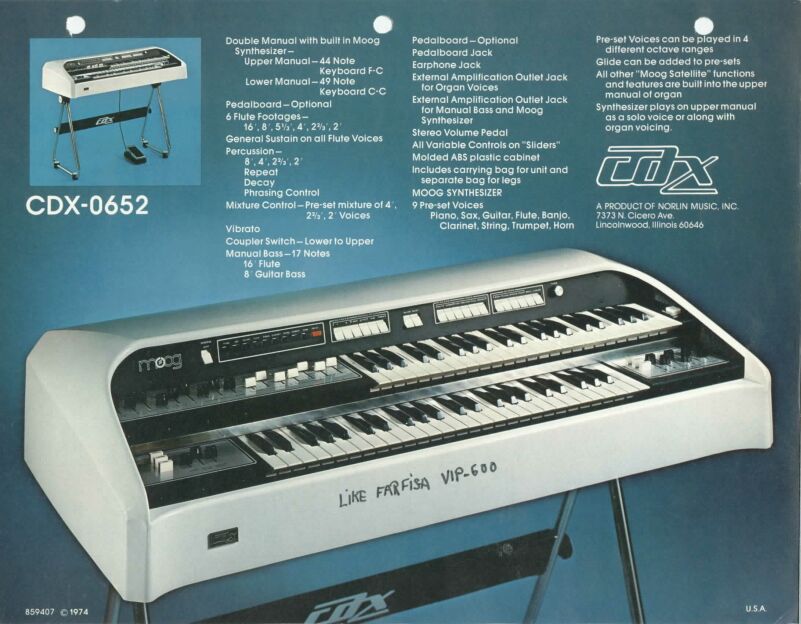
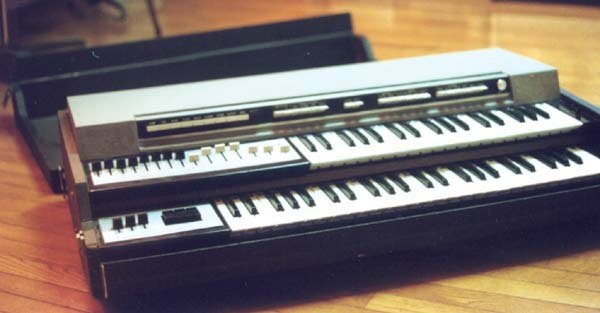
For some great close up shots of a Satellite in great condition, check out this Web site . You can also find some more information on the combo organs that sported the Satellite on, where else, but combo-organ.com. The Satellite was slapped on to at least a couple of different models, including the extremely space-age looking Cordovox CDX 0652 as well as the not-so-space-age looking Thomas/Moog organ.

Credit should go where credit is due - I got a lot of the information above at the usual spots:
All are great resources.