Showing posts with label wavestation. Show all posts

Thursday, February 23, 2012

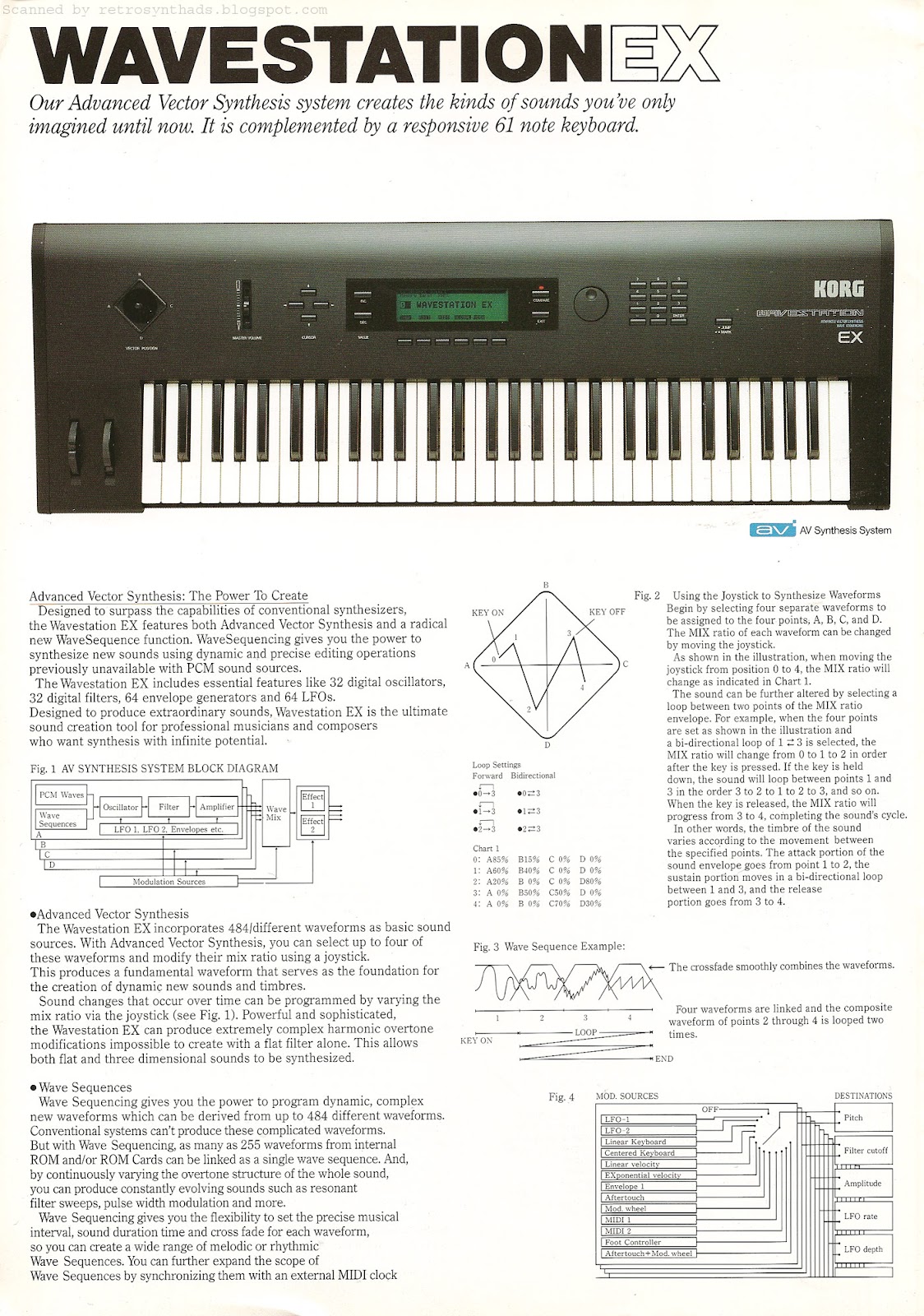
Korg Wavstation EX and Wavestation A/D brochure, 1992


Korg Wavstation EX and Wavestation A/D 8-page brochure from 1992.

I gotta tell ya. I'm all Wavestation-ed out. It's been a good run of blog posts, but I think my curiosity has reached its limit.

Actually - I thought I was already done with everything "Wavestation" on the blog. I even ended that last blog post with what I thought was a relatively witty Madonna/Britney Spears analogy that I was quite proud of. All wrapped up nice!  :D

But then I came across this brochure. Gah. Maybe it just looked too similar to the 1991 Wavestation/Wavestation A/D brochure I posted back in December, camouflaged, hiding from the world. Well, too bad. Like a crazy-assed Toddlers and Tiaras mother, I'm gonna shove this baby on stage whether it wants it or not.

Again - I'm surprised this brochure didn't get produced until 1992. I always thought the Wavestation EX came out *before* the A/D, as a response to customer feedback that the original Wavestation didn't include drums and other more basic sounds. The last sighting of the Jan Hammer Wavestation ad that appeared in July 1991 included additional EX ad-copy: "Now with expanded memory and more sounds". Also, the ad that followed in August 1991 featured BOTH the EX and A/D, suggesting they may have come out at approximately the same time. The Wikipedia page for the Wavestation includes 1991 production dates for both, and always seems to list the EX before the A/D in tables and such.

But then why did the Wavestation-Wavestation A/D brochure come out in 1991, but this brochure with the EX didn't appear until 1992? Also, why did the Spec Sheet for the A/D appear in March 1991 but the Spec Sheet for the EX didn't appear until November 1991.

Was it just that the additional awesomeness of the A/D, including an extra RAM bank and analog inputs, give it a leg up in getting promoted over the EX? Huh.

Hey - I seriously just noticed something on that Wikipedia page. Near the bottom of the page, it says that Korg's OASYS and Kronos also include wave sequencing and vector synthesis! I quickly jumped over to Ebay to check prices... oh. nevermind. The OASYS, released in 2006 still commands about a $5,000 price tag, and the Kronos is running at about $2,500.

I think I'll stick with my Wavestation A/D.

Okay, *now* my Wavestation curiosity has come to an end. And just in time - been getting a few requests lately - mostly for Oberheim stuff. Time to jump back into the 80s.

I'll end with a summary of my Wavestation posts. A good run.   :)

July 1990: Wavestation 2-page "Make Waves" intro ad
September 1990: Wavestation 1-page "Make Waves" ad
April 1991: Wavestation "Portraits" Jan Hammer ad (July 1991 version includes EX info)
August 1991: Wavestation A/D and EX "Top Ten Reasons" ad
November 1992: Wavestation SR "15 Sounds" ad
November 1993: Wavestation A/D and SR "5 And A Half Amazing Racks" ad

And, don't forget about the brochures!

1990: Original Wavestation brochure
1991: Wavestation and Wavestation A/D brochure
1992: This Wavestation EX and Wavestation A/D brochure

Monday, February 20, 2012

Korg Wavestation A/D and SR "Five and a half amazing rack systems" ad, Keyboard and Electronic Musician 1993


Korg Wavestation A/D and SR synthesizer "Five and a half amazing rack systems" 1-page advertisement from the inside front cover of Keyboard Magazine and page 79 in Electronic Musician November 1993.

Man - is it nice out.

*And* it's a long weekend.

*AND* I have a geek date to play Legend of Drizzt.  

*AND* I'm currently building a new table-top to fit onto my studio desk. I've had one of those Quik-Lok WS500 workstation desks for quite a few years. Not the most stable workstations (people can't dance in my studio because it makes my Tannoy's and computer monitor bounce), but very useful and serves my needs.  I used a Korg Z1 as a large master controller that sat on the upper arms, and then had a small wooden board on the table portion of the desk that held a keyboard, mouse, Mackie Control, and a various midi/audio in-out devices. Needless to say, it was getting very crowded.

And now that I've recently upgraded to a laptop, I need to make room for that. So, I took out the Z1 and put the 17" laptop on the open arms. Nice fit. And my master keyboard has now become a much smaller Korg MicroKey and sits on the desk now - closer to me than the laptop keyboard. Figure I input notes a lot more than I use the laptop keyboard. We'll see.

But, that small board was now really crowded with the addition of the keyboard. So, off to the store to buy a much larger 44"x30" piece of wood. Now everything fits nicely. The less cluttered look really makes me want to be in the room and create music again.

 I'll post a pic or two on my Retro Synth Labs blog in the near future.

Anyways, point is this will be a short blog post for all the reasons above. And ptobably my next blog post too. :)

Okay... time to be honest. I'm getting waaaaay past my comfort zone as I venture more into the early-90's. And I'm not just talkin' synthesizer ads - that includes many synthesizers as well.

I found that by this time, more than a few of the big synthesizer companies were just pumping out too many of what I considered to be just derivative versions of previous synths (if I'm using the word derivative correctly?!?!). Sure they would add a few new features, more ram/voices/etc... but nothing really "new". E-mu was in full swing pumping out their Proteus series, Roland with their JVs, Yamaha with their SYs (actually, not too shabby), and of course Korg with their 0x/Ws.

Don't get me wrong - they were nice sounding machines. They were workhorses. They were powerful. But I just didn't find them fun.

Sure, there were a few interesting things popping onto the market - the Wavestation stuff, Roland JD800, E-mu Morpheus, Kurzweil K2000 and the Waldorf Wave - but they were the exceptions that proved the rule.

Luckily there was more fun to come. I just had to wait for big and small companies a-like to get their butt in gear and release things like the Korg Prophecy, Doepfer A100 gear, QuasiMidi Raveolution, and Access Virus... it would just take time.

Until then - we got this. Korg's 1993 holiday push for it's five and a half racks.

It got good play in the November and December 1993 issues of Keyboard Magazine appearing on the inside front cover, but then got kicked into the back-half of the magazine in the January and February 1994 issues when Korg decided that their new Korg X3 workstation needed inside-front-cover attention. In Electronic Musician, the "Five and a half amazing racks" ad ran for a similar length of time, but never hit cover status as far as I can tell. Boo.

At least Korg had the courage and respect (hee hee) to list the Korg A/D and SR first. Even before the newer X3R and 5R/W. Makes me happy.

Korg was using the shotgun approach this holiday season - spraying pellets of rack-goodness at all types of musicians from the professional musician with a six-figure advance to the amateur home recordists in need of an under-$1000-all-in-one-box solution. And when I say all-in-one-box, I mean it. That little 05R/W had a built-in MIDI interface for MAC and PC. Okay, maybe the synth-gear world wasn't as stagnant as I made it out to be earlier.

I'm not too sure how long the SR and A/D  remained in production after this ad was released, but the Wavestation's Wikipedia page gives the Wavestation series an end date of 1994.

Almost hurts to see the Wavestation brand end with this ad - sharing advertising with an X3R. Bah!

It's kinda like Madonna sharing a stage with Britney Spears.   :)

Thursday, February 16, 2012

Korg Wavestation SR "15 sounds" ad, Keyboard and Electronic Musician, 1992


Korg Wavestation SR "15 sounds" 1-page advertisement from inside front cover of Keyboard Magazine and page 48 in Electronic Musician, November 1992.

Talk about good timing.

This ran exactly a year after the last Wavestation A/D and EX ad ran in Keyboard, and just in time for the Holiday buying spree! And Korg probably figured out that since the Wavestation SR was a lower-cost rack-mount, it probably had a better chance of getting permission from the spouse for purchase and entry into the house. Plus I'm sure the spouse got something of equal value too...  :)

The ad had a good run. It spent the whole holiday season - November 1992- February 1993 in Electronic Musician (albeit not near the coveted front of the magazine), but Korg opted for a more spread-out approach in Keyboard. After appearing in the November issue, there was a month break before re-appearing in February and March. And then, didn't make another appearance until June. But, if you look a little closer, there often seemed to be a possible reason for its absence. And on purpose or not, it allowed the SR to lengthen its eye-ball run considerably in Keyboard.

In the December 1992 issue, The SR turned up in the Spec Sheet section of Keyboard - a good replacement for an ad in my books - and free! I'm doubt Korg gets a courtesy call before a Spec Sheet blurb their gear appears, but it would have given them good reason to switch out the SR ad and use the Spec Sheet appearance as a substitute:
"Korg rack-mount synth. Korg has introduced the Wavestation SR, a single-space rack-mount synthesizer with 550 sounds (600 performances with optional program card). With three RAM banks and eight ROM banks, the SR contains a collection of performances from the Wavestation library. The unit is also compatible with Wavestation program cards and Korg's 0/1W PCM cards. The SR's multi-sets can play a complex split layered performance on each of 16 MID channels. $1,399.00 Korg, 89 Frost St., Westbury, NY 11590. (516) 333-9100. Fax (516) 333-9108."
That December 1992 as well as the January 1993 issues of Keyboard also had two other ads that may also played a role in giving the SR ad the boot. The first was that Korg included a two-page, horizontal ad for the O/1W that appeared on the inside-front cover and page 1 of the mag. You had to turn the magazine sideways to read the ad properly. A great way to grab attention.

The second was an ad for the Korg M1-PlusONE - a board that put "four megabytes of killer new PCM sounds like screaming electric guitar, celestial ebony flute, classic rock organ, and world percussion*" into your M1. The asterisk at the end of that sentence continues the voice list at the bottom of the page: *Also contains new PCM samples of acoustic guitar, electric piano, solo violin, rap percussion, harp, analog synth, marimba, string bass, assorted ethnic percussion, glockenspiel, and more.

Killer glockenspiel? Really? But I respect their attempt at keeping "synth hot-rodding" alive.  :D

Anyways, point being, that ad was "a sound partnership" ad by Korg and InVision Interactive (pun intended I'm sure). And maybe both this ad, and the O1/W two-pager in the mag, resulted in the SR ad getting punted.

The SR ad then got great ad-space in the February and March 1993 issues of Keyboard appearing on the front inside cover and page 3 respectively. .

The ad's April 1993 absence was no doubt due to Keyboard's cover feature that month - the "M1 Monster Sound Round-Up". Korg did the right thing by choosing to run a "lowest price ever" ad for the Korg M1 where the SR ad appeared the month before (page 3). Good work.

The May 1993 absence of the SR ad was easily made up for by its appearance in the "Short Takes" review section of Keyboard. Jim Aikin's review actually clocks in at just under one page if you include the full length photo of the front panel running across the top of the page, and does more than any ad could have making people think "happy thoughts" about the SR:
"The best thing about the Wavestation has always been its distinctive sound. Or sounds, actually. While it's known for rich, swirling pads, ferocious one-finger grooves, and hair-raising special effects, the kind of thing that other synthesizers can only do weak imitations of, it will produce detailed electric pianos, punch basses, crisp clavs, vibrant solo winds, and a wide range of other standard timbres just as easily. It's hard to program a Wavestation sound that doesn't have character."
Can't beat that kind of introduction.

The ad then made one final showing in June 1993, a full four months after it stopped running in Electronic Musician. Eight months long - not a bad run with only January and April missing out on anything SR-related.

The Wavestation brand had now been running close to three years. Hard to believe Korg wasn't done with it yet...

Thursday, February 9, 2012

Korg Wavestation "Portraits" ad featuring Jan Hammer, Keyboard, Electronic Musician 1991


Korg Wavestation "Portraits" 1-page advertisement featuring Jan Hammer from inside front cover of Keyboard Magazine and Electronic Musician, April 1991.

Hard to believe that by the time this Jan-Hammer-endorsed advertisement appeared, the Wavestation had already been in reader's minds for over a year. Sure, the introductory Wavestation ad may have first ran only nine months prior in July 1990, but readers of magazines such as Keyboard and Electronic Musician were hearing the wave-sequenced-buzz of vector synthesis technology months before.

For example, the original Wavestation Spec Sheet appeared a full four months earlier that the intro ad in the March 1990 issue of Keyboard Magazine. And Keyboard knew Korg had something special on their hands, because they opted to print a relatively large photo of the keyboard below the blurb. Only a few pieces of gear get that kind of star treatment:
"Korg WS Synthesizer: The WS Wavestation synthesizer is the first offering from the Korg R&D group in San Jose, which comprises mainly former Sequential Circuits personnel, including founder Dave Smith. The WS incorporates 32-voice, 16-bit digital vector synthesis, which was originally developed by Sequential for the Prophet-VS. Over 500 multisampled waveforms and sounds are included and can be linked together into user-programmable wave sequences. Dual programmable multi-effects, both joystick and wheel controllers, a 61-note velocity- and pressure-sensitive keyboard, 240 x 64-pixel graphic LCD, and RAM and ROM cards ports are included. About $2,500.00 . Korg USA, 89 Frost St., Westbury, NY 11590. (516) 333-9100."
This is an awesome Spec Sheet that not only provides some good technical information and preliminary pricing info, but also shows that either Korg was taking good advantage of the Dave Smith connection in it's promotion of this synthesizer, or that Keyboard knew their shit when it came to the design of the instrument. My guess is probably both. :)

But that wasn't the only early sighting of the Wavestation. Not even close.

If you were lucky enough to pop in to the January 1990 NAMM show, you were way ahead of the game. I don't think I would be out of touch with reality if I said that the Wavestation was one of the top darlings of the show. Unfortunately for readers, NAMM news at the time didn't usually hit the gear mags until a few months later. In the case of the Wavestation, that was April - a month after the Spec Sheet appeared.

The April 1990 issue of Electronic Musician listed it under the heading "The Ten Products People Told Us We Had To See", recognizing it both for the addition of Sequential's vector synth technology and for its PPG-style waveform "scanning". Interestingly, in the same NAMM article, EM also gives nods to the newly introduced Yamaha SY22, another synth offering vector synthesis, by including "...it's good to see that this type of synthesis didn't get lost in the cracks of MIDI history". Agreed!

Keyboard's April 1990 NAMM report gave the Wavestation top billing in the synth section of the article, and introduced the instrument with "Perhaps the most intriguing keyboard...". Not a bad start. They also reported on its PPG- and Sequential roots, also noting it's Prophet-VS-style joystick, and its MIDI-synchronization capabilities.

Side note: I would be remiss if I didn't point out that my man-crush (As my GF refers to Trent Reznor) was also featured in this issue of Keyboard Magazine, posing with his Emax sampler...

But that is enough history for one blog post...

This ad is a major shift in direction from the previous "Make Waves" advertising campaign. And I'm not just talking about design - but also the addition of an endorsement deal from none other than Jan Hammer. Personally, I only knew him from his Miami Vice soundtrack days (looks like he kept a shirt or two from the show), and even though I wasn't a fan, I sure as heck knew the soundtrack. Even more so, the music video. Not so much for his use of the Wavestation.

This ad continued to run for four months - April to July - and in that last showing in the July issue of Keyboard, we see a slight addition to the ad.


Let me read that again for you:

"Now with expanded memory and more sounds"

Whaaaaaat? That's right. As far as I can tell, that is the first sign that the new EX version of the Wavestation is just around the corner. It would still be a good four months before the Spec Sheet for the EX upgrade would appear... but this post is getting a little long, so will save that for my next one.

Oh - and end with this... :D


Monday, February 6, 2012

Korg Wavestation "Make Waves' ad, Keyboard/Electronic Musician 1990


Korg Wavestation "Make Waves" 1-page advertisement from inside front cover of Keyboard Magazine and Electronic Musician Magazine September 1990.

Well, we are already into the second month of 2012 and I have yet to circle back to the Korg Wavestation family of ads - an obsession that started at a much younger age, but was again re-ignited late last year when I posted the 2-page "Make waves" introductory ad. And what I later referred to my resulting behavior as "page-flipping/ebay-buying/scanning marathon sessions that could well provide blogging fodder well into mid-February".

This second advertisement, a direct descendant of the first, had began to appear in Keyboard Magazine immediately following the two-month run of the Wavestation intro ad in the September 1990 issue. Yup - the issue that had Public Enemy on the cover! The ad continued to run constantly between September 1990 and March 1991 in the coveted front inside cover page of the mag, usually next to an ad for the Korg S3 drum machine or a T-series ad.

And you have to remember - this is the 90s. There was another musician's magazine out there catering to the synth crowd - Electronic Musician. And Korg made sure they gave them some Wavestation ad-revenue-love as well. The same two-page intro ad appeared on similar real-estate in that magazine on the front-inside cover, and this one-page version of the ad carried on the tradition appearing on the inside front cover as well. Nice.

With such a long ad-run, Korg was wise to modify the advertisement during the second-half as more and more accolades for the Wavestation started to roll in. It was always a small change, but I think enough to keep the ad from becoming invisible to readers.

The first change in the ad appeared in January 1991 when the very top of the ad was sacrificed for a call-out box that included positive comments from Keyboard and Electronic Musician magazine.


I can't explain it, but I always feel uncomfortable whenever I see another magazine's name in Keyboard. Or Keyboard's name in another music magazine for that matter. I don't know why - it just feels dirty or something. Is this just me? Anyways - more on those reviews in a later blog post.

In that same January 1991 issue, it was announced that the Korg Wavestation had won the "Hardware Innovation of the Year award", as determined in the 15th annual Keyboard Magazine readers poll.

This nod to the Wavestation's beautiful internal and external design was immediately put to good use by Korg in the second modification to this advertisement that appeared in February and March 1991.  Again, bragging rights were added as a top of the page cut-a-way.


 The ballots appeared in the October 1990 issue of Keyboard, under the "Hardware Innovation" category (explained under the question: "Which hardware product set the standard this year against which others are judged?"). The Wavestation had some stiff competition, including the Alesis 1622 mixer, Buchla Thunder, Kat Drumkat, Lone Wolf Miditap, MOTU MIDI time piece, and Yamaha SY77. Readers also could write in their own piece of kit if they so chose.

And, on a similar note - guess who appeared under the "New Talent" category? Trent Reznor!

We know the results of the Hardware category, but how about new talent? Drum roll please.... Jane Child. Wait... what? She beat out Reznor by a fairly large margin apparently. And at a distant third was Oleta Adams, the "lounge gig refugee" discovered by Tears for Fears. Not sure how I feel about that. Grrr.

It is hard to believe, but by the time this ad ended its run in the March 1991 issue of of Keyboard, it had actually already been a year since the Wavestation first appeared in front of reader's eyes.

"What?" - I can hear you say it now. Okay, I can't really hear you, because that would be weird.

But yeah - a year! The ads may have only started running in July 1990, but readers got a preview much earlier.

More on that in my next blog post.

Monday, December 19, 2011

Korg Wavestation & Wavestation A/D brochure, 1991


Korg Wavestation & Wavestation A/D 8-page brochure from 1991.

Christmas is getting closer and time is running out. Added on to the regular pressures of work are the pressures of buying gifts (I dislike the whole obligatory gift thing), holiday get-together events (I have a general hatred for all humans), extra food eating (too many calories) and the extra exercise that has to follow (recipe for injuries). Bah humbug!

I get even more tired just thinking about it. Need to de-stress.

And lately, what are best ways to de-stress during the holidays? Well, if it isn't kicking a feral troll's ass or stompin' a goblin cutter while adventuring through "The Legend of Drizzt" board game with a few select geek friends, then the next best thing is mindless scanning. It takes me about ten times as long to scan any given ad or brochure because as soon as I start scanning one, I usually end up lazily paging through related reference info in other magazines and promo material. Good times... good times... the only thing missing is a hot tub and bubbles (not good for paper. Or scanners  :)

So, what starts with a Korg Wavestation 2-page intro ad, quickly turns into page-flipping/ebay-buying/scanning marathon sessions that could well provide blogging fodder well into mid-February.

And so it continues with this 1991 Wavestation & Wavestation A/D brochure. Flipping to the back of the publication, it looks like it might have been printed as early as March or June of that year, depending on how you read the print date/code on the back. It reads "1991 0306C0CGH". So, that 0306 could be either the month/day or day/month.

Either way, its still a fairly long time after the original Wavestation brochure came out (date code is 1990 0203CFOTH), and yet you have to give Korg creds for keeping to the original design while also making positive improvements. And, if it's unclear, I'm talking about both the brochure AND the Wavestation A/D itself.

Much like the A/D kept to the original synth design with all the same functions and capabilities, so does this brochure keep to the original by using a similar textural background. It also uses a very similar writing style and includes a lot of the same charts and diagrams. Recycling at it's finest!

The A/D also improved upon the original Wavestation through additional waveforms and effects algorithms, as well as adding those awesome analog/digital converters. Aside: A trademark sound from my main set included using a Dead Can Dance vocal riff (shush!) sampled into my Emax SE. Then, I would route the sample through the Wavestation's inputs with the vocoder effect, triggering both the sample and the wave sequence at the same time. Re-sample and repeat. Spectacular!

And this brochure definitely improves on the first brochure. The first thing to be noticed when looking at this brochure is that it is oriented vertically, while the first Wavestation brochure was horizontal. I have a love/hate relationship with horizontal brochures - from a design perspective it is creative and fun, but it doesn't always feel natural and is sometimes uncomfortable to hold. This second brochure is definitely easier to hold, open, and read. Also, readability is enhanced significantly in this brochure now that the textured background is removed from pages with actual information. Nothing beats black text on a white background. So much easier easier to read, especially with such a small font.

Well - I just thought of another one of my great stress reliefs. Watching Survivor! Time to hunker down in my pre-xmas-gift snuggie and watch Ozzy take victory! Go Ozzy go! 

Thursday, December 15, 2011

Korg Wavestation brochure, 1990


Korg Wavestation 6-page horizontal brochure from 1990.

And here you have it.

Instead of walking out of my local synth store with an actual Wavestation one sad day in 1990, I walked out holding this six-page brochure in my hand, my head held low. With probably only $100 to my name, there was just no way that keyboard was leaving with me. I was an angry elf that day. But yet strangely satisfied that I managed to actually get a live demo of the machine.

Well... to tell you the truth, this isn't the *exact* brochure. My original brochure, which I still have, is all tattered and torn - much like my heart that day. This second scanned copy is one that recently appeared in my mail box.

And what a great little brochure it is. Sure, the font is a little small and the copy can get lost against that speckled background - but it includes some great info, not to mention a print date. I like that.  The diagrams and charts are clean and are not only informational, but great eye-candy.

It would be a long time before this poor grad student would finally scrap together enough coin to get my hands on a used Wavestation A/D. And even after I did, much like my grandmother who would instinctively pocket buttons whenever she came across them even though she had a collection of thousands and couldn't possibly need any more, that feeling of 'want' is still so powerful in me today that every time I see a used one in a music store or online I instinctively want to purchase it. Like a squirrel collecting acorns before hibernating. 

Anyways, after the relatively good response to my last blog post (one retweet and two emails - LOL!), I knew the Korg Wavestation had an equally large influence on others. As with most marketing and communications professionals, I calculate that every tweet or email is equal to three billion actual responses.  :D

And if my rule-of-thumb calculation of nine billion responses doesn't convince you this thing is awesome, you can find other references to the Wavestation's immense greatness online. For example, In 2009, Music Radar listed the Wavestation as #7 in it's "10 greatest synthesizers of all time" article. Bam!

Also - according to the Wavestation's rather well-written Wikipedia page, "Keyboard Magazine readers gave the Wavestation its "Hardware Innovation of the Year" award, and in 1995 Keyboard listed it as one of the "20 Instruments that Shook the World". Pow!

The Wikipage includes some great history, including Dave Smith's involvement in the Wavestation's development:
"The Wavestation was designed by a team which included Dave Smith, who designed the Prophet-5 and, along with Roland, helped to invent the MIDI protocol in the early 1980s. His synthesizer company, Sequential Circuits, was purchased by Yamaha in 1988. The division was renamed DSD (intended by Yamaha to stand for Dave Smith Designs). The team, ex-SCI engineers Dave Smith, John Bowen, Scott Peterson, and Stanley Jungleib, then went on to Korg in May 1989 and designed the Wavestation, refining many Prophet VS concepts."
Makes me happy that other SCI engineers got creds too.

Well - I think you'll find my write-ups get smaller through the holiday break. Just too much work to do, and then time for a break. But I have a few more to go before Xmas.

Monday, December 12, 2011

Korg Wavestation Introductory Advertisement, Keyboard 1990


Korg Wavestation introductory 2-page advertisement from the inside front cover and page two of Keyboard Magazine, July 1990.

Okay. I know what you are thinking. Wavestation? Vintage ad? But I just had to scan and post it.

You see, my buddy had just popped into town. During our early years we were in an electronic band together and we were both greatly influenced by early Keyboard, Electronic Musician, and other music magazines. Until the Internet, those magazines were where we got 99% of our info from. What synths our favorite bands were using, what news synths were coming out. You know what I'm talkin' about.

Anways, it never fails that while maintaining our 20+ year tradition of gear-store/movies/pizza habit, our conversation eventually turns to the topic of synthesizers. But this visit, the conversation mostly revolved around iPad apps.
Aside: He's always wanted a Fairlight, and discovered the Fairlight app while in town. It wasn't long before sounds from Art of Noise's Moments in Love was making a come-back in my living room)
But in between spurts of iPadding and Netflixing (did I just use Netflix as a verb?), we also talked about my recent Korg infatuation. I was talking about Korg's evolving ads and it soon became apparent that it wasn't a 70's or even 80's Korg ad that had one of the biggest effects on me. It was this two-pager for the Korg Wavestation.

I can't remember half of my good friends' names, but I can clearly remember looking at this two-pager, as well as other Wavestation ads, thoughout the second half of 1990 and beyond. And I can remember walking into my favorite local gear store and the keyboard guy pressing his index finger on a single key and hearing the enormous and complex sound that emerged. I even remember that guy's crazy hair. But most of all I remember having to walk out empty-handed. Well - I did take the six-page brochure. Still have it. Can you guess what my next post is?  :)

The thing that stood out most for me was that the Wavestation wasn't a workstation. I disliked workstations at the time. Still do for the most part. Especially that miserable M1 - 80% because I knee-jerk to most really great mass-appeal ideas (not really a "plus" for someone in my occupation), 10% because it didn't have a resonant filter and 10% because of all those patches that became go-to signature TV commercial sounds (yes, I realize the hypocrisy of that last statement - I'm aware that Wavestation sounds became TV and movie soundtrack staples as well as the Apple Mac start-up sound).

But the ex-Sequential Circuits crew that designed the Wavestation had the balls to make this thing pure synth. Sure, they used the internal architecture from Korg's M- and T-series, but as far as I'm concerned, they gave that system new life. And they had the balls to not even include drum sounds in the original keyboard. I never missed drums, and tend to not touch the drums too often when programming on my Wavestation A/D.

In my opinion, the timing was perfect for bringing wave sequencing to the masses. What the Wavestation did for Korg at the time, is like what punk did for rock music.

Heck - Dave Smith was, and still is, punk with a capital P-U-N-K.

He took Korg technology and made it his bitch. He turned it upside down. He, along with Bob Moog and a few others, brought hardware back when few others would dare.

A "P," thats "PUH" and a "U"-"N"-"K", "UNK". Put those guys together and you got PUNK.

But I'm getting away from my point. Errr... what was my point? Oh yeah.

I *had* to post this two-pager introductory ad that appeared on the inside cover and page two of Keyboard magazine (a page position that Korg held for quite some time). I had to post it so you could see a great example of how Korg ads had evolved from the 70s and the 80s.

Sure, that second page has yellowed a bit compared to the heavier-duty magazine inside cover page. But even today I still get all gushy looking at it. It was perfect then and it is perfect now. Enough info to start me drooling. Enough info to make me hang around home as much as possible until the next issue of Keyboard came in the mail so I could check for a Keyboard review of the beast. Enough info to make me go back to my gear store every weekend so that I could hassle them into keeping one from walking out the door until after I could check it out.

And can you guess what the first thing that workstation-loving keyboard guy with the crazy hair said to me: "Doesn't have drums... or a proper sequencer".

Nice sell job. And I honestly thought he knew me better than that.  :)