Showing posts with label modular moog. Show all posts

Sunday, October 12, 2014

Moog Modular System I, II and III "Setting Up Your Moog Synthesizer" installation and operation guide, 1970


Moog Modular System I, II and III "Setting Up Your Moog Synthesizer - A Guide to Installation and Operation of Synthesizers I, II and II" 16-page installation and operations manual, 1970.

Also available as PDF (4MB).

According to the InterWebz, today is the 50th Anniversary of the Moog Modular. To help celebrate in my own little way, I thought I would scan my 16-page installation and operations manual. I've seen bits and pieces of this document everywhere, but I haven't come across the whole thing. It probably does exist. But just... in... case... here it is.

Moog Music has posted a special 50th Anniversary video for this occasion. I highly recommend watching it, even if just for the GAS factor. But you are bound to learn a thing or two as well.


One of the most informative parts of the video for me is an explanation to the possible "why" of Moog's choice of the "S" trigger. The video goes into it around the 8:45 mark, comparing it to the short found in the electronics of a door-bell button. Aaaaaaaah. That does kinda make sense.

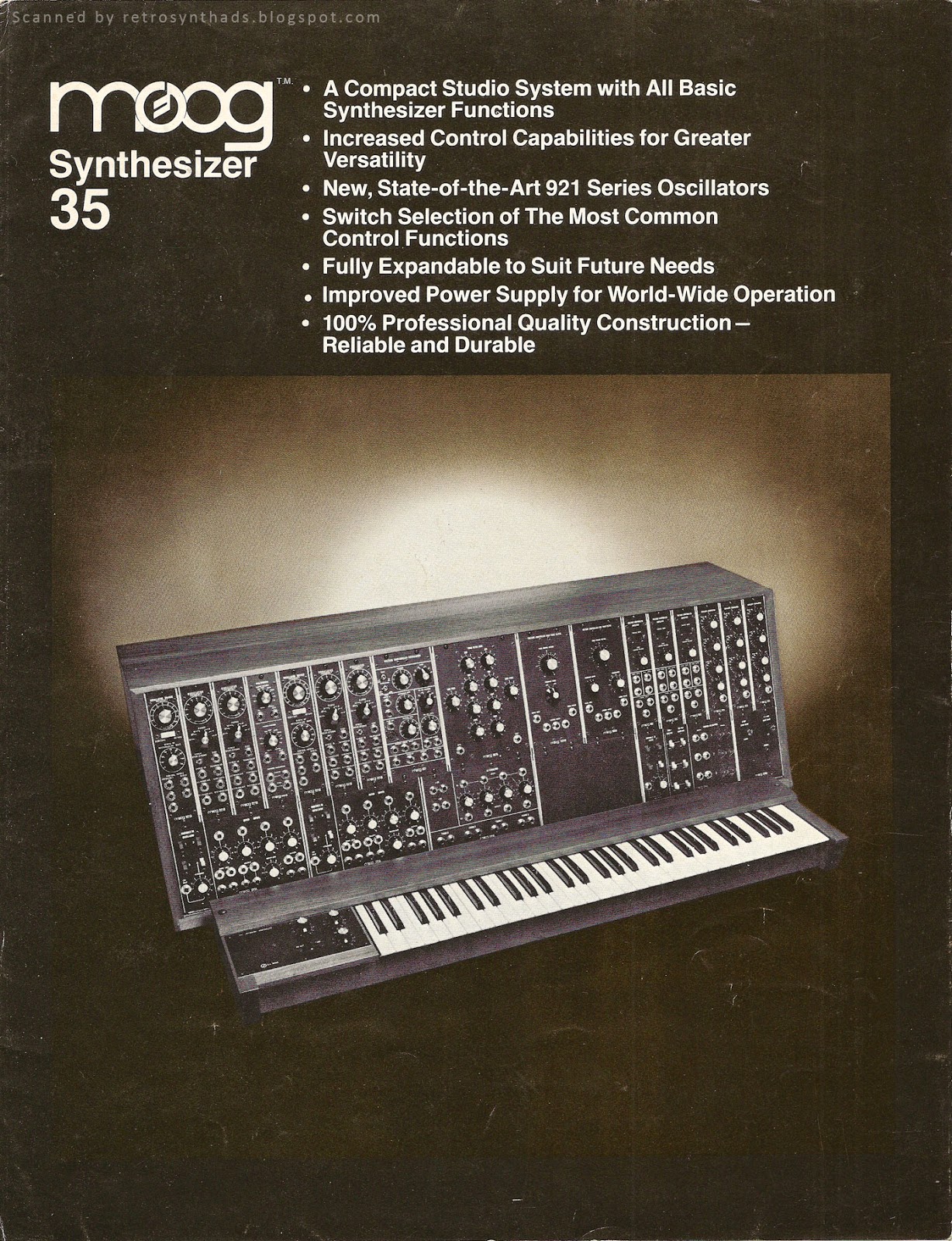
If you are really in "the moog" for more Moogy goodness, check out a few other juicy Moog Modular pieces from the blog, including System 15, 35 and 55 multi-page brochures...

http://retrosynthads.blogspot.ca/2014/05/moog-synthesizer-15-modular-system-six.html http://retrosynthads.blogspot.ca/2014/04/moog-synthesizer-35-modular-system-six.html http://retrosynthads.blogspot.ca/2012/05/moog-synthesizer-55-system-six-page.html

...and several later module brochures I recently posted.

http://retrosynthads.blogspot.ca/2014/09/moog-903a-random-signal-generator.html http://retrosynthads.blogspot.ca/2014/09/moog-903a-random-signal-generator.html 

You'll notice this installation and operations document is looking a little... well... old, and I often get asked why I don't "clean up" my scans. One reason is... not gonna lie... laziness. But it's also about capturing the time period. This document is over 40 years old, and I like the look, feel and smell of it.

Fetish?

Maybe. :)

Happy 50th, Moog Modular. You make me happy. 

Monday, September 29, 2014

Moog 902 Voltage Controlled Amplifier brochure, 1976


Moog 902 Voltage Controlled Amplifier four-page brochure from 1976.

Voltage Controlled Oscillators aka V. C. A.  aka Y. U. M. :)

If you are keeping track - this is the forth brochure in the series I've posted. You can view the other posts by clicking on their images below.

http://retrosynthads.blogspot.ca/2014/09/moog-921a-oscillator-driver921b-voltage.html http://retrosynthads.blogspot.ca/2014/09/moog-921-voltage-controlled-oscillator.html http://retrosynthads.blogspot.ca/2014/09/moog-903a-random-signal-generator.html

Like all the brochures in this series, the front cover includes a nice close-up shot of the module itself.  The 902 VCA brochure resembles the VCO brochures in that it includes four pages of deliciousness. Flip open that gorgeous cover and you are greeted with the brochure copy on the left and some official looking diagrams on the right. And ultimately, specs on the back page.

One thing I haven't been freaking out about lately is that Moog logo. I love logos. Especially the old-skool logos like Moog, ARP, Sequential and the like. In all of these brochures, that lovely Moog logo is right there at the top.  And the best part is, that Moog logo design is the one still used today. Nice.

But, did you notice that the location of the Moog logo on these brochures isn't constant. It's always on the opposite side that the module photo is on. Module on the left - logo on the right. Module on the right - logo on the left. Interestingly, the one brochure where the logo is on the right is also the only brochure I've posted so far that was printed in 1974 - not 1976 like the rest of them. Not sure where I'm going with that - just an observation. As I post more, we'll see if the pattern sticks.

I've never paid too much attention to VCAs until I really got into modulars. On most "regular" (read: non-modular) synths they usually just kinda sat there, almost invisible, next to an envelope generator or whatnot. They really do get the short end of the stick on most synths.

Comparatively, VCOs have wave form selection buttons, octave knobs and various other doo-dads. VCFs have, at their most basic, cut-off and resonance controls. More advanced VCFs even let you choose the type of filter -low pass, high pass, bandpass...  lucky ducks.

But VCAs... Maybe a volume knob. Waaaah.... waaaaaah.... On an Korg MS20 it's just an image of a triangle. No, really. The Yamaha CS15 has one control to adjust initial volume (besides the modulation controls for LFO and EG).

I guess my point is that its not surprising how little we pay attention to them.

I was lucky that my Moog Modular came with three VCAs, each sitting next to an envelope generator. So, it dawned on me early on how important their role was. More importantly, it dawned on me *before* I started creating my Eurorack modular. It's quite common out there to get a Eurorack system started without figuring VCAs into the equation. 

Aside: speaking of Eurorack, one of my favorite VCA-type modules at the moment is local (to me!) Eurorack module designer Hexinverter.net's Galilean Moons. And yes, I've paired it with his Jupiter Storm module too. Together they are almost too much fun in a box to be legal. He includes some great sound examples on those pages. Check 'em out.

But back to the point. VCAs *are* important, especially as your system grows and you start creating more complex patches. Don't believe me... Just read through this "Do I really need a VCA" thread on Muff Wiggler.

Some great quotes:
  • Filch: "The general motto around here is : "You can never have enough VCA's""
  • fredguy "I started out not using vca's much and then came to understand what they brought to the party."
  • robkramble: "I totally derped and overlooked the use of a VCA as a CV router... "
  • Matos: "No, you don't need a VCA. You need many VCAs!  "
  • boramx: "i personally think you should have about 2 VCAs per 3u of modules."
And, I'll end this post with one other quote from forum member monobass:

"vcas are the next level shit y'all"

Yup.

Monday, September 22, 2014

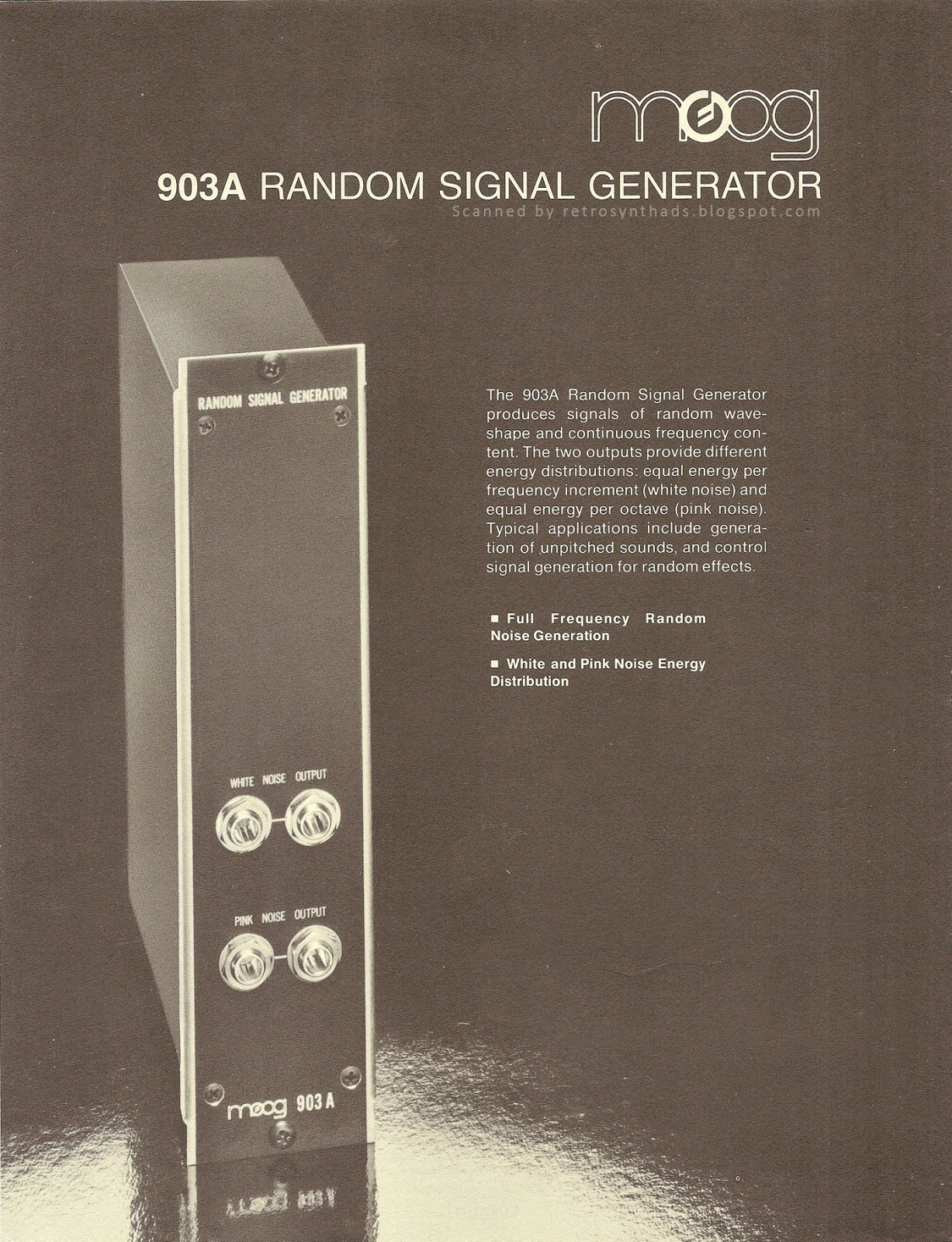
Moog 903a Random Signal Generator brochure, 1976


Moog 903a Random Signal Generator two-sided brochure from 1976.

For the last couple of weeks I've been swooned by a series of Moog module brochures. This 903 Random Signal Generator brochure is the third in the series - after blogging on the Moog 921a/b oscillator bank and the Moog 921 voltage controlled oscillator module.

http://retrosynthads.blogspot.ca/2014/09/moog-921a-oscillator-driver921b-voltage.html http://retrosynthads.blogspot.ca/2014/09/moog-921-voltage-controlled-oscillator.html

I gotta say, this series is shaping up to become a handsome set of brochures with those lovely front covers. Sweet.

There is one little difference with this latest brochure though. Those first two brochures each included four pages of juicy Moog-y goodness, but this latest 903a random generator module brochure consists of only one two-sided piece of paper. It's not a surprise though - that 903 panel is sparse-city, consisting of just dual white noise and pink noise outputs.  No big dials, switches or flashing lights in the local vicinity.

That may give someone not familiar with noise generators the wrong idea. A noise module is a MUST for any modular. The back of the brochure goes into some good detail on how noise can be used effectively within a patch. Percussive sounds - check! Sound effects - yup!  And of course there's the signal control applications as well like their involvement in creating randomly timed and tuned beep, boop, boop, beep, boops.

Growing up I loved noise. Not the really loud variety of clanging and banging (that came later) but that soothing noise that I find described so well by William Gibson in the opening line of Neuromancer:

"The sky above the port was the color of television, tuned to a dead channel."

I love that quote. and I also love the sound that often accompanied that screen "color" late at night when a television channel went off the air. SSHSHSHSHSHSHSHSH...

It wasn't until I got my Moog modular that I realized there was different "colours" of noise. And even then I wasn't too curious what the differences were for a long time. If you Google the topic you will soon learn there are a wack of different "colours "of noise - and as math is introduced into the equation (pun intended) if you are like me your head will begin to hurt a little bit.

According to Wikipedia, noise tends to be divided into two groups.

The first group are those colours of noise that have precise definitions:

White. Pink. Brown(ian). Blue. Violet. Grey.

In the case of this module, White noise has a "flat" frequency spectrum - "the signal has equal power in any band of a given bandwidth... when the bandwidth is measured in Hz". The example they use is that the sound power between the frequency range of 40Hz and 60Hz is equal to the sound power between 400Hz and 420Hz. Here's the chart for white noise from the Wikipedia page.


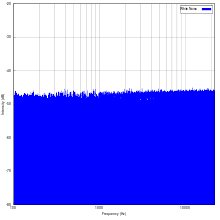
Pink noise, on the other hand, is linear in logarithmic space - "it has equal power in bands that are proportionally wide". Using the same example above, there is the same amount of sound power between 40Hz and 60Hz as there is between 4000-6000Hz. Now compare its spectrum chart below to the one for White noise above.

The visuals definitely help. :)

The second group are those with less precise definitions, synonyms for formally defined colours, or have multiple definitions - Red. Green. Black. Noisey White. Noisey Black.

I'm not even going to pretend I know *exactly*what they are talking about, but I get the idea.

I'll let you read the Wikipedia page to find out more info.

My head hurts.   :D

Monday, May 12, 2014

Moog Professional Systems Price List, March 1, 1976


Moog Professional Systems Price List from March 1, 1976.

When friend of the blog Micke posted those links to the Moog 1972 and 1974 modular price lists in the comments section of my Moog Synthesizer 35 post, I immediately recognized the 1974 price list as looking eerily similar to a 1976 price list I had on my shelves somewhere. I went over to the Moog section and after a bit of digging finally found this little gem - in great condition too. Nice thick paper. Dark print. Yum.

When I did a cursory comparison, they looked identical (except for the colour), but as I took a closer look the differences started to make themselves clear.

The cover of the 1974 price list and this 1976 price list are pretty much identical, except that the "TM" is missing from the Moog logo that sits in the top right corner - and in fact, its missing from every corner of every page. The design of concentric circles matches the design style used for their product reference sheets from the same time period.

Flip open the list to the inside pages and again - very similar. On the inside-left page, the two paragraphs in the 1974 price list and this 1976 list are identical. No words have been changed. Underneath is the Instrument price lists, and its a little surprising to see just how much prices have gone *UP* in just two years.

For example:
Moog System 15 -  1974: $3,495.00  ----  1976: $3,845.00
Moog system 35 -   1974: $5,395.00  ----  1976: $5,935.00
Moog System 55 -  1974: $8,795.00   ---- 1976: $9,675.00

And remember, those differences are in 1976-dollars. That was a lot of cash back then!

On the inside-right page of the 1974 price list and the 1976 list are modules prices. Again, we see the uptick in pricing in 1976, and we also are surprised with the availability of a few more modules!

  • The 928 Modular Sample and Hold
  • The 1630 Bode Frequency Shifter
Excellent additions.

Finally on the back of the the 1974 price list and the 1976 list are images of the three different models available and a few selling points for each. Again, all similar between the two.

The most interest difference between these two price lists is right at the bottom of the back page. On the 1974 list is written "Distributed by: NORLIN MUSIC Inc." along with some contact info. This is rather surprising considering that according to the "Bob Moog: A Timeline" page on the Moog Music Web site, Norlin Music purchased Moog Music Inc. from Bill Waytena in 1973, essentially making Moog a sub-brand.

But, by 1976, Norlin finally decided to take advantage of their ownership status and up'd the tagline on that 1976 price list to "Another Quality Product from Norlin".

And just to make it official, slapped that Norlin logo right next to it.

Monday, May 5, 2014

Moog Synthesizer 15 modular system six-page brochure, 1974


Moog Synthesizer 15 modular system six-page brochure from 1974.

Ooooh... Aaaah... There we go. I feel so much better now.

I need order in my life. Whether its aligning my cutlery on a restaurant table just so or posting a particular series of synth brochures in a particular order. It drives me batty until its finished.

In this case, it was finally getting to post the third Moog Modular brochure in the 55/35/15 series.

Seeing them all in row below completes me. :)

http://retrosynthads.blogspot.ca/2012/05/moog-synthesizer-55-system-six-page.html

You have to admit - they do look rather nice all lined up like that.

There are a few noticeable differences between the brochure for the Synthesizer 15 when compared to the others. First, as I pointed in my last blog post for the Moog Synthesizer 35, is the accent colour - this time a lovely baby blue.  I do rather like seeing that Moog logo in the inner-centre page pop so nicely on the page.

Next, and this also drive me a little batty, is that Moog decided to change the third subheading a little bit. The first two subheadings on the inner pages are consistent among all three brochures, But in this Moog 15 brochure, the third subheading reads "The Synthesizer 15 can:", while the Moog 55 and 35 brochures read "The Synthesizer 55/35 will:".  Gah.

But, I gotta say, one difference I do like is the "Moog Model 15 Synthesizer" label that can be found on the bottom of the control voltage and trigger output panel.


That label isn't found on the 55 or 35, and I've always thought the one thing missing from these Moog Modulars is some kind of model brand/identity. Of course, every module contains a lovely little Moog logo - a tradition that has remained with most, if not all modular synth manufacturers since. And I also get that the modular nature of these instruments means that model numbers mean very little when so much customization can be done. A Moog 35 can quickly blend into something that more resembles a Moog 55 with the addition of a few modules.

One other thing I really dig about this brochure is the module chart list. All three brochures included them, and the Synthesizer 55 is definitely the most impressive, but because there are less modules in the Moog 15 chart than in the Moog 55 or 35, it means each module photo in the chart can be larger. That makes for one sweet lookin' image:


Just as I was finishing up this blog post early Sunday morning, wise friend of the blog Micke dropped by last weeks post to leave a comment on the print/availability dates of the brochures. The print date for this brochure, like the others in the series is 1974. But I posed the question that since the 921 oscillators were referenced as "new" in this brochure, I thought there was a chance that there had been an earlier printing since those oscillators actually became available around 1972.

So, I'll end the post with the full comment from Micke that includes two links to early 1970's price lists...
"To the best of my knowledge the Moog systems 15/35/55 were all introduced in early 1974 and therefore I'm pretty sure this is the original version of the brochure.
Moog system/module price list Feb 1974:
https://www.flickr.com/photos/23461646@N03/2793105680/sizes/l
https://www.flickr.com/photos/23461646@N03/2792253573/sizes/l

It is correct however that the 921 series oscillators became available in '72.
Moog system/module price list oct '72:
https://www.flickr.com/photos/23461646@N03/3931303117/sizes/l
https://www.flickr.com/photos/23461646@N03/3931275147/sizes/l

The Moog 12 (with the new 921s) appears to have been released this year as well. I seriously doubt that the system 15/35/55 became available as early as '72 though. The fact that the older systems are still being listed in this price list from late '72 should be proof enough that the 15/35/55 didn't exist yet.

cheers,
Micke"
Thanks Micke!