Showing posts with label 1974. Show all posts

Thursday, December 31, 2020

ARP "From Jimmy With ARP" advertisement, Downbeat Magazine 1974


ARP "From Jimmy With ARP" half-page black and white advertisement from page 41 in the June 20, 1974 issue of Downbeat Magazine.

Well, look at this! I hope you are noticing the trend. As part of trying to get all my 2020 ARP 50th anniversary celebration posts... eeer... posted, I've been uploading quite a few ARP pieces this month, including two of the many ARP advertisements from the time period that used a very similar half page, black and white format. 

And now... I've posted the third. With more to come.

I love that all three of these ads all fit into a theme, but yet they are all very distinguishable from each other. There isn't a stagnant "photo/artwork at top" - "text in the middle" - "Logo in bottom right" format to them. Each of the ads has kept a unique look. As unique as the different artists that are featured in each one. 

One other thing I like about all three ads is they all contain one of those little cookies I went on about in my last Carpenters ad. This earlier ad uses the code "DB-620" (Downbeat June 20), but curiously leaves out the "year", unlike that those other 1975 ads included (DB 1-16-75). Looking at a few of the other earlier ARP ads like the Edgar Winter ARP ads that appeared around six months earlier, they too used the earlier cookie format that didn't include the year. No real other comment to make on that fact - just interesting that they changed the format.

Another little thing that separates this earlier ad from the others is the little picture in the bottom right hand corner of three of ARP's products. This little photo also appears in Edgar Winter's Frankenstein and Freeride ARP ads, but not in Billy Preston's Space Race ARP ad or Stevie Wonder's WonderArp ad (none which I've posted yet). Once I've mapped out the timeline for all these half-pagers, it will be interesting to see when exactly they were added and removed. 

My past experiences of 'Zep run along the same lines of The Who. I didn't really understand or 'get' the synth influences first time around. The one thing I do notice when looking back, is that fans of Townsend were much more accepting of the band's use of synthesizers where Led fans weren't so sure they shared their favourite band's love for them.  Just my observation - your mileage may vary. 

Now, where deeper knowledge of most Zeppelin songs flew over my head (except for the mandatory ever butt-grabbing Stairway to Heaven), there was one song I was always willing to get behind...

Carouselabra. 

For some reason I've always had an affinity for that one. Maybe it was the synths that first got me hooked? Maybe?  It could also have been that some of the dreamier parts reminded me of Alan Parson's stuff.  I dunno. Hard to say. But I can tell you when the topic of Led Zeppelin came up with friends at a party, I would turn the convo towards that song, and trying to convince them to play it on whatever stereo system was handy.

Just for fun, I googled the song to see what others had to say, and this rather interesting post on Cheatsheet.com came up - "What Robert Plant Regretted About Led Zeppelin’s ‘Carouselambra’". It takes a little bit of a deep dive on the lyrics of the song.  

Go Cheatsheet! Go Carouselabra! 

And okay... go Stairway to Heaven!

Wednesday, December 9, 2020

ARP "The Arp Story" brochure, 1974


ARP "The ARP Story" 8-page colour brochure for the Pro Soloist, Odyssey, 2600 and 2500, including two extra colour inserts for the Axxe and Explorer. 

Okay, it's been a while since I've blogged. But it's ARP's 50th anniversary and I just gotta get a few more ARP posts in over the next week or so. So, if things go as planned, you will be sick of me. But lucky you, I'll be keeping these short. 

We are talking a colour brochure for six of Arp's kick-ass instruments, gorgeously designed and positioned. The instrument shot, those sexy flowing backgrounds, thin, yet chubby font, and those unique little white computer generated swirlies that appear somewhere on each product's page.  And, then to accompany each of those product page (except the 2500) is an accompanying page that includes some info on each instrument along with... yup... my fav...  

DIAGRAMS. 

Diagram. Line drawing. Whatever you want to call 'em. 

I call it... ART. 

Straight up, Boo. (I have no idea what I just said. But the kids will get it, I'm sure). 

Now, you will notice that ARP sacrificed a back page for the 2500 so it could, rightfully, include a little bit about ARP itself.  But even this page is very much art, with its colourful duotone photographs - one that includes, of course,  Alan R. Pearlman, and the other, double f course - Pete Townsend of The Who. More on him and his connection with ARP in a future post, I'm sure

Now, if there is one thing I like in my brochures, its when they talk about other marketing material I just have to get my hands on. And ARP punches me in the face by throwing a few teasers out...
"We offer an exclusive series of instructional programs, playing guide songbooks, and cassette tape packages designed specifically for ARP synthesizers."
Gak! Time to go down another rabbit hole. But first, let me finish...

All put together, the brochure and the extra leaflets, it all becomes one of the most gorgeous retro synth brochures in existence. Not just ARP brochures - of all synth brochures. Sure, there are few others on this level. But this is top five for sure. If not top three. ARP at it's finest. 

There is nothing more I can say that is not already included on those pages. I suggest you give ARP some of your time during their 50th anniversary and read 'em.   :)

Thursday, May 23, 2019

Moog Minimoog "The Moog for the road" brochure/poster, 1974


Moog Minimoog "The Moog for the road" eight page colour brochure/poster from 1974.

I've sweated over blogging about this brochure/poster for a long time because I was never sure exactly how I was going to scan and post such a unique piece of marketing material? The problem is that it is both a brochure and a poster. Let me explain.

The piece starts off as a brochure - with a front cover, two inside pages, and a back cover. Great. Cool. I can scan that easily enough and post the scans as I normally would for a brochure (which I did above).

The other side is a poster, where the two upper quadrants are specs and features and the two bottom quadrants make up one big awesome photo of the Minimoog. Again - Great! Cool! I can scan and post that side as chucks of a poster.

Here's the problem...

Because of the way the piece was design and folded,the two inside pages on the "brochure-side" are actually upside down!


You will also notice that those two top quadrants (the inside pages for the brochure side) are also a bit shorter, The designers purposely did this so that tag line "Minimoog... a whole new freedom of expression" from the bottom of the "poster" side can be visible on the "brochure" side!


Not only is that a cool design feature, it's also functional, giving a great visual cue to the reader to flip up those two inside brochure pages to reveal the poster right-side-up on the other side! Genius!


The piece is gorgeous and quite a departure from the Minimoog "The INstrument of the pros" brochure from just two years previous.

Don't get me wrong - I loved that 1972 brochure with its amazing illustrations. But this 1974 brochure's professional photography, less busy design and unique brochure/poster fold makes for one of my favourite historical pieces - not just from Moog, but for all synths.

Just gorgeous.

Happy Birthday Mr Bob Moog.

Monday, September 15, 2014

Moog 921 Voltage Controlled Oscillator brochure, 1974


Moog 921 Voltage Controlled Oscillator four page brochure from 1974.

Last week I posted the brochure for the 921a/b VCO bank from the same series. This 921 VCO is like the Simon to the Garfunkel of the 921a/b bank. The Captain to the Tennille.

Actually, maybe I should be using synthpop references. The Annie Lennox to the Dave Stewart of Eurythmics. The Vince Clarke to the Alison Moyet of Yazoo. The Neil Tennant to the Chris Lowe of Pet Shop Boys. The Marc Almond to the Dave Ball of Soft Cell. The Rob Fisher to the Peter Byrne of Naked Eyes. The Neil Authur to the Stephen Luschombe of Blancmange.

Okay, think I milked that one. Point is, chances are you will find both 921s and 921a/b banks making beautiful music together in a Moog Modular.

I mentioned in my last post how researched seemed to indicate that the 921 series came to be in part because the Moog Modular was transitioning from an experimental machine found mostly in music "labs" to that of a musical instrument to be found in some of the top professional recording studios. In particular, the 901 series was replaced by the 921 series with their better temperature stability, tracking accuracy and extra functionality - requirements when trying to churn out the next top 40 hit.

But these modulars were highly technical machines. And they required some technical knowledge to get up and running (and keep going).  Thus, this brochure is NOT marketing Moog modules to the average musician. And I'm not even sure if its directed towards the average studio tech either, although I wasn't hanging around in studios back in 1974 so can't really comment to their technical knowledge. The highly technical content leads me to believe this series of brochures was still being targeted towards the music lab gurus - and probably only the ones with the whitest lab coats, biggest pocket protectors and (in reference to the men) the biggest beards.

Aside: before you knock me for my nerd-bashing, I will have you know that I wear a pocket protector every day at work, and usually a different every day. Geeez - how else do people protect their pockets these days?!?! So, if you have any vintage (or new!) pocket protectors, please contact me! I'm serious.

Back to the point... were was I... oh yeah... targeted audiences.

To make my point, let's compare this brochure to the marketing material of another one of Moog's legendary products - the Minimoog.

http://retrosynthads.blogspot.ca/2012/10/moog-minimoog-you-know-what-this-is.html
Minimoog

No text whatsoever. :)

Yeah, I know - silly comparison. By 1979, the Minimoog was such a standard tool in the studio that not only did it not need more than 10 words of marketing content, but Moog didn't even have to slap a logo in their ad. So, okay, a totally shitty comparison.

A better comparison might be Minimoog's 1972 brochure. Here's the inside scan that links to the blog post.

http://retrosynthads.blogspot.ca/2010/05/moog-minimoog-brochure-instrument-of.html

So, this Minimoog brochure was printed TWO YEARS before the 1974 921 VCO brochure.

Let's compare the first real line of content of the two brochures:

921 VCO
"The 921 Voltage Controlled Oscillator generates periodic waveforms within a total frequency range from .01 to 40,000 cycles per second."

Minimoog
"Brutal, caustic, volcanic - Evocative, flirting, caressing - crisp, powerful, biting - Entrancing, embracing, exhilarating!"

Yup. Definitely different audiences. :)

That 921 VCO brochure content is definitely targeted towards those pocket-protected white-lab-coat-wearing music technicians while the text in that Minimoog brochure was obviously meant for the  tight-shiny-gold-pants crowd.

To be fair, there was some cross over between these two groups. And I have to say, those men and women in the lab coats *and* tight gold pants were definitely the most awesome.

I'm not saying Moog didn't create modular marketing material for a musician audience, I'm just saying this series of brochures was definitely not. 


Monday, May 5, 2014

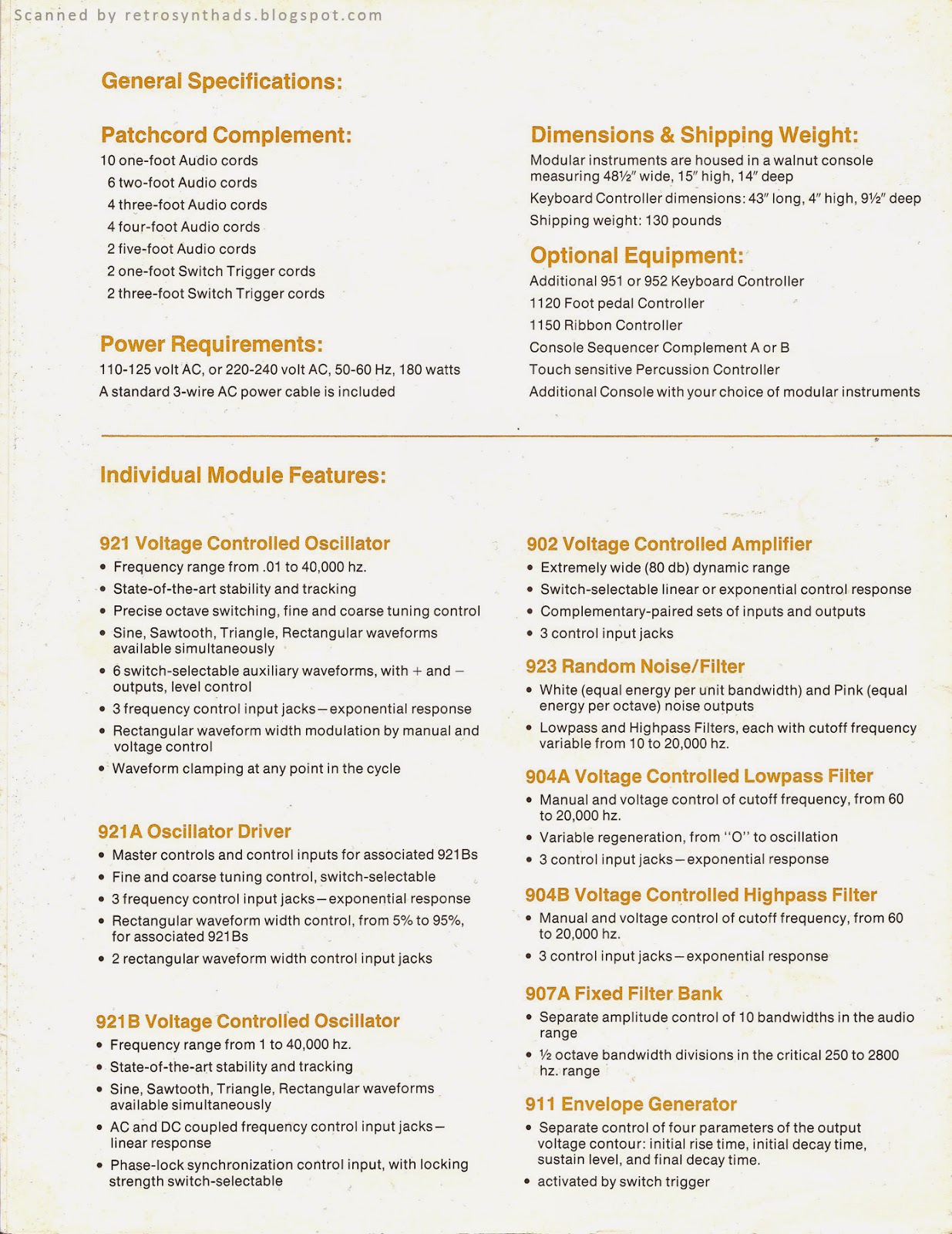
Moog Synthesizer 15 modular system six-page brochure, 1974


Moog Synthesizer 15 modular system six-page brochure from 1974.

Ooooh... Aaaah... There we go. I feel so much better now.

I need order in my life. Whether its aligning my cutlery on a restaurant table just so or posting a particular series of synth brochures in a particular order. It drives me batty until its finished.

In this case, it was finally getting to post the third Moog Modular brochure in the 55/35/15 series.

Seeing them all in row below completes me. :)

http://retrosynthads.blogspot.ca/2012/05/moog-synthesizer-55-system-six-page.html

You have to admit - they do look rather nice all lined up like that.

There are a few noticeable differences between the brochure for the Synthesizer 15 when compared to the others. First, as I pointed in my last blog post for the Moog Synthesizer 35, is the accent colour - this time a lovely baby blue.  I do rather like seeing that Moog logo in the inner-centre page pop so nicely on the page.

Next, and this also drive me a little batty, is that Moog decided to change the third subheading a little bit. The first two subheadings on the inner pages are consistent among all three brochures, But in this Moog 15 brochure, the third subheading reads "The Synthesizer 15 can:", while the Moog 55 and 35 brochures read "The Synthesizer 55/35 will:".  Gah.

But, I gotta say, one difference I do like is the "Moog Model 15 Synthesizer" label that can be found on the bottom of the control voltage and trigger output panel.


That label isn't found on the 55 or 35, and I've always thought the one thing missing from these Moog Modulars is some kind of model brand/identity. Of course, every module contains a lovely little Moog logo - a tradition that has remained with most, if not all modular synth manufacturers since. And I also get that the modular nature of these instruments means that model numbers mean very little when so much customization can be done. A Moog 35 can quickly blend into something that more resembles a Moog 55 with the addition of a few modules.

One other thing I really dig about this brochure is the module chart list. All three brochures included them, and the Synthesizer 55 is definitely the most impressive, but because there are less modules in the Moog 15 chart than in the Moog 55 or 35, it means each module photo in the chart can be larger. That makes for one sweet lookin' image:


Just as I was finishing up this blog post early Sunday morning, wise friend of the blog Micke dropped by last weeks post to leave a comment on the print/availability dates of the brochures. The print date for this brochure, like the others in the series is 1974. But I posed the question that since the 921 oscillators were referenced as "new" in this brochure, I thought there was a chance that there had been an earlier printing since those oscillators actually became available around 1972.

So, I'll end the post with the full comment from Micke that includes two links to early 1970's price lists...
"To the best of my knowledge the Moog systems 15/35/55 were all introduced in early 1974 and therefore I'm pretty sure this is the original version of the brochure.
Moog system/module price list Feb 1974:
https://www.flickr.com/photos/23461646@N03/2793105680/sizes/l
https://www.flickr.com/photos/23461646@N03/2792253573/sizes/l

It is correct however that the 921 series oscillators became available in '72.
Moog system/module price list oct '72:
https://www.flickr.com/photos/23461646@N03/3931303117/sizes/l
https://www.flickr.com/photos/23461646@N03/3931275147/sizes/l

The Moog 12 (with the new 921s) appears to have been released this year as well. I seriously doubt that the system 15/35/55 became available as early as '72 though. The fact that the older systems are still being listed in this price list from late '72 should be proof enough that the 15/35/55 didn't exist yet.

cheers,
Micke"
Thanks Micke!

Monday, April 28, 2014

Moog Synthesizer 35 modular system six-page brochure, 1974


Moog Synthesizer 35 modular system six-page brochure from 1974.

As a communications guy, I'm always looking for that "hook" to use in a news release or promotion. For example, if you are planning a topical news item on the Internet, the lead-in or hook should no doubt be a story about a kitten (or eight kittens). And I would recommend including a video of those cute kittens if at all possible.

It's that little bit extra that is going to give the news item its legs and hopefully help push journalists and bloggers into being interested on whatever it is you want promoted. That little extra can also help keep the story alive longer than the news by itself may have been able to.

A great real-world example (and why I posted this delicious brochure!) is how Moog Music recently made a huge announcement last Friday at MoogFest - the 50th anniversary of the Moog Modular. This news on its own would have made the rounds of MoogFest and the Internet with some fanfare, but it was their hook that made the story come alive. 

The unveiling of the new Emerson Moog Modular System! Bam! 

From the news release:
"Over the last 3 years Moog Music has set out to research and build a faithful recreation of this highly complex, custom instrument. Using the original documentation as well as circuit board and art files for nearly every original Moog module, Moog Engineers have painstakingly recreated the original Emerson Modular System. The new Emerson Moog Modular System is comprised of handcrafted Moog modules built from the original circuit designs and are true recreations of the originals, utilizing the same hand assembly methods used in the Moog Music factory in Trumansburg, NY in 1969. The modules in the new Emerson Moog Modular System are built just as the originals were, by hand-stuffing and hand-soldering components to circuit boards, and using traditional wiring methods. Even the front panels are photo-etched aluminum (a rare process now), which is the classic and durable, look of vintage Moog modules."
Definitely check out that news release link above - it contains yummy photos of Keith Emerson and the beast of a modular itself. And his original system. Yum! :)

So, some may say that this Emerson Moog *was* the actual news - not the hook. But that news had already come out 24 days before when Moog originally announced the existence of the Keith Emerson Moog on April 1. Yup - April Fool's Day. The actual announcement was titled something like "The Synthesizer Genome Project: Moog Reverse Engineers the World's Most Famous Keyboard". Unfortunately the original link to the announcement that was included in the photo promo and link from Moog's Facebook Timeline no longer works:

http://www.moogmusic.com/news/synthesizer-genome-project
(has it been taken down? Or just moved?). 

But as you can see from the comments underneath the Timeline photo, many took it as an April Fool's prank. A mighty good one at that!

The point is, Moog did a wonderful job setting up their April 25 announcement TWENTY FOUR DAYS EARLIER by first announcing the *almost* too-good-to-be-true Keith Emerson Moog on April Fools Day. A set-up that would become a great lead-in or hook to an already fantastic story for many of the online news sources and blog posts.

Now, not every April 25 article referenced the April 1 "pre-announcement". And some sites didn't even originally take it as an April Fools joke.  But as far as I'm concerned, the really good new stories did include the reference to the April Fools Day pre-announcement as a lead-in, and that little bit extra in the lead-in made the story that much more fun to read. For example:
  •  MATRIXSYNTH's lead-in -
    "Remember the April Fools post? Turns out the April Fools joke was that it's actually real."
  • The title and opener for Peter Kirn's article on Create Digital Music -
    "Moog Really Is Recreating Keith Emerson’s Modular, in Biggest Analog Relaunch Ever

    "April Fools’ Day seemed an appropriate time for Moog Music to announce they were recreating Keith Emerson’s legendary, room-sized modular rig.

    I mean – that’s be preposterous. You’d need an unprecedented engineering team working round-the-clock for years to execute such a project. To do it right, you’d have to go back to the original circuit boards and reprint them, find surplus, vintage parts, source new parts that fit the specs, and assemble the entire thing by hand..."
It was the perfect story vector and made the story that much more enjoyable for readers.

Well played Moog. Well played. :)

http://retrosynthads.blogspot.ca/2011/09/bob-moogs-basic-patch-sheet-diagram-for.htmlI should probably comment on the brochure itself before I end the post. If you read my blog regularly, you will know I'm lucky to have had a Moog Modular come home with me over 20 years ago and has been an integral part of my musical "therapy" over the years. Most recently I blogged about it when I took it to the doctor's office a short while ago, but have also posted a few other things about it, including a patch-sheet that includes Bob Moog's own handwriting. Lucky indeed.

It's the main reason I took so much interest in the announcement of the Emerson Moog and one of the main reasons Moog Modular brochures like this one are such a treat for me to read and share.

http://retrosynthads.blogspot.ca/2012/05/moog-synthesizer-55-system-six-page.htmlIt was almost a year ago that I posted the Moog System 55 six-pager. They are very similar in design inside and out, but one of the first differences you will notice is the accent colour. The System 55 has a purple accent colour while this System 35 has an orangey-gold. Psst: the System 15 uses baby blue - but I'll save more on that one for a future post!  :)

The content on the inside three pages of each brochure are quite similar in style too, with similar headings:
  • The System XX is:
  • The System XX contains:
  • The System XX will:
In particular its the Instrument Complement under the "Will" section of each that rocks my socks the most. It contains a call-out box with a cool little photo of each type of module with a label key underneath. It's what I imagine a LittleBits promo kit would look like if they had gone with Moog instead of Korg. Truly awesome and may just become my Facebook image in the near future.  :)

The outside pages are nothing to sneeze at either. The one page contains sections called "General Specifications" and "Individual Module Features", and the other page is the same great photo of some of Moog's best instruments, along with Bob Moog sporting side burns the size of which would make Wolverine jealous.

The brochure has a print date of 1974, but I also have a reprint from 1976 that looks to be identical. Could the 1974 brochure also be a reprint from an even earlier version? The front of the brochure says "New state-of-the-art 921 series oscillators" - but according to sources on the Web like Synth Museum and Synth-Werks (PDF), those 921s and the System 15/25/55 became available as early as 1972.

If there are earlier System 15/35/55 brochures out there, then I must find them!  :)