Showing posts with label synkey. Show all posts

Thursday, October 20, 2011

EML SynKey 2-sided brochure, approximately 1978


EML SynKey brochure from approximately 1978.

This brochure was sent to me, along with quite a few others pieces of  EML literature, by George Mattson. George was an independent factory sales rep for EML before he built the Syntar (drool).. and more recently, is the man behind Mattson Modulars (more drool).

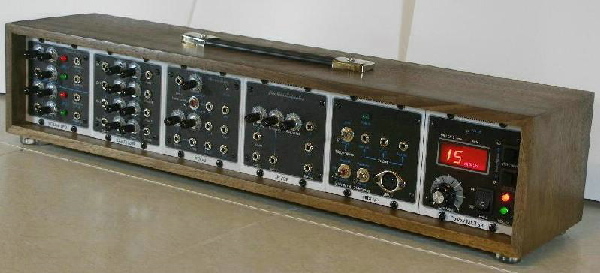
Side note: Although my Doepfer obsession has reached new heights recently, I am about to decide whether to get a Mattson starter modular, or the six-pack - which looks too dang cute!


Sorry - got side-tracked for a sec. Can't... stop... looking...

Like this advertisement for the SynKey that I recently posted, this brochure is rather rare. Almost as rare as the 75 or so SynKeys that were produced (according to Mark Vail's book Vintage Synthesizers).

The front side of the brochure is one you may have come across on the Web, and includes ad-copy that builds on the text found in the SynKey's Contemporary Keyboard advertisement. It clearly carries the SynKey's message of simplicity and ease of use.

The back side of the brochure seem to be much more rare to find online, and includes ad-copy that focuses on the SynKey's three big promotional features - programming, second touch and pushbutton semitone select. Definitely take the time to read through it to get a good idea of how the SynKey operated. The back of the brochure also provides a list of the programmable parameters that are available on the SynKey. All in all, a very well-written piece.

My only peeve is my usual one - the document doesn't have a print date.  Gah.

When a document such as this doesn't have a date I usually rely on pricing info to get an idea of when exactly the piece was created during the life cycle of the instrument. In the case of the SynKey, I have one good price reference - the programmable SynKey was listed in Contemporary Keyboard's May/June 1976 Giveaway contest #5 at $2,195.00. I also have another price reference point - but it's a bit sketchy. Mark Vail's Vintage Synthesizers book lists the programmable SynKey price at a much lower $1,350.00 - but that includes a production start date of 1979. Considering the first ads for the SynKey were out in 1976, we know the actual production start date was much earlier. BUT, could that $1,350 price tag be the price that the unit cost in 1979? The huge price drop could have been on account of the card reader technology which would have quickly devalued the instrument as RAM memory costs went down in competitor's synths. But this is all just a hunch. And it all doesn't matter anyways because there is no pricing info on the brochure to cross reference with.

But, I do have one other theory to give this brochure a 1978 print date:

The brochure includes information on the non-programmable SynKey (model 1500) as well - but its kind of been added on as separate ad-copy underneath the main photo of the instrument in a *completely* different font.  Sites such as synthmuseum.com often include a scan of the front of this brochure - but the scan doesn't include the extra text about the non-programmable version. To me, this suggests that the scanned ad found on synthmuseum.com is probably the first version of the brochure. And this could possibly suggest that the non-programmable model 1500 SynKey came out later and was added to the brochure at that time.

The book Vintage Synthesizers lists a production start date for the non-programmable version at 1978 (and a cost of $925). I know - a long shot. I've asked a few people for more info on the two model's different start dates.

Note to readers: My theories have about a 20% success rate  :)  Will update when I learn more.

Changing topics, I've found a few good sources for photos and demos of the SynKey online.

MATRIXSYNTH posted a relatively recent April 2011 ebay auction that included some great photos of the programmable SynKey. That baby blue accent color found on the instrument is gorgeous. Another even more recent May 2011 auction post also has some good photos - and close up, you can see the baby blue bars are actually stylistic punch cards with hole punches! Nice design touch.

But, my favorite MATRIXSYNTH SynKey auction post is this one from MARCH 2009 because it includes photos of the colour punch cards as well (same blue colour!) as well as a few other pieces of literature.

The only place I've come across a colour photo of the orange non-programmable model 1500 SynKey is VintageSynth.com. Scroll down to the second photo to see the gorgeous orange accent colour of that machine.

As far as demos are concerned, I really enjoyed YouTube contributor "xgregcompositionx" vids. He's uploaded three SynKey video demos that show off it's great sound.

Check 'em out below. Time for me to watch Survivor  :D


Monday, October 17, 2011

Electronic Music Laboratories, Inc. SynKey synthesizer ad, Contemporary Keyboard 1976


Electronic Music Laboratories, Inc. SynKey synthesizer 1-page advertisement from page 9 in Contemporary Keyboard May/June 1976.

I posted a scan of this ad back in 2009 but never really had the urge to blog about it. But, then I came across the same ad online somewhere and it piqued my interest a little bit - mostly because of the punch card programming.

You heard right. Users could recall "preset" synth sounds from the 25 prepunched cards programmed by EML, or punch their own custom sounds for recall on the 25 blank cards also provided. The high-res scan of the ad gives you a clear indication of what the punch cards looked like. Kinda cool, really. And promoted as the first programmable synth. Ever.

The ad-copy stays pretty high-level, but gets a little technical by telling readers about SynKey's "unique top-octave divider" that delivers the equivalent of 13 oscillators. If I understand correctly, it allowed what was essentially a monophonic instrument to play chord intervals by just the press of one key. That would make a huge sound.

For readers of that issue of CK, a lot more technical info on the SynKey could be found in Giveaway contest #5 on page 14 - it reads like a Spec Sheet promo:
"Syn-Key by Electronic Music Lab is the first synthesizer you can program. Instead of fumbling with knobs, patch cords, and forgetting the settings for sounds that you like, simply punch a plastic computer card to preset more than twenty Syn-Key functions. Insert the card. Push the button. You've got the sound you want. This feature permits changes in sound in a matter of seconds. 
A unique integrated circuit creates the effect of having thirteen oscillators for a full rich synthesizer sound. And you don't need to tune the oscillator - a series of indicator push-buttons selects accurate intervals from the root through the thirteenth semi-tone. 
Other programmable controls include oscillator root waveform; modulation-oscillator shape; filter tune; resonance and mode; filter envelope attack, decay, and sustain;and amplifier attach, decay, and sustain. 
Syn-Key's 3 1/2-octave keyboard has a second-touch feature that produces dynamic changes in timbre,vibrato, wah-wah, and pitch-bend. 
Syn-Key comes with 25 pre-progammed cards, 25 blank cards, and a punch. The unit measures 29 1/2" wide, 8" high, 17" deep, and weighs 29 lbs." 
That contest page also gives us a price: "A $2,195.00 Value". A surprisingly much higher price than I've seen in the past.

Interestingly the external hype the company tried to generate about their punch card technology wasn't viewed the same way internally. The story goes that they went with a card reader for memory storage rather than RAM because they were getting a deal on the card readers. Of course, RAM tech changed quickly, and it wasn't long before memory prices decreased to the point where punch card technology quickly became a dinosaur.

As much as I find the technical aspects of the machine interesting, it is the small writing in the bottom left hand corner of the ad that really got my curiosity up.

"A Kaman Music Product made by Electronic Music Labs, Inc. 
Synkey is a registered trademark of Kaman Corporation."

Kaman Music Product? As far as I recall, none of the other EML product ads had any reference to Kaman, and this ad is telling me "SynKey" is actually a registered trademark of the Kaman Corporation?

I did a bit of Googlin', and came across the Wikipage for Kaman Music Corporation. According to this page, the company began in 1966 and was best known for its composite-body Ovation guitars. But they weren't really a synth company by any stretch. In 2007, Kaman was purchased by Fender, but I noticed it still retains a Kaman branded Web site.

But, I couldn't find anything about SynKey on those pages.

Luckily, Mark Vail's book Vintage Synthesizers contains a whole chapter on EML and the Kaman/SynKey connection becomes a bit more clear. Turns out that EML was first going to create the instrument for Kaman Music and had begun production for the deal. But the deal never went through and EML was left with a lot of inventory. EML decided to sell the instrument themselves and my guess is that they got the registered trademark back from Kaman at this time.

For me, the info above makes this ad all the more valuable and historically significant because it means the ad must have been created *before* the deal with Kaman fell through.

Nice!

Monday, December 21, 2009

EML family of products advertisement 3, Contemporary Keyboard 1976


Electronic Music Laboratories, Inc. (EML) 1/3-page ads of its family of products including ElectroComp 101, 200, and 401 semi-modular synthesizers, 300 manual controller, 400 sequencer, and SynKey (model 2001) from page 38 (both) of Contemporary Keyboard Magazine July/August and November/December 1976.

Okay, I do realize that I've kinda been obsessing with EML ads lately, but I figure the end-of-the-year holiday season is here and I may as well just finish 'em off and then move on to some other great ads in the new year.

So, I'll continue... :o)

This is the third EML ad to appear in Contemporary Keyboard in as many issues. It continued to run for at least the next two to three years - with the only other change being that they sloppily added the 1-800 number after the paragraph of text (see the second image).

If you compare this ad to the the previous ad, you will notice some definite similarities. They continued to run with the 'they grow on you' campaign. They also kept the exact same ad copy and re-shot the photo with the same general positioning of the gear - including some patch cords hanging over the lid of the ElectroComp 200.

EML did change a few things for the better. They pushed up the brightness of the photo so that you could actually make out the ElectroComp 300 sitting on top of the ElectroComp 401. They also moved the headphones.

But the big difference is that the gear and ad copy are rearranged a bit to make room for another piece of EML gear - the Model 2001 SynKey synthesizer. And although I'm glad that EML decided to include another synthesizer in this ad, I am a little disappointed that the ElectroComp 500 synthesizer was not that synthesizer.

It could be that the 500 had already been out for a few years, while the SynKey was a newer synthesizer with a whole different look and feel about it. Plus, as mentioned at the end of the previous blog post, EML had just finished blowing some cash on a full-page SynKey ad as well as in a CK contest give-a-way. So, it would kinda make sense to keep running with it.

But for some reason, even though I've never owned or played an ElectroComp 500, I feel more of a bond with it. Maybe it is because it reminds me of the white-faced ARP Odyssey with its colouring, shape, and sliders (check out Vintage Synth Explorer to compare both the ElectroComp 500 and the white-faced ARP Odyssey). Or maybe it is because the 500 was the underdog in a battle for synthesizer supremacy dominated by the MiniMoog and Odyssey. But most likely it is because I'm cheap - and the 500 was available for a much lower price than the MiniMoog and the Odyssey. Yeah... probably that.

I gotta say, before blogging about these EML ads, I knew very little about EML gear, and I felt like I was playing catch-up.

Sadly, Wikipedia has very little on EML in general, and what little is there seem to be incorrect. The page says that the company stopped producing synthesizers in 1976. Yet I find this hard to believe considering that EML continued to promote their synthesizers in CK well into 1979. And, in Mark Vail's 'Vintage Synthesizers', one of the founders, Jeff Murray, says that although demand fell off, they continued to make all their existing product line in the latter '70s, while also doing custom work for other companies.

Check out some of the other usual online synthesizer reference sites for some good info.

One more thing - I still haven't decided whether to post over the rest of the holidays. Keep an eye on the site!

Monday, July 20, 2009

Kaman EML SynKey, Contemporary Keyboard 1976


Kaman Corporation EML SynKey from page 9 of Contemporary Keyboard magazine May / June 1976.

The SynKey apparently dripped with 1976 cutting-edge technology. Punch card programming... After-touch... Awesome.