Monday, October 12, 2009

E-mu Emulator, Contemporary Keyboard 1981


E-mu Systems Inc. Emulator sampler ad from page 9 of Contemporary Keyboard Magazine May 1981.

Although this is not E-mu's first ad for the Emulator, I thought it most fitting since today is Thanksgiving Day in Canada.

This version of the ad contains a photo of an early model a prototype model of an Emulator that included a lighter display panel and a Tune section with only one knob. Late the same year they replaced the photo in the ad with a later manufactured Emulator. The later model manufactured Emulator (in a totally different ad) can be seen in one of my other blog post scans. I'll give you a second or two to go take a look and compare...

Great - you're back. Did you notice one other difference? I saved it for last since the topic is kind of near and dear to my heart...

THE LOGO!

The Emulator in this ad is sporting an early E-mu logo that included a stylized thirty-second music note and the Mu symbol. You can see a better image of the logo in this Emulator price list pdf from the Emulator Archive Web site. I think this logo might make good tattoo material in the near future.

The Emulator looked great with its clean lines and stripped down user interface. And, best of all, it included a small holder for the 5 1/4 inch floppy disks that you would use to store your samples on. Musicians weren't accustomed to using disks, so having a place to hold the disks right on the instrument was definitely convenient. Unfortunately, the holder couldn't store them while transporting the instrument, and Keyboard magazine writer Dominic Milano creepily predicted the soon to be well-overheard phrase 'whoops - I forgot to bring the disks with me' in his March 1982 Keyboard Report:
"One more thing about the diskettes: Don't forget to pack them up and bring them with [you] when you're taking the Emulator out on a gig, because it won't work without them. We musicians aren't used to thinking about diskettes yet."
I can't tell you how many times I had to drive back home to get my Emax disks after arriving at a gig to set up. Grrr...

Well, time to start preparing Thanksgiving dinner. Gobble gobble.

Thursday, October 8, 2009

Korg Maxi-Korg K-3, Contemporary Keyboard 1977


Korg Maxi-Korg K-3 synthesizer from pg 15 of Contemporary Keyboard Magazine January 1977.

I think this is the first half-page ad I've posted. I also think this ad is one of Korg's earliest to appear in CK.

I have to confess I'm not that familiar with this line of Korg synths (my MS-20 and Trident are about as far back as I get). While starting to do some research, it soon became clear that this piece of kit goes by a few different names online. Maxi-Korg K-3. Univox K-3. Korg 800DV. Maxi-Korg 800DV.

The problem is that I'm one of those people that believes everything I read on the InterWebz and, even more problematic, I crave consistency.

So, which is it? Maxi-Korg? 800DV? Univox K-3? Time to dig a little deeper.

Synthmuseum.com indicates that this synthesizer was marketed as the Univox K-3 in the US and as the Maxi-Korg 800DV elsewhere.

This MATRIXSYNTH post (from an eBay auction), contends that the piece of gear in question was sold under the name 'Maxi-Korg K-3' in the US and as the 800DV and Univox K-3 elsewhere.

This other MATRIXSYNTH post has great photos of a U.S. model sporting the Maxi-Korg logo on the front and lists K-3 as the model on the back. And when you click on the link to the auction, there is a photo of the back of the synth with the Univox logo.

Meanwhile, back in 1977, Unicord puts out this ad in a US magazine - with 'Korg' in big print, a Maxi-Korg logo on the left hand side of the control panel, and although distributed through Unicord, the name 'Univox' can't be found anywhere in the ad copy. But, my guess is that 'Univox' is slapped on the back of the synth in the photo.

So, I'm going say the US model should be officially called 'Univox Korg Maxi-Korg K-3 distributed by Unicord'. Sounds about right. :o)

The fact is, the big reason I like this ad is because Unicord totally jacks the Timothy Leary 1960's counterculture phrase 'Turn on, tune in, drop out', tacking on 'EXPAND YOUR MIND' at the start of the ad copy. Nice touch for 1977 - I think Unicord definitely knew their audience.

Sound on Sound has a great article from April 1998 about some of the early Korg gear including the Maxi-Korg, with some great insight as to why this synthesizer was so unique. BTW - big 'ups' to Sound on Sound for putting their older articles online.

For more on the history of Univox and Unicord - it's a good ride - check out this site.

And, one final note. I'm going to beat Zenbecca on commenting on the Univox/Maxi-Korg font. Yes - very retro... :o)

Monday, October 5, 2009

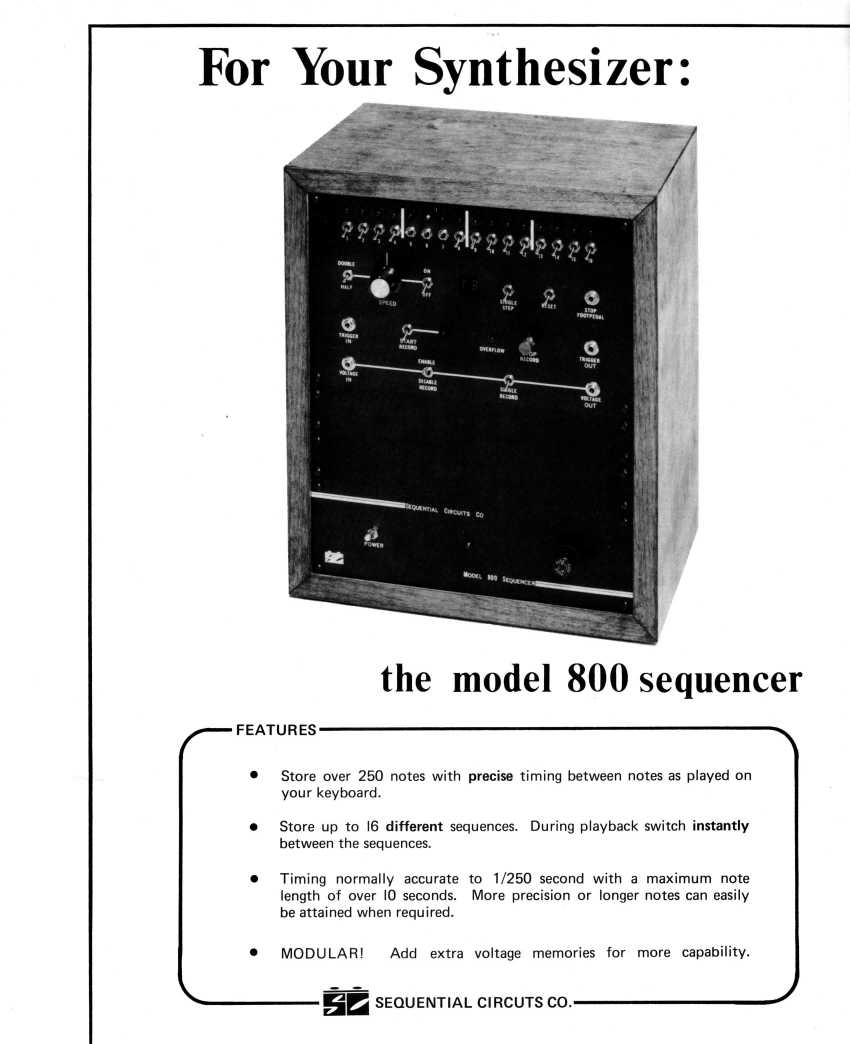
Sequential Circuits Model 700 Programmer and Model 800 Digital Sequencer, Contemporary Keyboard and Synapse 1977


Sequential Circuits Model 700 Programmer and Model 800 Digital Sequencer from page 7 of Contemporary Keyboard June 1977 and page 5 of Synapse May/June 1977.

My archives are far from complete, but this must be one of Sequential Circuits earliest ads - at least in CK magazine.

Historically, I find the images in the ad most valuable from the perspective of SCI's logo evolution.

If you look closely, the Model 700 in the ad has a Sequential Circuits 'Co' logo rather than the more familiar 'Inc' logo. I'm not sure when they stopped using 'Co', but photos that I've found online of the 700 Mark 2 (released in 1979) can be seen with various versions of a non-'Co.' logo, including this one on Matrixsynth with the SC logo on the right side of the front panel and this photo in a brochure PDF I found on the Emulator Archive Web site that has the logo dead centre.

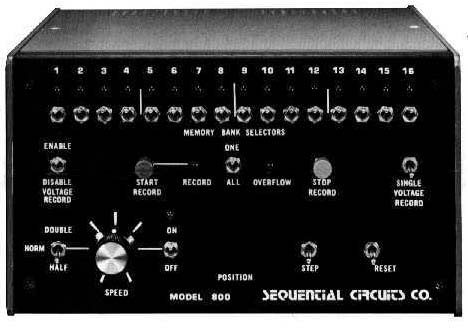
The Model 800 Digital Sequencer in the ad has what I believe is an even earlier version of the Sequential Circuits logo. This stylized 'SC' logo is more visible at the bottom of this very early Model 800 ad I found on synthmuseum.com.

You can follow more of the evolution of the SC logo throughout the Model 800's lifespan. After the stylized 'SC' logo, the front panel of the 800 displayed the 'Sequential Circuits Co.' logo as seen in this photo from Synthnut's tech pages, and then the logo changed to the straight-up 'Sequential Circuits' logo like this one from matrixsynth's Flickr photo stream.

More on SCI logo evolution later...

Thursday, October 1, 2009

Korg VC-10, Contemporary Keyboard 1978


Korg VC-10 vocoder from page 79 of Contemporary Keyboard Magazine November 1978.

This ad began running in CK Magazine in Nov. '78 along with two other Korg ads - the MS-20 and MS-10. Interestingly, as can be seen in past blog posts, these MS-20 and MS-10 ads were very technical in text and design, while the VC-10 ad was largely dominated by artwork and included practically no technical information. Fortunately a bit more information was available in the Spec Sheet section of the same issue.

Although vocoders faded out of the spotlight over time, they never really left us - for example, my 1990's Wavestation A/D contains a fairly usable vocoder effect. More recently, vocoders have made quite a comeback in pop, alternative rock and electronic music. Hardware and software manufacturers have stepped up to the plate to provide updated vocoding tools to bands and producers, including Korg, with their own microKorg and R3.

Basic information on the VC-10 can be found online in the usual places, including Vintage Synth Explorer and Synth Museum. Korganalogue.net also has a good online version of the manual.

Wikipedia doesn't seem to have a VC-10 page, but they do have a fairly extensive general vocoder page for those interested in more information.

Monday, September 28, 2009

Octave Electronics CAT ad #2, Contemporary Keyboard 1977


Octave Electronics Inc. CAT synthesizer ad from page 7 in Contemporary Keyboard Magazine April 1977.

This is the second in a series of Octave Electronics' CAT ads featuring distinctive artwork that appeared in Contemporary Keyboard Magazine when the synthesizer was first introduced.You can read about the first ad here.

Looking at this ad, it got me thinking about the whole cat&synth meme that currently exists on the Web. As far back as I can remember, discussions about cats and synth gear have existed both on- and off-line. Members of forums and e-mail lists such as Analogue Heaven have exchanged stories at least as far back as 1999.

When matrix, owner of the popular synthesizer blog MATRIXSYNTH, was asked about the phenomenon in an e-mail earlier this month, he replied "I noticed that of all animals, cats seemed to be the most predominant in synth shots". He started posting cat&synth photos on his blog with a cat label (now synth cats) back in December 2005, and it became such a popular MATRIXSYNTH theme that readers began sending in their own videos and images featuring cats and other animals. Dogs run a close second along with birds and reptiles.

Amar, creator of the CatSynth blog, started blogging about cats and synths in mid-2006, virtually unaware of the large number of others sharing the same two interests. "I started searching online for 'cats and synthesizers' and found Matrixsynth and some past articles at CDM, and it was only then I really found out the phenomenon of cat and synth pictures". Amar adds that it is not surprising to see cats with music gear. "They do like to get around and explore things and they like warm surfaces. I think a lot of musicians with cats enjoy having them as a presence in their creative spaces".

Many, says Amar, refer back to the popular 'cat on a keyboard in space' image as a possible unofficial beginning to the meme - but I've yet to track down the date this image first appeared online.

Regardless of when the phenomenon took off, it didn't take long for photos, videos, and everything else cat&synth to start showing up all over the Web. There is even a VSTi called the meowSynth.

On a side note, another cat&keyboard meme has caught on recently - and the original VHS videotape recording apparently dates back to 1986. The 'Keyboard Cat' video meme has been described by Rocketboom's History of Keyboard Cat as the "mercy kill of the Internet". Great stuff - definitely check it out.

Don't be a stranger - if you have any history to add, please comment.

And on that note, I'll let Fatso play me off...