Friday, September 1, 2017

Roland Alphabetical Retail Price List, September 1978


Roland Alphabetical Retail Price List for September 1978.

I had recently come across this price list and thought it was interesting enough to share. Don't really have much to say so I'll just start typing and see what comes out.

Well, gotta say it's a great list of historic gear that includes price lists for Roland's early synthesizers, drum machines,effects units and a wack of other things.

One of the highlights for me is seeing the retail prices for the System 100 synthesizer:
  • S-100 Synthesizer System - $2,425
  • S-101 Synthesizer - $795
  • S-102 Expander Module - $650
  • S-103 Mixer - $360
  • S-104 Sequencer - $495
  • S-109 Monitor Speaker Set - 149.50
Also, seeing prices for the System 700 and in particular the Laboratory system is kinda cool.
  • S-700 System Synthesizer - $13,500
  • S-700L Laboratory System (Blocks 2 & 8) - $3,100
  • S-700M Main Console System (Blocks 1 & 2) - $4,995
The pricing for the individual S-700 blocks is also there, but because the list is in alpha order, I almost missed 'em because they are on other side of the page. 

Block 1 Main Console - $4,495
Block 2 Keyboard Controller - $650
Block 3 Sequencer - $1,695
Block 4 VCO Bank - $2,795
Block 5 VCF, VCA Bank - $1,995
Block 6 Interface/Mixer - $1,195
Block 7 Phase Shifter / Audio Delay - $1,150
Block 8 Lab Console - $2,565

Keep looking and you'll find pricing for the early TR drum machines and the SH- family of synthesizers. The RE-101, 201 and 301 Space Echos are also here. And those cute early Boss mixers.

And see those asterisk symbols by the TR-33, TR-55 and TR-700? Those indicate that the units were recently discontinued, giving us a fairly accurate date of when these early drum machines were taken off the market. Roland Canada's drum machine history page tells me these only came on the market in 1972, giving the three machines less than a two-year life span.

This list is pure gold.

Friday, August 25, 2017

Roland SVC-350 "Have a say in your sound" ad, International Musician and Recording World, 1980


Roland SVC-350 vocoder "Have a say in your sound" full colour advertisement from page 91 in the July 1980 issue of International Musician and Recording World.

No offense to my first love - Keyboard Magazine - but lately I've been spending a bit of free time flipping through some of my other magazine archives. That's how I came across that CR-68/78 ad I posted earlier in August.  And now I've got this lovely vocoder ad.

This ad doesn't have the same sense of humour as the previous one I posted, but I gotta say I find it just as interesting. Full disclosure - I own an SVC-350 and *love it*. So, you may wanna take my interest with a grain of salt.

So, one of the most interesting things about this ad is summed up in that ol' saying: "You can tell a lot about a person by the company they keep". In this ad, Roland has chosen a photo of the SVC-350 pulled out of a rack that includes some of their other rack gear - a guitar pre-amplifier, stereo flanger, pitch-to-voltage synthesizer, digital delay and Dimension D. Together, Roland has named these and a number of their other effects, the "Roland Rack" system. I hadn't heard this term used to officially describe their rack gear before.

The word "system" was a buzz word that appeared in many gear-related ads during the 70's and 80's. For example, Korg used it in their 1984 "The Korg MIDI System" ad that included their Poly 800 and EX800 synthesizers, RK 100 remote keyboard, KMS-30 synchronizer (a personal favourite) and computer software.

Oberheim used the term "The System" in a 1982 ad to describe the proprietary multi-pin technology used to get their OB-Xa/OB-SX/DMX/DSX gear to work together. They continued using it in 1983 when they swapped out the synths for their OB-8.

Even earlier sightings can be seen in a 1978 ad where the Oberheim SEM teamed up with 360 Systems' Slavedriver to create their own "The System". And it wasn't just in ads - just look at the name of some of Roland's early synthesizers like the System 100, 100m and 700. Or Moog's System I, II and III modulars.

One more thing I noticed. After reading the ad-copy over a few times, something was nagging at me and I couldn't figure it out for the longest time. Then it hit me. At no point does Roland mention the model number of their vocoder in the ad-copy. Its always just referred to as the Roland Vocoder.  It would be like calling your synthesizer "Roland Synthesizer" in the ad-copy of a JX-8p ad.

I checked the ad for the pre-amplifier that is part of the rack system which ran prior to this one, and its model name - SIP-300 -  is referred to multiple times. Maybe because there are other Roland preamps but only one vocoder?

Curious. Probably just to me. :)


Tuesday, August 8, 2017

Roland CR-68/CR-78 "No more waiting for Louie" ad, International Musician and Recording World, 1979


Roland CR-68/CR-78 drum machine "No more waiting for Louie" full page colour advertisement from page 115 in the November 1979 issue of International Musician and Recording World magazine.

How time flies! Happy 8/08 day!

And what has now become kind of a tradition, I've uploaded this lovely 808... er.... wait a tick!   Actually, I've uploaded a scan of an advertisement for the predecessors of the TR-808 - the CR-68 and CR-78 drum machines. I haven't seen this ad online, so if it hasn't been available there, I'm happy to get it onto the record (pun intended).

Where to start? Well, for one, the ad-copy is very well done.

Read it... I'll wait...

I say its well done because Roland strays a little bit away from their usual no-nonsense "We design the future" text to poke a little fun at those drummers reading International Musician. A perhaps risky move since at the time synthesizers and drum machines were viewed by more than a few "real musicians' as just boxes of job-stealing tubes and wires.

But Roland handles this topic well by not suggesting that the rest of the band kick Louie the drummer to the curb for being late all the time, but instead to use this waiting time wisely by plugging in one of their drum machines so they can keep on practicing. To make sure they stay firmly on the fence, they conclude the ad copy with:
"The Compu-Rhythms may not replace the drummers of the world, but they're going to make it a lot easier to live with their little inconsistencies". 
Well played, Roland... well played. Especially since these drum machines ended up on many hit records anyway including ‘Heart of Glass’ by Blondie and ‘In the Air Tonight’ by Phil Collins.

As mentioned above, the CR-series directly preceded the TR-808 drum machine, coming out in 1978 according to Roland's own "Roland Drum Machine History 1964-2016". A great treat for anyone who hasn't scrolled through it yet.

And, also according to the Web site, The CR-78 in particular is a unique milestone for Roland in that it "was the first of its kind to use integrated circuits - an important development in the history of drum machines." In other words, it included memory so that users could program their own patterns and store them for later use. Which you already knew because you made me wait while you read the ad-copy. Right? :)

I'm a little sad that the photo of the drum machines are so small in the ad. I love the look of these machines. The wood-grain sides. The dials. The buttons. And also the colours - some of which went on to appear within the TR-808 colour scheme.

One thing suspiciously missing from the ad is the CR-800 - a third CR- drum machine that also came out in 1978. This was kind of a mash-up between the CR-68 and 78, built within a large floor speaker. Jon Dent's blog goes into some great detail (with large photos!) on the similarities and differences between all three of these drum machines in a Feb 2015. Definitely check it out.

Time to go enjoy the rest of my 8/08 day!

Thursday, July 27, 2017

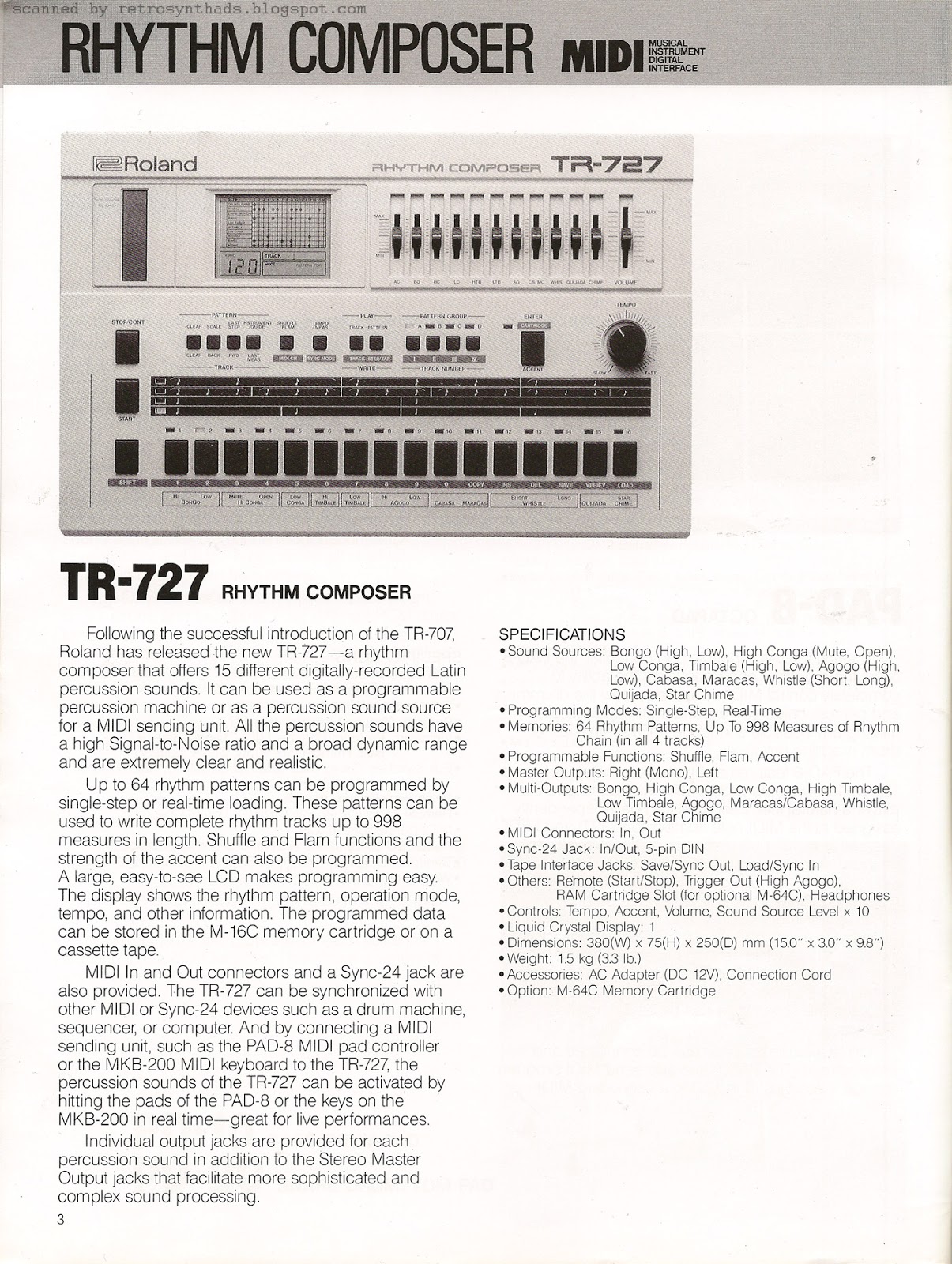
1985 Roland New Product News for NAMM show, 1985


1985 Roland New Product News for NAMM show 16 page black and white brochure from June 1985.

Another big XOX day! This time celebrating all that is awesome about the TR-727. Heck, who doesn't love the Agogo and Whistle sounds from Phuture's Acid Tracks!

Quite by accident, I just looked on Twitter and Roland tweeted out a Boss Summer NAMM highlights video. Honestly, a total fluke that I'm posting a Roland NAMM brochure from 32 years early.

And if you haven't guessed, Roland features the TR-727 in this "new products" brochure that they handed out at Summer NAMM 1985. And it had good company - so many great products are including in this document. And they all have one thing in common (besides the obvious) - SPECIFICATIONS. As far as the eyes can see. Damn I love specs.

Each summary write-up does a great job including various other Roland gear that would be compatible. For example, the summary for the TR-727 pulls in the Pad-8 MIDI pad controller and the MKB-200 MIDI keyboard - both also featured in the brochure.

The Pad-8 Octapad was a piece of gear I had always wanted but never managed to pick up. I so wanted to stand on stage and summon my inner Depeche Mode a la Construction Time Again.

Another great highlight are the two pages devoted to the MKS-7 - both the black and ivory versions! Every once in a while an ivory MKS-7 pops up around town but I always miss out on picking it up. Under the photo of the ivory rack are diagrams of typical and expanded set-ups featuring many of Roland's products. Yum.

One thing missing from today's market is something akin to Roland's CPM-120 compact power mixer. Eight channels including an effects send/return, all in a small box. I still use Boss's mini-mixers of the era and would snap up a CPM-120 if it was ever remade.

The back of the doc includes a table of contents as well as Roland's logo and tagline - "We design the future". Its hard not to think that Roland's current "The future redefined" tagline for many of their remakes isn't a nod back to this original tagline that featured many of the originals.

If I was gonna quibble, I'd say the only thing missing are suggested retail prices. But I ain't complaining. I love this brochure from cover to cover.

Friday, July 7, 2017

Roland TR-707 "Digital Dynamite" ad, Keyboard 1985


Roland TR-707 drum machine "Digital Dynamite" full page colour advertisement from page 50 in the May 1985 issue of Keyboard Magazine.

Well, it seems like its only been a week or two since I celebrated 6/26 day by posting a TR-626 ad. That may be because it has only been a week or two.  :)

Coincidentally, it is 7/07 day and to date, this blog has been conspicuously absent of any mention of the TR-707. So, time for that to change.

I'm a big fan of the TR-707. The large LCD screen and the fact it has MIDI, DIN sync, trigger out AND tape sync are big pluses for me (well, not so much tape sync any more). The individual outputs and the great little mixer section make it very useful in live situations.

As you can see from the image of the advertisement, this lovely drum machine got swept up in Roland's "Roland Makes It Happen" marketing campaign. The distinctive neon light design style and tag line started to appear in Keyboard and other magazines back in the summer of 1984 beginning with their gorgeous dark blue Juno 106 "Synful" advertisement, and carried on well into the spring of 1986 until ads with a new "computer art" design replaced it - like that used in their TR-505 "Light Heavyweight" ad.

Other Roland ads to get the neon "We make it happen" treatment included the JX8p (green) and MPU-401 (baby blue). And of course, this yellow TR-707 ad. But the most memorable piece from this marketing campaign bunch has to be Roland's three-page-plus  MIDI-love-fest fold-out that appeared in the July 1984 issue (see right).

The ad itself got little play in Keyboard Magazine, making only two appearances - May and December 1985.  During this time period, Roland instead chose to give their JX8p and new MPS software (Music Processing System) ads its monthly page real estate. Kinda makes sense since the Magazine is called "Keyboard".

The ad copy, although a tad hard to read, includes a lot of useful information, including my favourite historical reference- the price! $595 ain't too shabby. The text also highlights the increasingly rare M-64C memory cartridge, and  Roland fortifies its importance by including a not insignificant sized photo.

But one of the most interesting and notable features of this ad and others in the series is the size of the Roland logo. Its quite small compared to the other design elements. Normally I'd be freaking out about something like that, but Roland had such a large presence in Keyboard and its products' evolution was so highly recognizable, that they could get away with it. Work in their favour even.

A nice position to be in!